
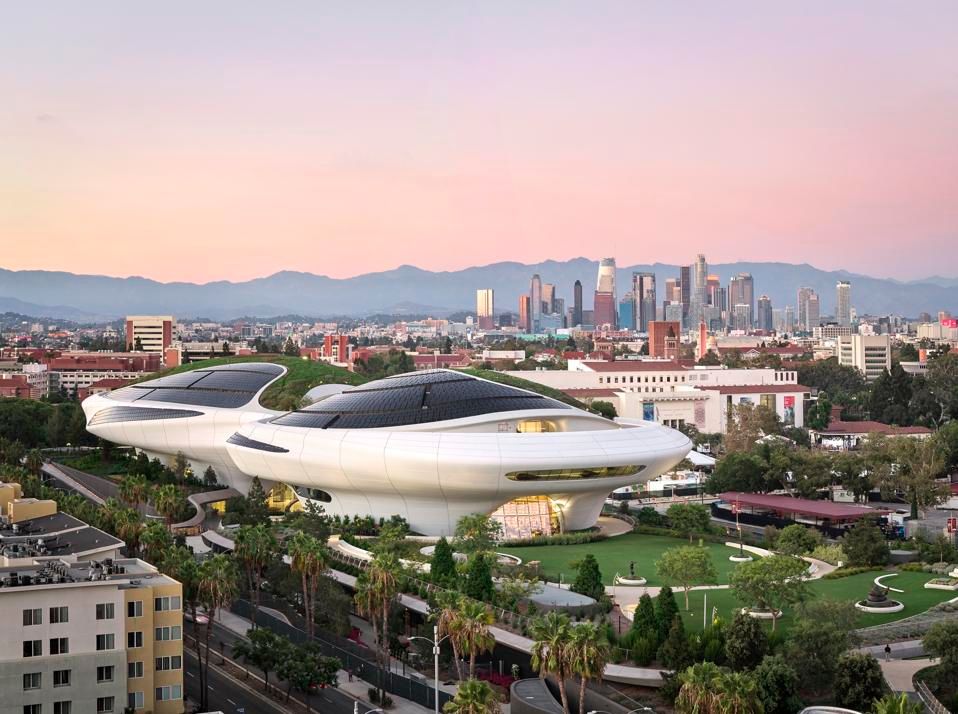
After years of construction and several delayed opening dates, the Lucas Museum of Narrative Art will finally open in Los Angeles on September 22.
The new museum occupies a swooping, futuristic building in Exposition Park, beside the Natural History Museum of Los Angeles County and the California Science Center. Inside are more than 100,000 square feet of galleries devoted not just to Star Wars and George Lucas’s filmmaking career, but to a much broader subject: the many ways humans have told stories through pictures.
The inaugural exhibitions will bring together more than 1,300 works across more than 30 galleries, ranging from paintings and murals to comic strips, children’s book illustrations, photography, manga, movie props, and concept art.
“The Lucas Museum of Narrative Art was created to honor humanity’s stories and the artists who illustrate them,” Lucas said in a press release announcing the opening. “Their work spans genres, media, and time. They deserve to be in a museum.”
That means visitors might encounter a Norman Rockwell painting in one gallery and Peanuts creator Charles Schulz, Frida Kahlo, Gordon Parks, Diego Rivera, Frank Frazetta, or Banksy elsewhere. Lucas and museum cofounder Mellody Hobson have intentionally placed forms of art more commonly associated with popular culture alongside works traditionally found in major museums.
“We wanted a museum unlike any other—one that brings people from every walk of life through the same doors,” Hobson said in the press release. “That’s why this collection holds so many different kinds of stories.”
What you’ll see inside
The museum’s first-floor exhibition, The History of Narrative Art: Heroes • Myths • The Sacred, reaches back thousands of years to explore how images have been used to create myths, convey beliefs, and shape societies.
Some of the most important works in that story obviously can’t be transported to Los Angeles, so the museum worked with institutions including the Vatican Museums, the Louvre, Spain’s National Museum and Research Center of Altamira, and Mexico’s Instituto Nacional de Antropología e Historia to create detailed reproductions using high-resolution images and 3-D scans. Visitors will encounter recreations of the Altamira cave paintings, the Sistine Chapel ceiling, the Aztec Sun Stone, and the enormous winged human-headed bulls that once guarded the palace of Assyrian king Sargon II.
On the fourth and fifth floors, the story shifts closer to the kinds of images many visitors encounter in everyday life. Galleries organized around love, family, and community bring together children’s-book illustrations, scenes of courtship and motherhood, and images of family life across generations. Other rooms look at labor, sports, recreation, danger, and adventure, with works by artists including Vincent van Gogh, George Bellows, Jacob Lawrence, Beatrix Potter, Charles White, and Ernie Barnes.
Other galleries are organized by genre. Fantasy, romance, and adventure feature artists such as early filmmaker Georges Méliès and fantasy illustrators Boris Vallejo and Julie Bell, and Ken Kelly. Nearby, galleries devoted to comic books, manga, graphic novels, photography, and murals include work by Krazy Kat creator George Herriman, Peanuts cartoonist Charles Schulz, comic artists Jim Lee and Frank Miller, Takashi Murakami, Robert Capa, Gordon Parks, Diego Rivera, JR, and Los Angeles muralist Judith F. Baca.
Several giants of 20th-century American illustration get galleries of their own, including Norman Rockwell, N.C. Wyeth, Jessie Willcox Smith, Maxfield Parrish, and Thomas Hart Benton—a reflection of the museum’s larger effort to give illustration the same kind of gallery space typically reserved for painting and sculpture.
One of the fifth-floor galleries focuses specifically on storytelling at monumental scale. It draws from Baca’s archive for her half-mile-long The Great Wall of Los Angeles and includes work and studies by Diego Rivera and JR, alongside never-before-seen acquisitions directly from Banksy’s studio.
And, yes, there is Star Wars. The inaugural cinema gallery will feature Star Wars in Motion, an exhibition devoted to the vehicles seen in the first six films. On display will be concept designs, props, and costumes tied to the saga’s racers and transports, including Luke Skywalker’s Landspeeder from A New Hope and the first physical build of General Grievous’s Wheel Bike from Revenge of the Sith.
Beyond the galleries
The museum extends well beyond its exhibition spaces. Outside, a new 13-acre park and gardens designed by Mia Lehrer of Studio-MLA has replaced what was largely an asphalt parking lot with more than 300 trees, meadows, a hanging garden, an amphitheater, and a waterfall-like fountain. Ten monumental sculptures are installed throughout the grounds, including works by Fernando Botero and Prune Nourry, along with several pieces drawn from the Star Wars universe. The park is free and open to the public, even without a museum ticket.
Inside, the Research Library is also free to visit. Its holdings include more than 30,000 comic books, materials from the former Skywalker Ranch Library, approximately 3,000 art books donated by Steve and Ann Martin, and more than 2,900 volumes from mythologist Joseph Campbell’s personal library, some containing his own annotations and research notes.
For travelers who want to make more of a day of it, Skywalker Grill sits atop the museum and is open to both museum visitors and the general public. Designed by Rockwell Group, the full-service restaurant serves lunch, dinner, and weekend brunch, with American dishes built around California-grown ingredients and panoramic views across Los Angeles.
How to visit the Lucas Museum
The Lucas Museum opens to the public on Tuesday, September 22, 2026.
Timed-entry tickets are required in advance. Admission is $25 for adults and $21 for visitors 65 and older, while children 17 and younger and active-duty military members enter free.
The museum is at One Lucas Plaza in Exposition Park, just south of downtown Los Angeles. The closest Metro stop is Expo/Vermont, and paid parking is available both on the museum campus and elsewhere in Exposition Park.
This article was originally published on Forbes.com