
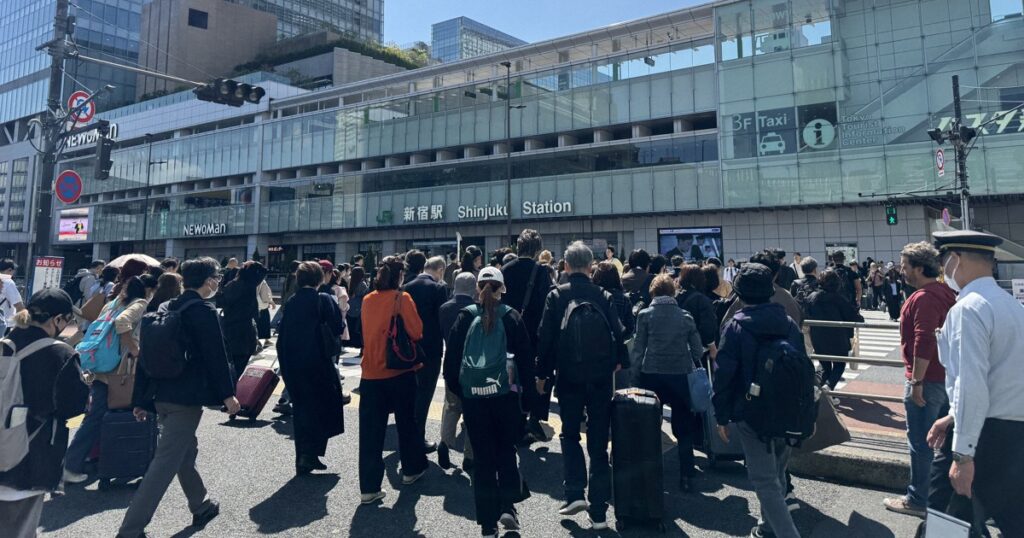

JR Shinjuku Station is seen in Tokyo’s Shinjuku Ward, April 16, 2026. (Mainichi/Sakae Kato)
TOKYO — A little more than a month has passed since the new academic and business year began in Japan. Among people who moved to Tokyo from other parts of the country for school or work, some may feel that “people in Tokyo are cold.” Why does this seem to be the case?
“There are circumstances unique to big cities,” explains Tatsushi Kawashima, 45, a licensed psychologist. The Mainichi Shimbun asked him how to cope when city life starts to get people down.
When a man was asleep on the train
When this reporter boarded the Yamanote Line at JR Shinjuku Station in Tokyo during the morning rush in early April, one sight immediately stood out: a young man stretched out asleep across a seat. The train was so crowded that passengers’ shoulders were brushing against one another, yet no one tried to approach him.
Was he sick? Maybe he was just drunk and sleeping it off. As I hesitated to speak to him, a man and woman who appeared to be tourists from overseas called out to him in English with concern. Without saying a word, the man got up and got off at the next station.
“When someone appears unwell and the people around them don’t say anything, that’s exactly the kind of situation that makes people feel ‘Tokyoites are cold,'” Kawashima says.
I am from Tokyo, but until March I had been living in Takasaki, Gunma Prefecture. When people in Gunma would say, “People in Tokyo are cold, aren’t they?” I used to push back. But, yes, I must admit this is the kind of scene that could make people think so.
Why don’t city people talk to each other?

A nightscape is seen in Tokyo’s Chiyoda Ward in this 2020 file photo unrelated to the story. (Mainichi/Natsuki Nishi)
Kawashima says factors behind situations like this include the sheer number of people and the kind of busyness peculiar to city life.
According to East Japan Railway Co. (JR East), the average number of passengers boarding each day at Shinjuku Station in fiscal 2024 was about 667,000. By contrast, at Maebashi Station, in the prefectural capital of Gunma but still in the same greater Kanto region, the figure was about 9,900 — a difference of roughly 67 times.
“As the number of people increases, responsibility tends to diffuse — people think, ‘Someone else will do it.’ That’s called the bystander effect, and it’s more likely to happen in places like big cities where there are a lot of people,” Kawashima notes.
Also, in cities, many people are rushing to catch trains that come every few minutes and simply do not have the breathing room to pay attention to those around them. Pressed for time, they end up becoming bystanders.
A decline in communication
Still, one reason people can come to dislike Tokyo after seeing or hearing about scenes like the one I described is that they may not have built deep relationships with the people around them.
In recent years, digital technologies such as artificial intelligence (AI) have advanced, and plenty of people now try to solve problems by asking conversational AI on their computers or smartphones rather than bringing questions to their bosses or colleagues at work.
“It may be more convenient, but with the arrival of AI and similar tools, human interaction has decreased, and so have opportunities to build mutual trust. If you can’t build trust with the people close to you, you’re more likely to start thinking, ‘People in Tokyo are cold,'” Kawashima points out.
How do you let go of that assumption?
So how can you wipe away that negative preconception?
What Kawashima recommends is recalling moments in daily life when someone felt warm or kind to you. Count the times someone greeted you or let you go first. When you do that, he says, you may realize your assumption is just that — the people around you are not actually so cold after all.
He also says it helps not to use sweeping subjects like “people in Tokyo,” because doing so only feeds that kind of assumption.
When making friends doesn’t go well
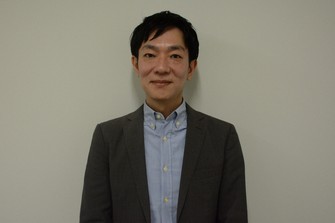
Licensed psychologist Tatsushi Kawashima is seen in Tokyo’s Chiyoda Ward, April 13, 2026. (Mainichi/Sakae Kato)
It is also important to make sure you have a place where you can let your feelings out.
Deepen your relationships within a small group of friends. If you have family close by, they are fine too. Kawashima says that even while living in a big city, having a small number of people you can really open up to makes you less likely to feel that those around you are cold.
“The key is to build lasting relationships in small communities connected through hobbies and the like. Personally, I recommend mahjong,” he says.
If neither letting go of your assumptions nor trying to make friends is going well, he says it may be best to stop worrying about it and take a short break.
“Try stepping away for a while from trying so hard at city life. In the end, the most effective thing is just to take each day as it comes.”
(Japanese original by Sakae Kato, Digital News Group)