
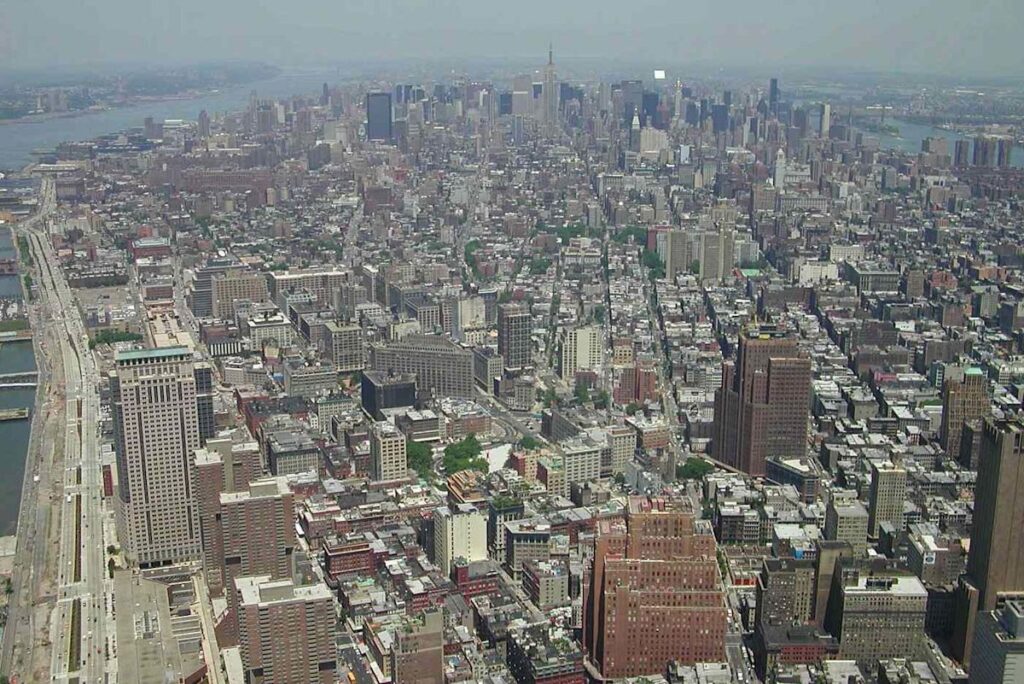
Windows on the World had a lot to prove when it opened in April of 1976. For starters, there was the curse of the 1975 Daily News headline: “Ford To City: Drop Dead.” Beset by violent crime, Himalayan mounds of garbage, and on the verge of bankruptcy, New York was looked upon as a once-great city with its best days behind it. The anticipated opening of the World Trade Center did little to dispel the sense of civic malaise. The New York Times architecture critic Ada Louise Huxtable wrote portentously in a May 29, 1966, story, “Who’s Afraid of the Big, Bad Buildings?“: “The Trade Center towers could be the start of a new skyscraper age or the biggest tombstones in the world.”
The year 2026 marks the occasion of the 50th anniversary of the restaurant’s opening, as well as the 25th anniversary of its destruction in an act of terror. To commemorate Windows on the World’s place in the story of New York City, on September 7, CNN Films will air Top of The World — a nostalgic and emotional documentary recounting the restaurant’s rise, fall, and enduring afterlife in American history.
A half-century ago, it was hard to imagine that a restaurant perched on top of the North Tower of the Trade Center could become a symbol of a great city reborn, or — more modestly — that the Financial District could, at long last, offer fine food and drink in the evenings. Drew Nieporent, the restaurant impresario who put Tribeca (the neighborhood immediately to the north) on the fine dining map, recalls the slim restaurant pickings before the towers were built.
“My dad used to work for the State Liquor Authority, which moved its offices to the World Trade Center. Before Windows, he would take me to lunch in the Financial District,” he said. “There were some really good places, but they all closed down before dinner. Windows changed things. It attracted Wall Street as well as thousands of uptown visitors and tourists to a part of the city that, frankly, didn’t do dinner.”
“Joseph H. Baum is an amazing man, the “wizard of eats.” As president of Inhilco, a subsidiary of Hilton International, he runs all of the restaurants in the World Trade Center. He created them all, too, and his artistry is evident in every detail of each restaurant. His is an art that is cool, meticulous, intellectual. Apollonian. You sit down to lunch with him in Windows on the World, his masterpiece, the world’s premier celebration restaurant. You take in the sweeping view of New York, lavishly poured out around you; a gaudy buffet. And you order a Lillet.”
Carl Desens in Food & Wine, June 1978
This was the challenge that restaurateur Joe Baum took on when the Port Authority of New York and New Jersey gave him carte blanche to create “The Most Spectacular Restaurant in the World” — a phrase that New York Magazine critic Gael Greene coined in the blockbuster cover story marking the restaurant’s opening. (It also serves as the title of Tom Roston’s definitive history of Windows.) If there ever was a man to meet this moment, it was Joe Baum, the son of a kosher hotel and restaurant family in Borscht Belt-adjacent Saratoga Springs. Baum was raised in the business. He lived and breathed it from early boyhood through a 50-year career that defined an era in postwar New York’s restaurant culture and had powerful ripple effects in the global hospitality industry.

Joe Baum, Alan Lewis, Andrew Renee in the kitchen of Windows On The World
Credit: Courtesy of CNN Films
The birth of the concept restaurant
Baum pioneered the idea of the “concept” restaurant. In this, he felt he was as much a theatrical producer as he was a restaurateur. Baum didn’t focus on the chef’s reputation to draw loyal customers or the figure that a sharply dressed restaurant owner cut as he worked the room. Instead, it was his painstakingly researched fantasies that animated the succession of restaurants that he and his partner, Michael Whiteman, created in the 1950s and 1960s.
A Taste of Windows
Executive Chef Hermann Reiner of Windows On The World in 1986
Credit: Courtesy of CNN Films
Amaretto-Cheesecake-Viennese Apple Strudel, Gateau de Pithiviers, White Chocolate Mousse in 1986
Credit: Courtesy of CNN Films
Lobster Salad with Crayfish in 1986
Credit: Courtesy of CNN Films
Salad of Mallard Breast with Asparagus in 1986
Credit: Courtesy of CNN Films
Cote de Boeuf and Vegetable Charlotte with Bordelaise Sauce in 1986
Credit: Courtesy of CNN Films
The “concept” was a combined statement made by design, décor, the art on the walls, the heft of the flatware, the choice of plants and flowers, the graphics that united everything from dinner plates to menus to matchbooks, the staff uniforms, and a bill of fare meant to create a sense of a time and place. The Forum of the Twelve Caesars, in Rockefeller Center, evoked Imperial Rome as it might have been imagined for the Metropolitan Opera. La Fonda Del Sol, in the Time Life Building, conveyed the brio of Central and South America through an impressively curated collection of Latin American folk art and a recurring motif of the sun that even an Aztec prince might appreciate. At The Four Seasons, on Park Avenue, Philip Johnson’s austere and elegant modernist design was a timeless triumph, and still exists today in the joint restaurants The Grill and The Pool from 2012 F&W Best New Chefs Mario Carbone and Rich Torrisi. The flowers, shrubs, and even the trees changed with each season. Along with a massive curtain created by Pablo Picasso, repurposed from a production of the Ballet Russe in 1919, it all conjured a Manhattan fantasy.
From Mad Men to Danny Meyer
Baum demonstrated that with the right concept and meticulous attention to every detail, a business could successfully operate a number of restaurants without succumbing to chain restaurant mediocrity. He offered a template for fine dining that served as the springboard for many of today’s dining empires. Danny Meyer, widely recognized as the most influential American restaurateur of recent decades, said that Baum and Rich Melman (of the Chicago-based Lettuce Entertain You conglomerate) were fundamental inspirations to him.
“I thought that the model for a restaurant business was Lutèce [New York’s most widely admired restaurant in the ’50s and ’60s],” Meyer said. “One location, the chef-restaurateur on the premises, two weeks off for the staff in the summer. Joe and Rich showed that if the experience was strong enough, a single restaurateur could operate more than one place.”
A View From the Top
Windows On The World view of Uptown
Credit: Courtesy of CNN Films
Nathalie Tolentino at Windows On The World.
Credit: Courtesy of CNN Films
Nathalie Tolentino at Windows On The World
Credit: Courtesy of CNN Films
Chefs in the kitchen at Windows On The World
Credit: Courtesy of CNN Films
Meyer’s formula, though no less focused than Baum’s on the grand gestures of architecture and decor, moved the notion of hospitality to the top of his priorities. In his view, in addition to being transported by the space and delighted by the food, the diner must, above all else, feel welcome. Though Baum was devoted to the theatricality of his restaurants, it’s worth mentioning he is also credited with being the first to require waitstaff to introduce themselves at the start of a meal. “Hi, I’m Peter, and I’ll be your server tonight.”
In less sure hands, the reality of a concept restaurant could verge on theme park tackiness, but under Baum, his creations captured the imagination of the dining public, their success fueled by the generous expense accounts of an era that began with Mad Men and ended on 9/11.
At Windows, Baum’s concept was more ethereal, but irresistibly potent: light and air. Every time you stepped off the elevator on the 107th floor and entered a space nearly the size of a football field, the view thrilled you. Skyscrapers and churches, the Hudson and East rivers coming together, factories and docks, freighters and ferries, sunlight and shadow playing on the watery canvas of New York Harbor, the daily march of clouds across an endless sky. It awakened a sense of the whole world opening before you.
The wine cellar in the sky
Bottles of wine at Windows on the World in 1976.
Credit: Photo by Sal Traina / WWD / Penske Media via Getty Images
Windows also profoundly influenced the history of wine in America. In his famous essay, “Here Is New York,” E.B. White wrote, “No one should come to New York to live unless he is willing to be lucky.” When a gifted young wine salesman named Kevin Zraly stopped in at the Windows office for a sales call in 1976, Baum got lucky. Instead of placing an order, he hired Zraly on the spot and gave him an unlimited budget with the instruction to build “the best wine collection in the world.” Also, Zraly would be called the “cellar master” rather than the more pompous and un-New York title of “sommelier.”
As New York Times wine critic Eric Asimov said, “The legacy of Windows on the World lives on most prominently in Kevin Zraly and all the people he influenced. The wine list he created was inarguably great. Even more important, his Windows on the World Wine School, and the book that came out of the classes, has turned millions of people onto wine.”
“Tonight, Zraly is back on top of the world—at the top of the World Trade Center, that is, 107 floors above Manhattan. He’s just uncorked his 23rd annual eight-week Windows wine course, which 10,000 students have attended since 1976. As the lights of New Jersey sparkle in the distance, Zraly, 48, bounds down the aisles like a barrel-chested Jerry Springer. “Everybody say poo-lay foo-may,” he booms into the mike. “If you can say it, you can buy it!””
Andrew Essex in Food & Wine, July 1999
Asimov noted that the wine acolytes whom Zraly trained have done much to shape our modern winescape. Not the least of his contributions, by Asimov’s reckoning, was this: “Zraly was among the first to encourage and promote women in wine.”
Eating with your eyes
Concepts and wine lists aside, Windows was most importantly a restaurant: that is, a place where people go to have a meal. The food had to be good, and under the direction of a succession of highly regarded chefs, it usually was. The most lauded era was that of the restaurant’s final chef, Michael Lomonaco, the only born-and-bred New Yorker to be given command of the Windows kitchen.
“Occasionally a dish at Windows on the World will escape the master’s overview and cause disappointment. The parade of hot main dishes sometimes marches by with a slight limp. Always exciting, however, is the lunchtime cold buffet, an international mélange of fresher-than-fresh, audaciously seasoned salads, seafood, meats and vegetables. The desserts excel each other.”
Carl Desens in Food & Wine, June 1978
Still, pretty much every review bore a qualified “Yeah, but…” It could not have been otherwise; turning out as many as 1,000 covers during a dinner service, Windows could not reasonably be expected to go head-to-head with Midtown’s temples of gastronomy, which might serve 200 people or fewer on a busy evening. The prevailing take from the reviews was that the food at Windows, though quite good, could not compete with the spectacle of the view. That view drew the crowds that made Windows the highest-grossing restaurant in America for much of its 25-year run. It was a destination for tourists and townsfolk alike: a place to celebrate birthdays, romantic dinners, marriages (probably a few divorces too), million-dollar deals, and billion-dollar deals.
History records that it all disappeared in the demonic black cloud loosed upon our city by the al-Qaeda attack of September 11, 2001. On a gloriously sunny day under a sky of unbroken blue, the world watched the Twin Towers fall — an indelible and unthinkable coda to a beguiling fairy tale of New York.
How to Watch “Top of the World”
CNN Films will debut Top of the World on Monday, September 7 at 9 p.m. EST/PST on CNN, and streaming the next day on the CNN app.
The film will stream live for pay TV subscribers via CNN.com, CNN connected TV and mobile apps on Monday, September 7.
It will also be available beginning Tuesday, September 8 to CNN’s streaming subscribers and pay TV subscribers via CNN.com, CNN connected TV and mobile apps, and Cable Operator Platforms.
Read the original article on Food & Wine