

“Why would I ever drive a bus?”
That was how Kang Hee-jung, 42, answered her father when he suggested she become a bus driver. She had poured everything into a business that failed, but she still had plenty she wanted to do. To pay off her debts, she had taken on hard physical work without hesitation — loading and unloading parcels, warehouse shifts, factory lines, move-in cleaning jobs. But of all the jobs out there, a bus driver? And a young woman at that? It had never once crossed her mind.
 Kang Hee-jung, a bus driver in her second year on the job. Photo courtesy of Brobooks
“There is no love around us.” Wanting to share love with her neighbors, Kang launched the Good Walk project in 2014, sending T-shirts to children in Uganda. She could not shake the memory of locals she had met on a 2013 visit to the country, who pleaded with her for even secondhand clothes. After spending three years preparing to launch a social enterprise, Kang opened the Good Walk Planet donation cafe in 2017. Customers who bought a drink received a 500-won donation coin, and when they dropped it into a “love box,” a gift was delivered to someone in need.
But ideals and reality diverged. The business did not go as she had hoped. Revenue never came, while rent and utility bills went out every month. The love that had filled the cafe in its early days was nowhere to be found. Good Walk Planet closed its doors in 2021. For Kang, who had identified herself with her work, her world collapsed in an instant. Feeling like a failure, she shrank into herself.
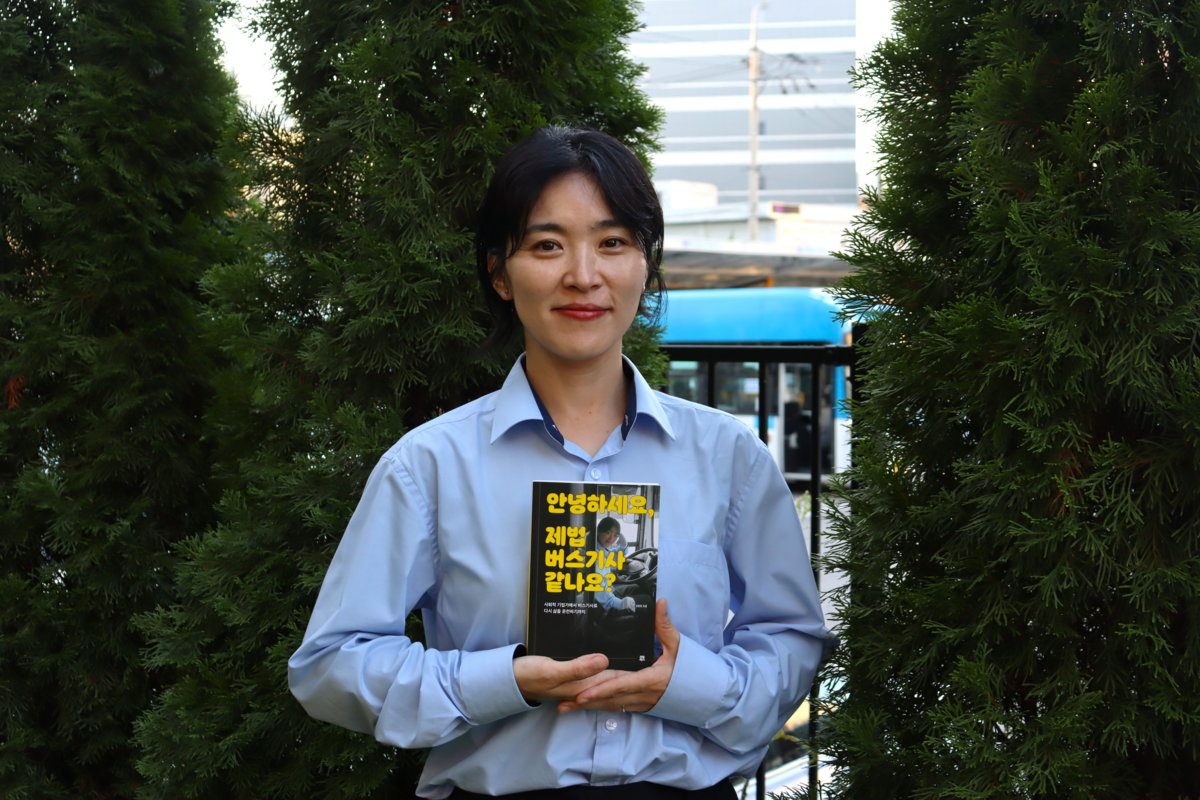 Kang Hee-jung, photographed at a bus depot in Anyang, holds her essay collection “Hello, Do I Look Like a Real Bus Driver Yet?” Kim Su-ho
What remained was debt. As Kang worked through one physically demanding job after another, her father suggested driving a bus. A bus depot? Isn’t that a world of men in their 60s? “No. Why would I do that,” Kang said flatly. Yet days passed and the idea would not leave her head. Gradually her thinking began to change. Doing set work at set hours and receiving an agreed wage — it was a sense of stability that only someone who has watched a business collapse can understand. Another thought struck her. “If I become a bus driver, I’ll meet countless people all day long. How many faces will I get to see? In that moment, for the first time in a very long while, my heart beat a little faster.” (From “Hello, Do I Look Like a Bus Driver Yet?”)
Kang, who published the essay collection “Hello, Do I Look Like a Bus Driver Yet?” in August, met with a reporter on the 3rd near a bus depot in Anyang, Gyeonggi Province. She had just come off a shift that began with the first run before dawn and ended at 3 p.m., greeting every passenger who boarded with a “hello.” Kang, who says she drives simply hoping that each person is well, is in her second year as a bus driver.
“Hello, I’m Kang Hee-jung, Your Bus Driver”
— The greeting in your book title stands out. What does “hello” mean to you?
△ Call it a greeting to the passengers who ride my bus. It asks “are you well?” and at the same time carries the wish that they be well. Greeting people is not hard at all. It is harder not to say it out loud. I have been told since childhood that I greet people well. I titled the book “Hello, Do I Look Like a Bus Driver Yet?” because I wanted to show both the journey to becoming a driver and my commitment as one.
 A video featuring Kang Hee-jung on the YouTube channel “Failure Is My Strength.” As of the 4th, it had drawn more than 2.44 million views.
— I’m also curious about the path from appearing on YouTube to publishing a book.
△ I filmed myself on my first day driving a community bus and put it on my personal YouTube channel. That video hit 10,000 views in a single day, and an interview channel invited me on. The episode was titled “Why She Became a Bus Driver After Her Business Failed in Her Late 30s,” and it took off. So many supportive comments came in that I felt I had received a lifetime’s worth of consolation. As luck would have it, a publisher saw the video and offered me a book deal.
— You drove a community bus for a year before recently moving to a city bus route. What changed?
△ It varies by region and company, but when I drove a community bus, I covered about 220 kilometers a day. I drove 18 hours a day. In exchange, it was an alternate-day schedule, so I had the next day off. It was physically very hard. After moving to city buses, my working conditions improved. I work two shifts (morning and afternoon) and get two days off a week. Each run takes about two hours, and breaks are 30 to 40 minutes. Compared with the roughly 10-minute breaks I got on the community bus, it is far better. My pay went up too. (Starting salaries for city bus drivers range from 40 million to 50 million won, with regional differences. As of 2025, a fifth-year driver on a Gyeonggi Province quasi-public bus route earns 4.85 million won a month before taxes.)
— What is the process of becoming a bus driver like?
△ It is not as simple as people think. The required licenses and paperwork were one mountain after another, and each step took time. The longest wait was for the bus driver training program in Hwaseong. You practice driving on a track built to resemble actual roads, and because people gather from across the country, competition is fierce and the waitlist is long. I was lucky — a spot opened up after about three months of waiting. There were about 100 people in my cohort, and I was the only woman.
— What is the gender ratio like on the job?
△ Again, it varies by region and company, but in Anyang it feels like about one in 20 bus drivers is a woman. When I first started, I was the only young woman driving, so senior drivers and passengers alike seemed surprised. I heard remarks like, “Can she really drive properly?” I wasn’t intimidated. Instead I showed them through my actions — by driving well.
According to an industry official, as of 2025 the gender breakdown among bus drivers in Gyeonggi Province, where Kang works, was 96.5% men and 3.55% women. In 2024, the share of women drivers was too small to register in the statistics, but by 2025 it had grown enough to be counted.
— New hires are reportedly getting younger, and more women are applying.
△ With more young drivers coming in overall, it seems a generational shift is underway in the bus driving industry. The company says competition for entry-level positions has grown several times more intense, and applications from young people and women have visibly increased. Some people bring up my story in their interviews, and others come up to me and say, “I applied after watching the ‘Kang Thanks’ YouTube channel.” It really is remarkable.
According to the Korea Transportation Safety Authority, the number of bus drivers in their 20s and 30s nationwide rose 37% from 7,559 in 2022 to 10,389 in 2025.
— What message do you have for people who want to become bus drivers?
△ I want to say, “Anyone can do this.” If you have the will to work hard, it is a job you can absolutely do. That said, some people leave the job quickly because they cannot keep up physically or because of accident risks.
Realistically, the most necessary skill for a bus driver is driving ability. But I think patience matters too. The patience to keep to your own pace while staying properly spaced from the buses ahead and behind you. The patience to respond calmly when something unexpected happens. You have to know how to manage your own mind.
— Where do working conditions need to improve?
△ Back when I worked 18 hours a day on the community bus, I often could not even eat lunch properly. I wish every region and company would guarantee at least a minimum amount of time for meals and breaks. Also, rules such as ordinances banning food on buses differ by region, which leaves things unclear.
This is a personal complaint, but I really wish passengers who stand would hold on to a handrail. Many do not, and when an accident happens, sometimes the driver alone is held responsible. It makes drivers anxious and puts passengers at risk, so I think we need to raise awareness about holding the handrails.
— You became a bus driver after passing through many different jobs. What will your final destination be?
△ I have not set a destination. When I ran a social enterprise, my goal was clear. I kept running forward, chasing a point I could never reach. In doing so, I lost each day as it passed. I had started the work to put love into practice, yet there was no love in my own days. From now on, I want to look squarely at today, enjoy it, and give my best every day. If I do that, maybe I’ll arrive at the best destination without even realizing it.
Kang, who says she is learning how to live each day well by driving a bus and meeting people, smiled as she said, “I feel love slowly blossoming.”
 Photo courtesy of Brobooks
“The biggest thing that changed while driving a bus was not my driving skill. It was the way I see people. I used to go looking for people in order to do good. Now people come to me first. So today, too, I try to stay awake — so that I do not simply pass by the one person who walks in front of me.” (From “Hello, Do I Look Like a Bus Driver Yet?”) Kang Hee-jung, who says she wants to be a driver who tends to her passengers’ hearts, takes the wheel again today.
We meet the people behind the characters in films, dramas and books, and listen to their voices. By “recasting” the real people behind these works, we aim to record the parts of their lives and of society that the works themselves could not capture.
 Subscribe to “Kim Su-ho’s Recast” on Naver to encounter vivid stories about the people behind a wide range of works.