

Digital subscribers can listen to this article.
Subscribe today for unlimited access to Texas Monthly. Already a subscriber? Log in.
During a whirlwind 24 hours in Paris this month, I was in the city just in time to catch a glimpse of a solar eclipse. I came to eat at Melt, a Texas-style barbecue restaurant chain that opened nearly a decade ago. In 2023, cofounder Jean Ganizate and his team attended the Texas Monthly BBQ Fest, in Lockhart, and he pleaded with me to visit his restaurant, but I wanted to come unannounced as I do at barbecue joints in Texas. When I had successfully snuck into Paris and Melt—the original Oberkampf neighborhood location—without him noticing, he was miffed that I hadn’t reached out to him beforehand. So he invited me over Instagram to Oobatz, a modern pizzeria in the Eleventh Arrondissement, just over half a mile away from Melt.
In the middle of our meal, we left our table that still had half a bottle of pétillant naturel wine on ice and took slices of mortadella-covered pizza outside to catch a glimpse of the natural phenomenon. As we reached Avenue de la République, a crowd bathed in fading sunlight stared through cardboard glasses into the sun. Ganizate handed me a pair from his pocket, and I looked up just in time to see the edge of the crescent widen as the moon moved across the sun.
In minutes we were back at Oobatz, finishing off a spectacular pizza covered in ribbons of zucchini and buffalo mozzarella. When we were leaving for good, Ganizate offered me a cigarette, which I declined—not because the label had a photo of a baby with a lit cigarette jammed into its pacifier, but because I cough for too many days after I smoke.
 Melt co-owner Jean Ganizate (bottom) at the Texas Monthly BBQ Fest.credit TK
The first time I met Ganizate, in 2014, he was traveling through Texas with Antoine Martinez, his friend and later business partner. (Martinez was a Melt cofounder but sold his share of the restaurant in 2019). They were on a shoestring budget, using the Texas Monthly Top 50 list as their barbecue research guide. They had already made stops at Franklin Barbecue, in Austin; Salt Lick, in Driftwood; and Pecan Lodge, in Dallas. We met in Dallas at Slow Bone BBQ. I bought lunch, and they shared their plans for bringing Texas barbecue to Paris. A month later, Thomas Abramowicz began serving smoked brisket and bourbon at Beast, in the Marais district.
“We thought it would take six months to open a restaurant,” Ganizate told me, but it took more than two years for Melt to come to fruition. Ganizate, Martinez, and their other partner, Paul Loiseleur, realized they would need one million euros to make it happen. They needed to raise about $200,000 euros for the down payment in order to get an interest-free loan from the city. They sent cold pitches to hedge funds, with little response, and canvassed the neighborhood where they planned to open, seeking investors. Not only did they not have any restaurant experience to tout, but they also had to explain Texas barbecue to bewildered Parisians. “In France, we have a culture of barbecue where you take a piece of meat and grill it on both sides,” Ganizate said.
They finally raised enough money, secured the loan, and found a building. Now they needed a pitmaster. “We knew we couldn’t do barbecue on our own,” Ganizate said. They had met Pecan Lodge’s pitmaster, Jeffrey Howard, on their Texas trip. After some discussions, they convinced him to move to Paris and become part of the Melt team. They celebrated with Champagne when he arrived at the airport, but they did not yet have a smoker for him to cook with. (They documented those early days in a short film, Melt. A Smoking Story.)
The building’s exhaust was not large enough for a J&R Oyler rotisserie smoker, so they instead ordered an Ole Hickory. It took a month to ship, and it arrived in the port just two months before opening. The customs agent in France gave them the bad news that it would be sent back to the U.S. Its electronics were not compatible with French requirements. “We were going to go bankrupt before the opening,” Ganizate said. He began a panicked search for any smoker he could find in Europe. A German reseller of Southern Pride smokers had an SPK-500 model that would fit in their kitchen and delivered it two weeks before the opening.
The team hurriedly unwrapped the smoker from its packaging to get it fired up. Howard had trimmed and seasoned some beef ribs and brisket for the maiden cook. Twenty employees and investors gathered around the cutting block as Howard uncovered those first hunks of smoked beef, the cuts unfamiliar to some in the anxious crowd. “In France, we had no such cuts for the beef rib, the spare rib, or the brisket,” Ganizate explained. But the brisket turned out great, and with great relief, Ganizate looked around at the happy faces of his partners and exclaimed, “We may have a business plan!”
Melt has come a long way ten years. From its original location, it’s grown to three more joints and two smaller delis selling only sandwiches. Howard returned to the U.S. after three years. “He put all the processes in place,” Ganizate said. Co-owner Loiseleur is now the “global pitmaster,” but each location with a smoker also has a pitmaster in charge of daily operations, and at the original location, that is Aga Realson.
I landed in Paris less than two hours before visiting Melt for the first time. I walked the streets nearby in search of a pastry and a coffee, which I found at a nearby pâtisserie, the French Bastards. On the sidewalk outside, I met a couple Brits from Manchester, and minutes later, Rhys and Aaron agreed to join me at Melt to share in the giant platter of meat I was about to order. We walked in about an hour after the restaurant opened and admired the smoker in the glass-enclosed pit room next to the ordering counter.
We settled on sliced brisket, pork ribs, sliced pork belly, beef cheeks, and jerk chicken thighs. (Smoked sausage was not available, but Ganizate said Melt will introduce a jalapeño-and-cheese link for the first time very soon.) Everything is à la carte, but there’s no need to guess how many kilos to order since almost everything is priced by the serving. For example, the small-size brisket is a two-hundred-gram serving (a little under a half pound) for 25 euros.
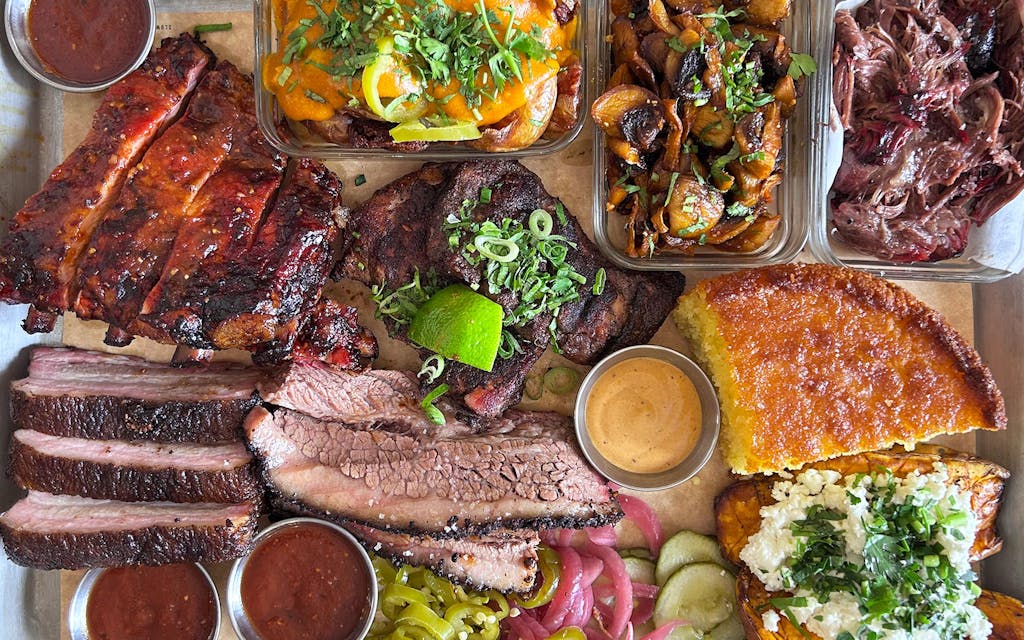 A tray from Melt with brisket, cornbread, mushrooms, beef cheeks, and morePhotograph by Daniel Vaughn
I asked the man at the counter for a wine suggestion, and he urged me to try a beer instead. Coming from a Frenchman, that took me aback, but maybe this was a different kind of French dining experience at every level. He poured a lovely pint of crisp IPA from La Rouget de Lisle brewery. It was a great pairing for the smoked meats—neither intensely hoppy nor sweet.
I pulled the slice of fatty brisket that had been hit with flakes of sea salt flakes from the tray and held it aloft. (Melt imports its briskets and beef ribs from Creekstone Farms and Greater Omaha beef.) It remained intact against gravity but was easy to pull apart. The bark was well formed, and the French oak smoke was pleasant. This was an impressive slice of brisket. The lean side didn’t fare quite as well. Its flavor was great, but it was a bit undercooked. The sliced pork belly needed a couple more hours in the smoker to tenderize and was the only real flop of the tray.
I loved the fatty layers within the spare ribs from the Spanish Iberico pork. A sweet sauce brushed on during the cook kept a bark from forming, but the meat was perfectly tender and required just a tug to come off the bone. I was most surprised at how well they translated less common cuts like the beef cheeks, which were shredded, with plenty of bark, fat, and gelatin in the mix. I dipped forkfuls into the peppery, tomato-based barbecue sauce and chased it down with some great house-pickled jalapeños.
Warm spices like cinnamon and allspice were evident in the boneless, skinless jerk chicken thighs, but they didn’t have much heat. The thighs were well smoked, but I should have chosen the skin-on half chicken.
I didn’t expect to find queso in the land of fromage. Ganizate said it requires some explaining to French customers. “It’s our homemade cheese,” he tells them, and they gladly add the cheddar-based sauce to the smashed-potato side dish. I enjoyed the creamy cheese, though it was missing that processed tang. I loved the side of magic mushrooms, sautéed with a soy-based sauce. A roasted sweet potato, split and covered in feta and herbs, was perhaps too overloaded.
Some of the sides have the feel of American craft barbecue rather than old-school Texas barbecue. That can be attributed to the influence of pitmaster Alex Smith, who Ganizate met while he was working for Hometown Bar-B-Que in Brooklyn. He asked him to consult on Melt starting in late 2017. When I took the first bite from the corner slab of the honey-butter cornbread, it felt like I was at Hometown even before I knew the connection. It had a tender crumb with browned, buttery edges. My tablemate Aaron had never eaten cornbread and loved this one, though I had to warn him that in Texas we could call this very sweet version corn cake. Regardless, I couldn’t resist several more bites.
A dense carrot cake with layers of fluffy cream cheese icing was our actual dessert. It was a good one and felt like an homage to the U.S. rather than Texas specifically. A pecan-and-chocolate-chip cookie and a vanilla sundae were also available. I didn’t have room for much more and needed to save some real estate for French cheese and oysters.
Melt will celebrate a decade in business in November. In October, it will welcome pitmaster and chef John Bates from Austin’s InterStellar BBQ for a takeover. Its staying power proves there is a Parisian appetite for smoked meats. Ganizate also gives credit to Abramowicz at Beast for introducing the city to smoked brisket.
I hadn’t heard from Abramowicz since shortly after he closed Beast in 2020. He was understandably wounded then. A second location of Beast opened in 2017 and nearly ruined his finances when it closed for good after just three weeks due to severe water damage to the building. The prolonged gilets jaunes (yellow vests) protests that began in 2018 were held outside the original restaurant and crippled its weekend business. Then came COVID, and he was forced to close for good. “I still smoke ribs for my friends in my backyard,” he wrote to me then. But he was done with restaurants.
A couple weeks ago, I emailed Abramowicz for an update. He is back in the world of barbecue as the European sales rep for J&R Manufacturing, which produces the popular Oyler rotisserie smoker in Mesquite. “I am trying to have them try cooking on an Oyler,” he wrote of Melt, which prefers its Southern Pride smokers. “It’s been running for ten years and it never let us down,” Ganizate said.
Ganizate assured me that wood is used in those smokers. He insisted the restaurant uses post oak wood from just outside Paris. When I clarified that post oak was a species prevalent in Texas, but not in France, he said he was mistaken. He thought the word “post,” so heavily used in Texas barbecue, referred to well-seasoned wood. I guess there will always be something lost in translation when it comes to Texas barbecue in Paris, but Melt speaks brisket fluently.
Read Next