

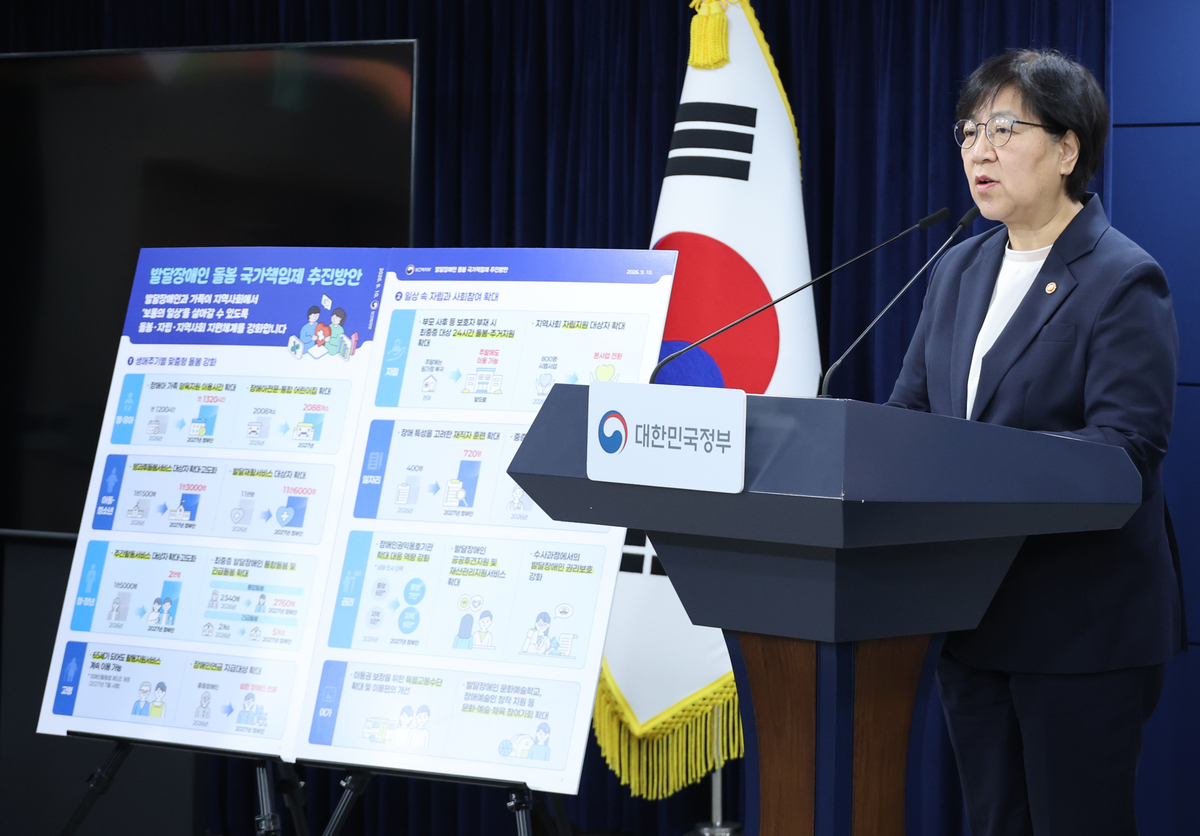
 Health and Welfare Minister Jeong Eun-kyeong briefs reporters on plans for a state-run care system for people with developmental disabilities at the Government Complex in Jongno-gu, Seoul, on Oct. 10. Yonhap News
The South Korean government will strengthen support for people with developmental disabilities at every stage of life, from infancy through adulthood, in an effort to close gaps in care. It will expand a daytime activity program for adults with developmental disabilities to 30,000 people by 2030 and widen integrated and emergency care for those with the most severe conditions.
The Ministry of Health and Welfare announced the plan, called a state-responsibility system for care, on the 10th in a joint statement with other ministries.
The number of people with developmental disabilities, including intellectual and autism spectrum disabilities, has been rising steadily. It grew to 288,000 last year from 248,000 in 2020, and their share of all people with disabilities climbed to 11.0% from 9.4%. Based on the average annual growth rate over the past five years, the government projects the figure will reach 335,000 by 2030. As of last year, 69.5% of people with developmental disabilities were adults aged 18 to 64.
The government will first move to ease the burden on families raising children with disabilities. Support hours for childcare will increase 10% to 1,320 hours a year next year from 1,200 hours this year. It will add 80 specialized and integrated day care centers next year to the current 2,008, and expand developmental rehabilitation services to 116,000 people from 110,000. After-school activity services will grow to 13,000 people from 11,500.
Support for adults will also widen. The daytime activity program will expand in stages to 20,000 people next year and 30,000 by 2030, from 15,000 now. Integrated care for those with the most severe developmental disabilities, who need the most support, will cover 2,760 people next year, up from 2,340 this year. The number of institutions providing emergency care for the most severe cases will rise to five next year from two. The government will also extend a 24-hour one-on-one support service, currently available only on weekdays, to weekends for people with the most severe conditions who cannot live independently in the absence of parents.
Funding will grow as well. The welfare ministry’s budget for developmental disability support has increased about 122-fold, to 488 billion won this year from 4 billion won in 2015, and the government’s proposal for next year sets aside 572.1 billion won. Related spending across ministries will total 2.8 trillion won next year, up 15.9% from this year.
“The number of people with developmental disabilities will grow further by 2030, so we need to secure a matching volume of services,” Health and Welfare Minister Jung Eun-kyeong said. “We will secure the necessary budget every year.”