
Last year’s copyright law violations soared
88,311 cases…Most cases of ‘planned complaint’ aimed at settlement funds were concluded by agreement
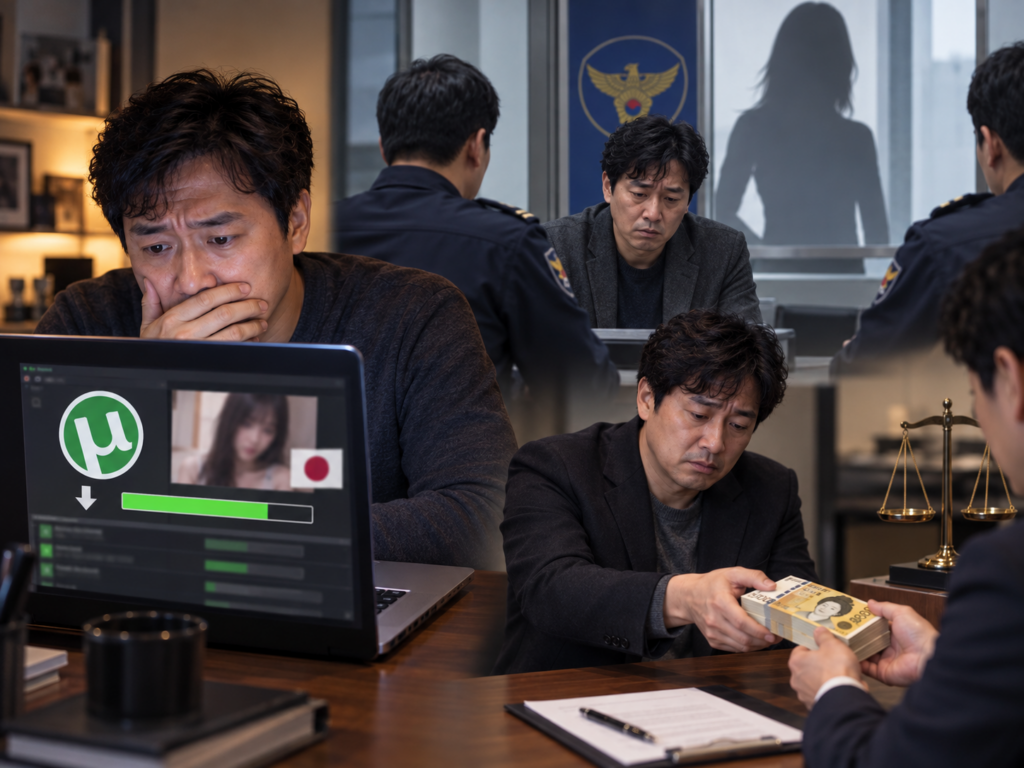
![AI images to help you understand the article. [Chat GPT]](https://www.laviezine.com/wp-content/uploads/2026/09/news-p.v1.20260911.af00a6048d2b4a59967f347eba76ee03_P1.png) 사진 확대 AI images to help you understand the article. [Chat GPT]
사진 확대 AI images to help you understand the article. [Chat GPT]
# An office worker in his 40s living in Seoul was recently investigated by the police after downloading Japanese adult videos from the file sharing (P2P) platform “Torrent.” The complainant said he would file a civil lawsuit separately from the criminal complaint and seek compensation for damages.
Mr. A, who was afraid of the case growing, asked the complainant for an agreement, and paid 2 million won and agreed. Mr. A said, “I had no idea that Japanese adults were also protected as works in Korea. “I was dizzy to ask for civil and criminal responsibility,” he said.
The number of copyright law violations aimed at illegal sharing of works is exploding. The scope of copyright infringement complaints, which had been centered on domestic movies, novels, and fonts, has expanded, and now users who share Japanese adult products without permission are being sued one after another. The method of receiving money by suing a large number of unauthorized distributors of works and demanding an agreement has become a profitable business.
According to the National Police Agency on the 11th, 88,311 cases of copyright law violations were reported to the police last year. This is a 48.3% increase in one year compared to 59,557 cases in 2024, and a 13.7 times increase in five years compared to 6,434 cases in 2020.
The number of copyright law violations, which peaked at 78,526 in 2008 when illegal distribution of works through web hard sites was prevalent, has been increasing rapidly since 2021 (6216 cases).
 사진 확대
사진 확대
The increase was driven by copyright infringement cases that occurred online.
The number of cyber copyright infringement cases increased 24.7 times in five years from 2,183 in 2020 to 53,963 last year. The share of all copyright law cases also nearly doubled from 33.9% in 2020 to 61.1% last year.
Most cyber copyright infringement cases occur through P2P platforms such as Torrent, including unauthorized use of typeface and illegal uploading of webtoons and videos.
The so-called “planning complaint” is cited as the background of the surge in cyber copyright infringement cases. It is a method in which copyright holders or rights agents sue illegal sharing users at once and receive settlement money on the condition that the charges be dropped.
Violation of copyright law is a pro-accusation crime that can be punished only when there is a complaint unless it is for profit or habitual, so if the complaint is dropped after agreement, the case will be closed. This is why there is a constant controversy over the “settlement trade” that some companies are actually using such settlements as a source of revenue.
Due to the Torrent structure, it is not difficult to track illegal distributors.
Torrent is a structure that divides files into several pieces and transmits them distributed among users, and downloads and uploads are carried out at the same time. At this time, the Internet address (IP) of the user who sends and receives files is also exposed, making it easier for the right holder to collect a large amount of IP as evidence.
The current copyright law does not take issue with the illegal copying of works for personal use, but prohibits the distribution of works without permission.
This increased number of complaints is returning to the burden of the police. It is clear that those who distributed the work without permission are responsible, but it is pointed out that the right holder is also overcharging criminal complaints as a means of resolving civil damages.
In fact, according to the results of the police’s handling of the case, only 10,627 cases, 12% of last year’s copyright law cases, were sent to the prosecution. There were 16,122 cases of termination of “no right to prosecution,” which includes cases in which the victim agreed with the suspect and expressed his intention not to punish him, 1.5 times the number of cases sent to him. While the police investigate whether they violate the copyright law, an agreement is reached between the complainant and the accused, and a complaint is taken, but an intention not to punish is submitted.
An investigator at the Seoul Metropolitan Police Station said, “There are times when I feel skeptical as an investigator because the complainant seems to consider the police investigation as an intermediate step to agree with the accused.”
The surge in copyright law violations has even changed the overall crime statistics.
The total number of crimes committed in Korea last year was 1,599,695, up 16,587 (1%) from 2024. During the same period, the increase in copyright infringement cases was 28,754, 1.7 times the net increase in the total crime. In other words, copyright-related cases have boosted the overall increase in crime.