
 Raul De Lara’s “The Secret Lives of Objects” at Hermès Maison Madison. All photography by Skot Yobauje and courtesy of Hermès.
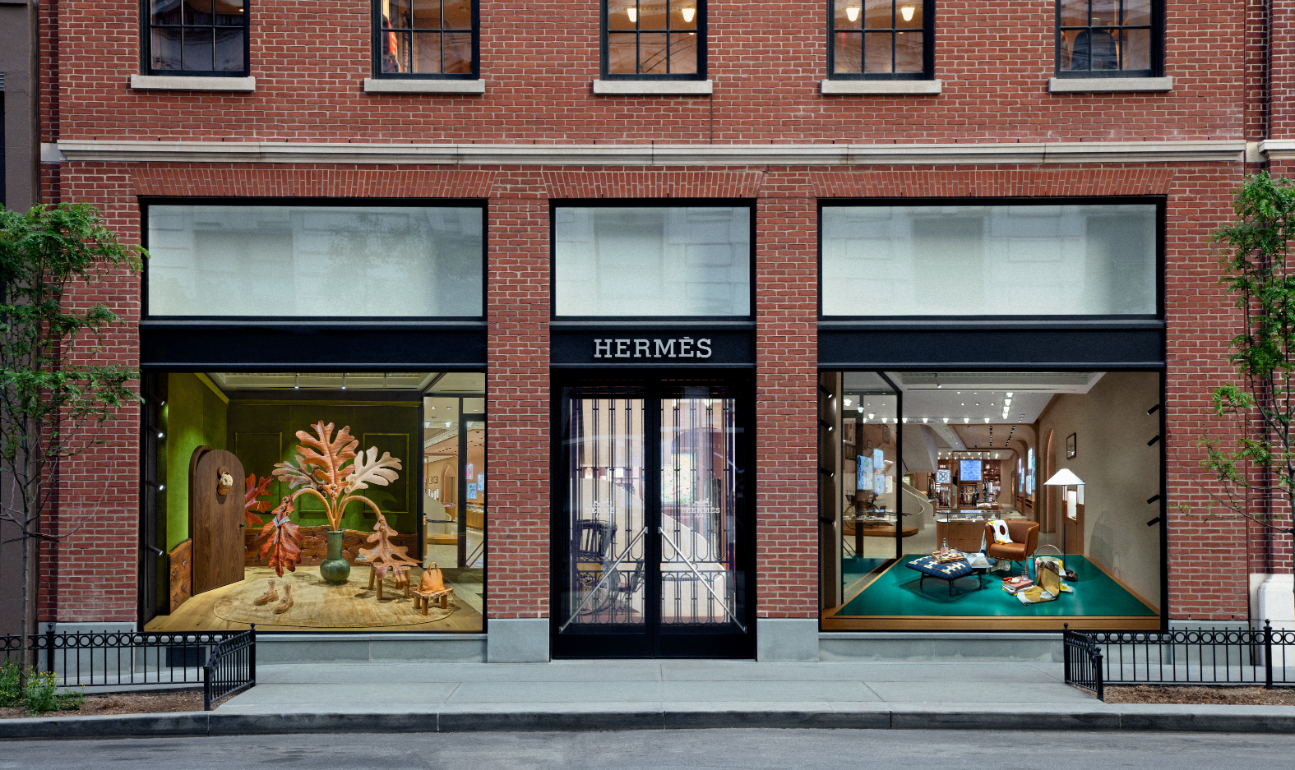
Artist Raul De Lara crafts sculptures for the home that may leave inhabitants struggling to discern which way is up. Houseplants have outstretched limbs more human than leafy. Plush-looking tufted chairs are actually solid wood, and children’s toys are swapped out with prickly cacti. Now, the artist brings these irreverent carvings to Hermès’s Maison Madison in a window installation titled “The Secret Lives of Objects,” that features all the possessions—or as he calls them, “silent roommates”—that adorn city homes.
The New York-based sculptor primarily works with wood, an interest that was piqued early in his life. He grew up watching his father, an architect in Mexico, practice woodcarving in his studio before he and his family migrated to Texas when De Lara was just 12 years old. De Lara is continuing his father’s legacy (sans the practicality) with larger-than-life, otherworldly sculptures that interrogate what it means to call a place home, and blend Mexican and American woodworking traditions.
These humorous, anthropomorphized household items are what nabbed the sculptor not one, but two, commissions for Hermès storefronts. His first, at the house’s Aspen outpost in 2023, saw Hermès saddles and throws blankets interacting with his signature rocking cactus sculpture and wooden chairs. But before De Lara’s sculptures went on view on Madison Avenue, the artist spoke with CULTURED about all the new tricks he employed for the city’s sure-to-be-captivated passerby.
You modeled the storefront scene after an “everyday New York apartment.” In what ways did your own homes, in New York, Austin, and Mexico, influence the layout of the installation?
I would say that all three homes taught me something about the objects we surround ourselves with. My dad built the home where I grew up in Mexico. Not being able to go back for most of my life turned it into a memory, a fantasy in its own right. After almost 20 years, I was able to go back to see it from the outside. Unfortunately, we no longer own it, and most things seemed smaller, except the trees. I then realized that these trees also grew up with me all these years. Something about that moment made me want to keep working with human-scale plants, as seen in this window.
My Austin home taught me the importance of whimsy in your everyday life. After abruptly leaving Mexico and starting a whole new life in the United States, we had the opportunity to begin our domestic visual lives from scratch. The Texas home is filled with wind chimes, plants, wooden saints, paintings, homemade furniture, cookware, and objects you end up with because you chose them. My mom has a sign that says “mi casa es mi casa.”
My New York living and work home is slowly becoming my own version of a log cabin in the middle of Queens. I dream of a log cabin because I could then carve on every square inch of its inside and outside. This fantasy inspired the large live edge slabs carved in this window appearing to be soft and gently tufted.
In three words, describe the type of person who would live in the installation’s apartment.
Active, curious, grateful.
The natural materiality of many Hermès products—the leather of the Birkin, the silk of the scarves—have much in common with your own work. Did any specific Hermès materials or products inspire your fabric-like carvings?
To be honest, I am always thinking of Bernini when carving these soft wood fabrics. He was able to melt marble in a way I deeply admire and borrow inspiration from. I try to bring that same humor and uncanniness into my work through carving. Yet the question stands: How does one bring materials to life? I think it’s all in the details.
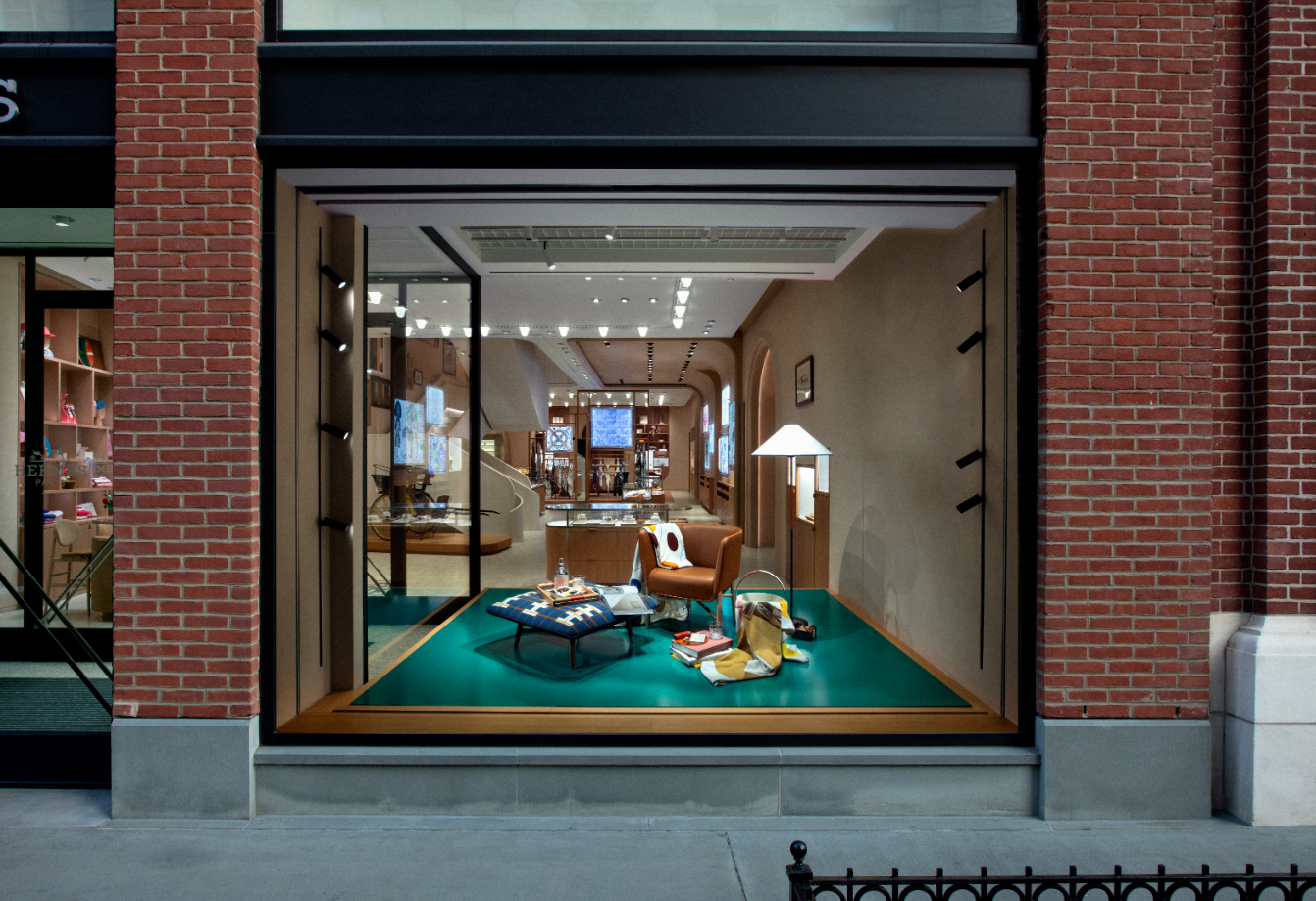
For this window, I wanted to playfully combine different wood species with materials found in Hermès products. You can find the leather Bolide bag sinking into what appears to be a soft ottoman hand-carved from solid walnut. Leather and wood are both humble materials that are taken beyond materiality with this gently carved gesture. There is also a pair of suede shoes with wooden socks standing straight up. I placed the delicate porcelain cup and saucer next to the heavy bronze vase for more material friction. There are material details scattered all around the window for the viewer to find.
You anthropomorphize everyday products in your work. How do you want Hermès products to interact with your pieces and come alive within the installation?
I grew up in a family of casino decorators, interior designers, architects, and engineers so thinking of storytelling through interior spaces has always been part of my thought process. I also grew up in Mexico watching artisans carve saints out of branches and always wondered, At what point in the carving process does the saint enter the wood? I think of houseplants, furniture, and prized possessions as our silent roommates. They witness our daily lives, our victories, and our struggles. We love them for their usefulness, their beauty, and the quiet moments we share with them. For this window, they are the main characters.
As a sculptor, I strive to imbue my materials with a spark of life. While thinking about how to activate this project, I decided to create a series of animated sculptures that make Hermès products not only feel like extensions of our personality, but rather, companions for our journey.
You designed an Hermès window in 2023. How does this work build upon and transform that display?
Since 2023, I have been able to meet more Hermès team members and see how they bring life to what they create. Collaborating with a company that doesn’t compromise on quality has been a gift. I have spent most of my life developing my woodworking skills, and finding a partner who values that is a true blessing. Because of our mutual attraction to extreme craftsmanship and generational knowledge, I have been able to dream as big as possible and see my skills grow over the years working together.
This project gave me the opportunity to reimagine some of my signature sculptural elements—including the wooden leaves, functional wooden hardware, large wooden vases, and carved tufts—in a new light. My studio operations also expanded in ways I never imagined, including working with an incredible foundry to cast my wood pieces in bronze. New horizons have now opened for me to work both indoor and outdoor.
What, if any, media inspires your work, whether in the form of films, books, songs, or anything else?
For this particular window, I was inspired by my favorite tree in Central Park. Every fall, I go visit him for inspiration as it gives off the most beautiful leaves. I collected six of them and used their shape to create the large wooden leaves you see at Hermès. I used a variety of wood species to capture fall’s color range. I was also inspired by the bronze sculptures and the scattered patina on copper architectural elements around the park. The wooden-looking vase you see in the window is actually cast out of solid bronze.
I would say that, in general, I am inspired by the space that exists between one material and the next. Wood is my primary medium, but I love looking at how other materials coexist within our world. New York is such a special place because one can look anywhere and see generational visual DNA. The music scene in New York is also a big inspiration for me. I find sonic and visual rhythm to go hand in hand with how I articulate my compositions.
A different kind of inspiration, but I have lived in New York for five years and I still have the same curiosity to look into people’s windows as I did the first day I moved here. It’s kind of hilarious but I love looking into the magical world people build for themselves. I wanted this window to feel like that. You’re walking down the sidewalk and all of the sudden, boom, a whole life right in front of you.
Describe the process behind your rocking cactus sculptures, one of which was featured in your last Hermès installation.
Like life itself, cacti have this hypnotic quality that simultaneously pulls you in and pushes you away. The rocking sculptures started as a way for me to meditate on the idea of home, not as a static place, but as a balancing act. Not a solid foundation, but rather, a life in motion. As someone who came to the United States as a child, had undocumented status for eight years, then had to spend the last 14 years under the precarious DACA program, I have developed a life where my foundation is always in motion.
When I make my works, I think of how curves help rigidity feel fluid; they keep your shoulders relaxed. Oftentimes, woodworking, sculpture, and products are associated with static verbs. In my world, motion, modularity, plurality, and fluidity are how they live. For me, most of the life force in the new Madison window lives within the curves you see on each leaf silhouette, the stems they hang from, the gentle folds between the leather, and the softened wood. So much can be said with a single curve.
More of our favorite stories from CULTURED
The 15 Must-See Solo Gallery Shows in New York This Month
What Does It Take to Make It as an Independent Fashion Designer in 2026? We Asked 3 of Them.
You’re Welcome to Keep Listening to ‘Rush.’ But Troye Sivan Has Moved On.
Post-Banana, Can Maurizio Cattelan Escape His Reputation as a Readymade Rabble-Rouser?
Art Fair Season Is Approaching. Here’s How to Get the Most Out of Your Visit.
Sign up for our newsletter here to get these stories direct to your inbox.