

Half of Seoul’s 40-64-year-olds
Care for parents and children at the same time
The quality of life of middle-aged and elderly people varies depending on their assets even if they earn income
![[Maekyung DB]](https://www.laviezine.com/wp-content/uploads/2026/09/news-p.v1.20260915.8579ada10e2641ec97901080ce2e902a_P1.png) 사진 확대 [Maekyung DB]
사진 확대 [Maekyung DB]
Mr. A, who lives in his late 50s in Nowon-gu, Seoul, lives with his youngest son who is a college student. Thanks to the fact that he owns a house and stable spouse income, there is no apparent difficulty. However, A recently had a problem that he couldn’t tell. They are in a “sandwich care” state where they have to take care of their parents, husbands, and children at the same time while taking care of their mother’s hospital treatment and meals, which have recently become uncomfortable. A said, “I don’t need a job right now, and I’m not in a very difficult situation, but I think my life is gone.”
According to the data released at the “Seoul Middle-Aged Policy Forum” held by the Seoul Metropolitan Government and the Seoul 50 Plus Foundation on the 15th, 48.4% of middle-aged people aged 40 to 64 living in Seoul were in the same “sandwich care” situation as A. Based on the age of 50-54, it rises to 62.1%.
In fact, the forum introduced a middle-aged case like A who was worried about other issues other than economic issues. Mr. B in his 50s said, “Thanks to the severance pay and spouse income I received during retirement last year, I am not worried about living expenses, but I am at a loss when I am done working,” adding, “I want to find a new job, but I am frustrated because I do not know where to start.”
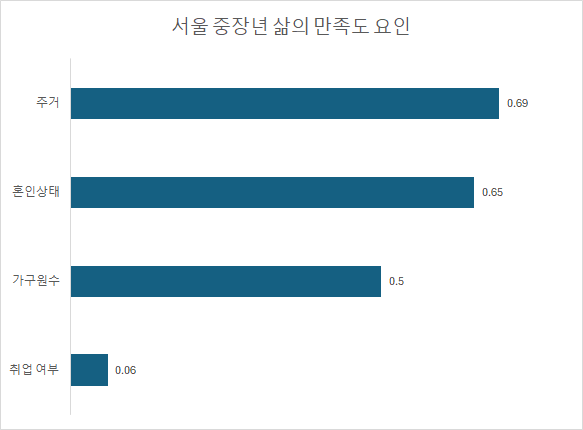 사진 확대
사진 확대
Single-person households have more anxiety. C, in his 60s who lives as a single household and works as a security guard, said, “I don’t have any worries about my income or health right now, but I’m already afraid to think that there will be no one to take care of me in a few years.”
“If middle-aged support measures have been focused on solving economic difficulties, it is important to identify various difficulties of middle-aged people and make policies suitable for them in the future,” a Seoul Metropolitan Government official said.
To this end, the Seoul Metropolitan Government established a middle-aged support department in the Lifelong Education Bureau this year. Expanding ‘customized support’ away from uniform support is a key role of the middle-aged support department.
For systematic support, the ‘middle-aged and elderly quality of life index’ was also developed. The indicators consisted of 12 areas and 75 detailed indicators in three categories: basic competency (elastic), living competency (active), and conversion competency (leap). “According to the results of the index analysis, there is virtually no gap in satisfaction between the employed and the unemployed, but there is a big difference depending on the type of housing occupancy and marital status,” a Seoul Metropolitan Government official said. “From a long-term perspective, the potential threat of middle-aged single-person households is great.”
The Seoul Metropolitan Government plans to set this year as the standard year for quality of life indicators and identify new policy demands based on this. An official from the Seoul Metropolitan Government said, “We will use the indicators to closely find invisible differences in life behind the data of ‘average’ to develop new policies and connect them to citizens in need.”