
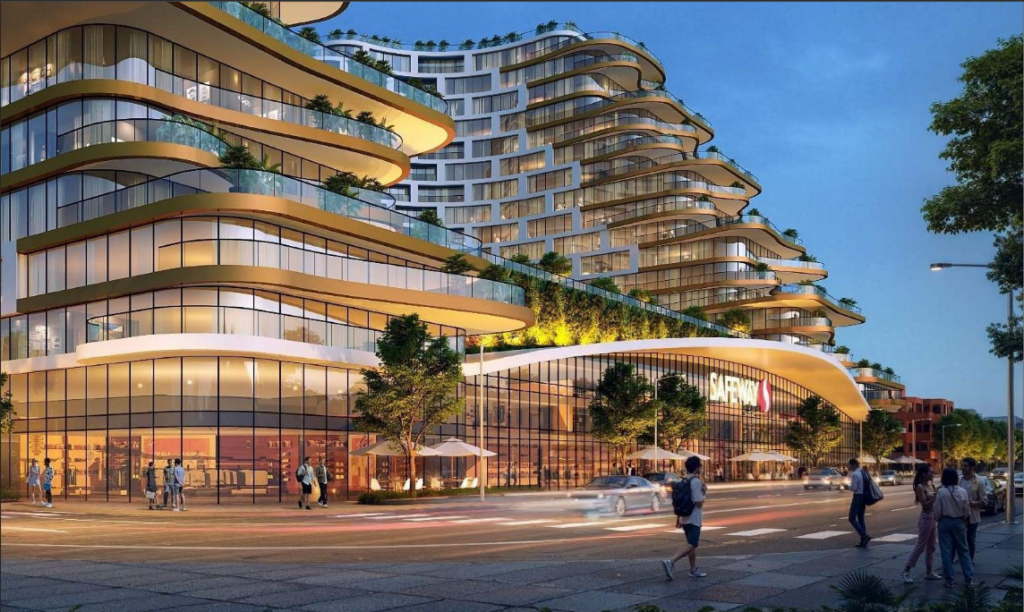
The planned housing development on the site of the Marina District Safeway is now facing a federal lawsuit.
Arquitectonica
A new nonprofit is emerging as the antithesis to San Francisco’s YIMBY movement — and not, its founders insist, because it opposes housing, but because it believes the city is approving major projects without adequate scrutiny. Its first target: the proposed 22-story Marina Safeway redevelopment.
A federal lawsuit was filed Friday in the U.S. District Court for Northern California by the new YesAnd Foundation, Neighborhoods United San Francisco and four Marina District residents against the controversial Marina project’s developer, Align Real Estate Partners. The complaint also names the city of San Francisco, its Public Health and Planning Departments, PG&E and Safeway parent company Albertsons.
It alleges that city officials improperly approved the project under Assembly Bill 2011, a state housing streamlining law, while allowing its developers to bypass a full investigation of toxic contamination at the site as well as required health and safety protections. The plaintiffs are asking the court to halt the project until those reviews are completed.
Article continues below this ad
The lawsuit echoes concerns expressed in recent weeks by Marina residents and community activists as well as the district’s supervisor, Stephen Sherrill, who have denounced the housing plan over its scale, potential environmental risks and have questioned its eligibility under AB2011. The complaint officially turns those objections into a legal challenge, alleging that the city is allowing the project to advance toward construction before the site’s contamination and potential health hazards are fully understood, through a streamlined process it was not eligible to use to begin with.
“Addressing our housing affordability crisis starts with building more homes, and that’s why a majority of District 2 residents support this project,” said David Balducci, of Align. “California passed stronger laws so that desperately needed housing can’t be blocked by the same old tactics that created this crisis in the first place. We’re confident this project fully complies with the law.”
“Once we are served with the lawsuit, we will review the complaint and respond in court,” a spokesperson for the City Attorney said. PG&E spokesperson Tamar Sarkissian said, “We have not reviewed the lawsuit.”
Late last year, the developer first proposed a large housing complex containing 790 apartments, including 86 below market-rate homes, in towers reaching 25 and 22 stories in height. After months of criticism over the project, including from San Francisco Mayor Daniel Lurie’s office, Align revised its plans this summer, lowering the height of its project to 22 and 18 stories while increasing the total number of homes that would be built above a replacement Safeway store to 848.
But the changes did little to appease critics. The proposed project would still soar above the low-rise Marina waterfront, which has a documented history of contamination from decades of industrial use, including a PG&E steam electric plant that occupied the Safeway site and a manufactured gas plant that operated nearby, leaving behind petroleum-related pollutants and other hazardous substances. A community meeting held about the project in July drew hundreds of attendees, and Sherill, the neighborhood’s supervisor, unsuccessfully argued that the project site did not qualify for AB2011’s streamlined approval process.
Article continues below this ad
Is it good for San Francisco that the city has made it easier and faster to approve new housing?
Most RecentTop Responses
Gary S
San Francisco, CA
09/16/26
yes! Has ANY new housing been built in the Marina in the past ten years? NIMBYs want to keep on NIMBYing
Rob N
San Francisco, CA
09/15/26
Massive tax revenue will flow to the city for this (and other projects). Take some of it to help people that need it to pay rent (means based: on the renter’s income, not forcing small landlords to subsidize tech bros and rich people that benefit from rent control). Lots of talk in SF about progressive politics, but when it comes to actually doing things that help people, like generating more taxes from these projects, it quickly changes if some people don’t like it.
Cynthia W
San Francisco, CA
09/15/26
It is going in the right direction. But there needs to be logical guardrailes. The traffic and polution and delicate infrastrucure at the Marina Safewa site makes this particular location high risk. It is already conested every time there is any event in the neighborhood which is almost weekly (if not daily). You would need to increase the size of all the roads in the areas, cut into the parklands to do so and also someohow provide even more transportation options in the area. We know how well we do with making transportation in SF, so it will only get worse. The Heratiage proposal is much more reasonable and appropriate for the area.
Yes. These lawsuits need to be rejected as baseless. These people are the reason the city is so unaffordable. If anything the city needs to be creating new streamline processes and expanding and restricting scrutiny on projects. The majority of the country can start a construction project the same year it is announced,. It is a shame that is impossible in such a capable place like San Francisco.
Eric W
San Francisco, CA
09/03/26
Yes, it’s important that SF change its old ways and allow housing to be built. SF rent is unaffordable. There is a chronic short supply because neighborhood groups don’t want new people to move it. Make space for them, as people made space for you 20 years ago!
The Board of Supervisors needs to get out of the way too. As long as proposed housing meets building and safety codes, people should be allowed to build what they want on land that they own. This brings down the cost for those of us who rent. And it allows new people to come into our town. Let them in!
I live in the Sunset district. There is plenty of space here. Just build the housing!
See More Responses
But the city’s Planning Department rejected that interpretation, and last month determined that the project met the state law’s requirements. That determination was not an automatic approval, however. The department confirmed it had 90 days to issue a final approval letter.
That final approval has yet to be granted, according to Planning Department records, even though city officials have indicated that approval was expected in the coming weeks.
Stuart Gross, an attorney representing the plaintiffs, said that detail is irrelevant to the complaint.
“We understand the project itself has not been approved yet, but the streamlining has been approved, which is what the lawsuit is based on,” Gross said. “We are challenging the decision to streamline without going through the necessary procedures. So our claims have merit. Once the project is approved there will be other elements added to the lawsuit.”
Article continues below this ad
The Marina group’s complaint asks the court to set aside the streamlined approval and order the city and PG&E to investigate and address contamination at the property.
“Neighborhood organizations followed the established process first,” said Lori Brooke, a District 2 community advocate, and co-founder of Neighborhoods United San Francisco. “We wrote to the Planning Department. We wrote to Public Health. We asked, in writing and more than once, that the environmental assessment required by state law be completed before the project moved forward. We were not asking for a veto. We were asking for proper review and a meaningful opportunity to be heard. When both are denied, the courts become the only option left.”
Brooke is also a board member of YesAnd. She said the new nonprofit cannot be identified as part of the pro-development movement YIMBY (Yes In My Backyard) or its counterpart, NIMBY (Not In My Backyard).
“We believe there is a middle ground,” Brooke said.
YesAnd’s work will include “educating and organizing residents” on housing, environmental, public health and land use issues, the group said in a statement on Monday. Similar to YIMBY Action, YIMBY’s affiliated legal organization, YesAnd plans to fund and file lawsuits against projects it believes violate housing, environmental or public health laws.
Article continues below this ad
“San Francisco needs more housing, particularly affordable housing, but we also believe good housing policy should include environmental responsibility, sound urban planning, transparency and meaningful community participation,” Brooke said. “Those things do not have to be in conflict, that is really the idea behind YesAnd.”
Regina Callan, who also lives in the Marina and is on the nonprofit’s board, said she and her neighbors “did not set out to start a nonprofit or hire lawyers.”
“We did it because every ordinary door closed on a decision that will permanently reshape one of the most visited and most fragile shorelines in the country,” she said. “A project of this size is supposed to be studied and public concerns heard before it is approved. This did not occur. No process should take away our voice.”
The dispute reflects a broader clash playing out in cities across California over its effort to accelerate housing construction. Laws such as AB2011 allow qualifying projects to bypass discretionary local review, public hearings and the California Environmental Quality Act, or CEQA, shifting land use decisions away from cities and residents toward state-defined criteria. In San Francisco, where city officials have been grappling with mandatory state housing targets, state lawmakers have sharply limited control over projects like the Marina Safeway.
Article continues below this ad