
Wet lab confirmed
In a Reuters interview, Eric Kauderer-Abrams, Anthropic’s head of life sciences, confirmed the lab and said, “We absolutely are doing that today, and I would describe our approach as being typical of what you would see in most biotech companies”.

A spokesperson later clarified that the facility is not for drug discovery specifically, declining to elaborate, while Anthropic said it wants to unlock treatments for rare diseases and that its biology work has gone beyond “in silico” or computer evaluations.
Kauderer-Abrams also framed the wet lab as the “final test” for biology, telling Reuters, “We believe that to do biology, the final test is still and will be for a while in real lab work”.
Automation and oversight
Reuters said Anthropic wants to push Claude’s ability to direct robotic units to carry out science experiments with limited human intervention, while the company also stressed that human oversight and involvement are essential for safety.
Left out by 9 of 11who reported it
Anthropic explored Claude directing robots with minimal human intervention. Reported by Tbreak UAE and International Business Times.
Kauderer-Abrams told Reuters, “We are in a very early phase of using AI to automate the execution of laboratory work,” and said the effort could accelerate many processes.
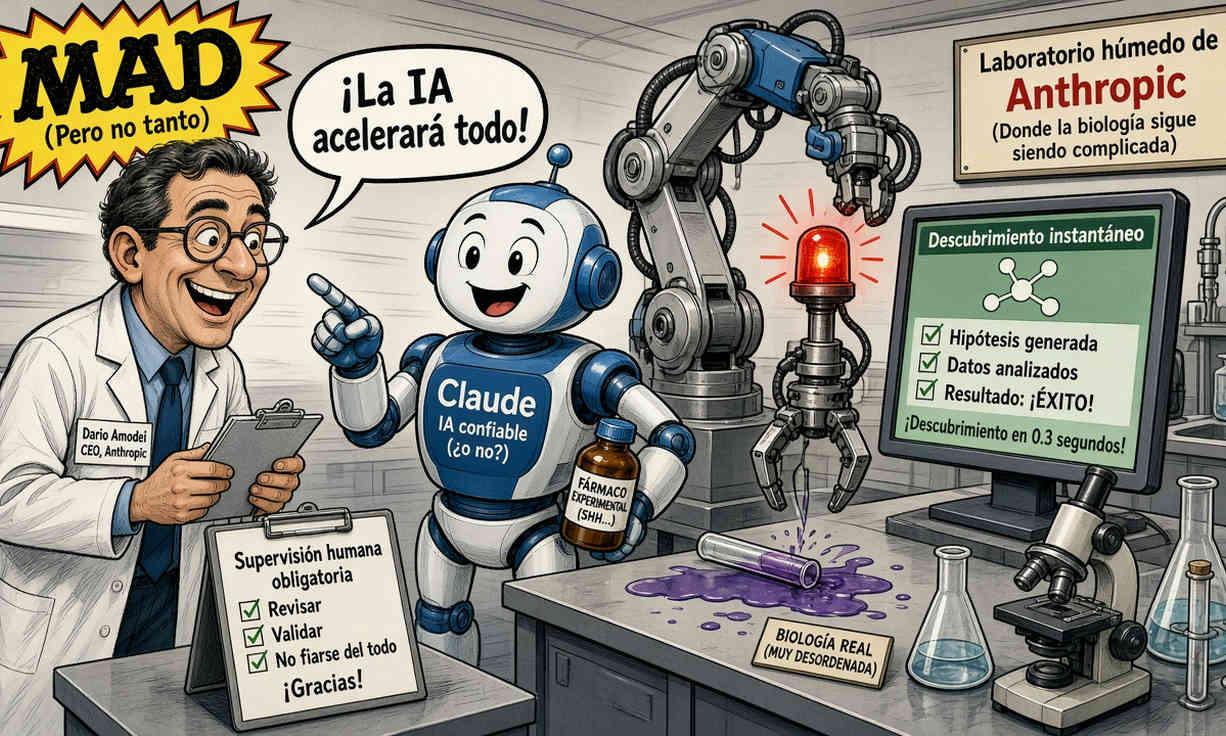
A spokesperson later clarified that the lab is not specifically intended for drug discovery, and Reuters reported that Anthropic has not yet run any clinical trial.
The wet lab move comes as Anthropic faces public fears about AI, including warnings from its researchers in the past two weeks that AI could lead to human extinction and Anthropic’s statement that it found examples where its systems could have been used toward biological weapons development.
Drug program ambitions
Reuters said Anthropic launched Claude Science, added Novartis CEO Vas Narasimhan to its board, and bought the startup Coefficient Bio for about $400 million in stock, while confirming the acquisition without commenting on the deal price.
In its life-science work, Kauderer-Abrams told Reuters, “In our life-science work, we’re always balancing these things,” describing efforts to improve models while being “thoughtful and careful” about deployment to limit risk.
The company also said it is preparing to go public in a potentially $2 trillion IPO to raise more money for AI development, as it seeks to translate physical biology experiments into treatments for diseases the pharmaceutical industry is neglecting.