

CITY HALL — One day after a City Council committee advanced Mayor Brandon Johnson’s proposed overhaul of the city’s tenant protection rules, rival alderpeople on a separate panel advanced a competing ordinance with several different stipulations.
Both measures could now be considered for passage by the full City Council as soon as next week, although a final vote may be delayed until later this fall.
On Wednesday, the council’s housing committee advanced Johnson’s Protecting Renters Ordinance, or PRO, which the mayor has said is aimed at shielding tenants from eviction and predatory landlords.
The ordinance would create a citywide rental registry, a tenant bill of rights, ban various “junk fees” and establish a new Bureau of Rental Housing Services within the Department of Housing, to be funded by a per-unit fee charged to landlords.
The measure passed through the housing committee Wednesday by a 12-9 vote, which came after the Johnson administration removed several major provisions from the ordinance. The removed provisions included “just cause” requirements when landlords chose not to renew leases and a stipulation they pay relocation assistance to renters who lost their housing through no fault of their own.
“As it stands, PRO is the only option that takes concrete steps to rein in the affordability crisis while providing the City the tools it needs to keep Chicagoans safe in their homes,” Johnson said in a statement on Thursday.
Those concessions, however, were not enough to convince alderpeople backing a rival measure, known as the FAIR ordinance, to stand down. That ordinance passed through the zoning committee Thursday by a 12-6 vote.
While FAIR would also create a registry of building owners and ban some junk fees, the measure would establish a smaller Office of Rental Services within the Department of Buildings — not the housing department. That office would utilize existing city staff, at least at first.
Unlike PRO, the competing ordinance allows landlords to continue to charge move-in fees to renters if they are “reasonably related to estimated costs associated with the tenant moving in, such as additional security or trash removal,” according to materials shared by sponsor Ald. Gilbert Villegas (36th) on Thursday.
Move-in fees have become increasingly common across Chicago in recent years as an alternative to security deposits.
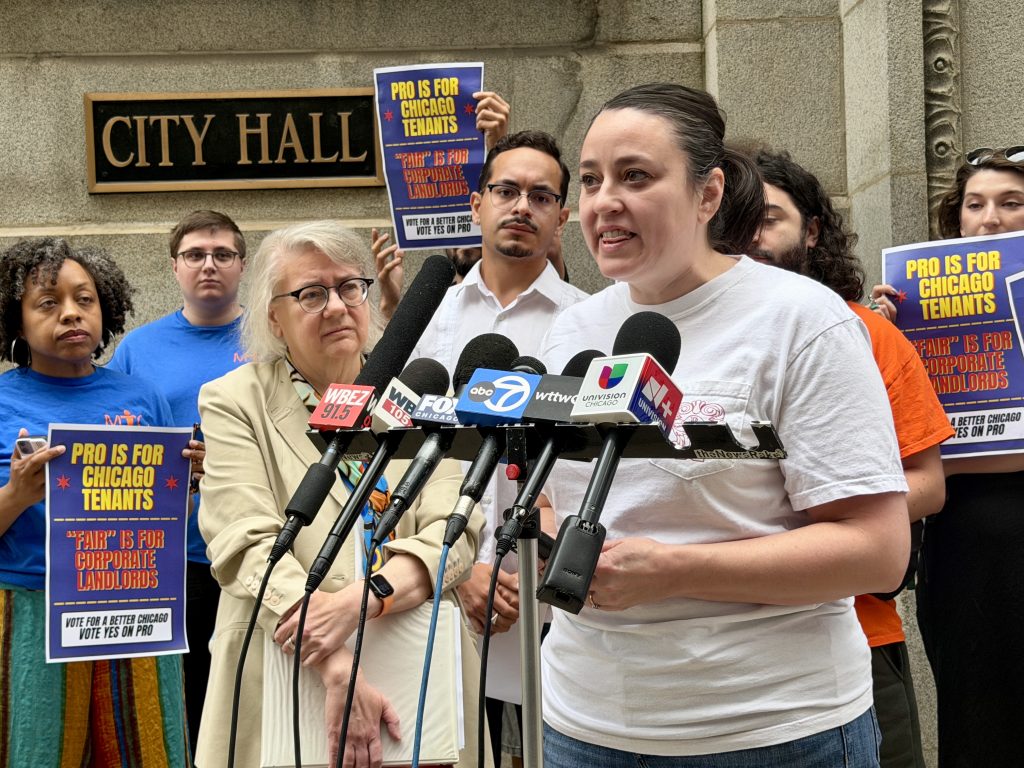 Devon Carson, member of the Belden Sawyer Tenants Association, speaks to reporters on Monday about the proposed FAIR ordinance. Credit: Melody Mercado, Block Club Chicago
The dueling ordinances have sparked an increasingly bitter fight in recent months between tenant rights groups — who say more protections are needed for Chicago renters — and the real estate industry, which argues PRO would lead to rising rents and discourage new housing development.
Ron Abrams, the owner of Silver Property Group who during Thursday’s public comment period said he owns and manages around 2,000 units across Chicago, vehemently urged alderpeople to reject the mayor’s bill.
“If PRO passes, tenants will pay more in rent. The costs that go up, such as not having any fees, capping fees, creating a whole new bureaucracy that’s going to charge each building a fee — those fees are going to be passed on, much like [rising property] taxes,” Abrams said.
Villegas called his legislation a compromise that boosts some protections for renters while also ensuring landlords aren’t overly-burdened by new regulations.
Meanwhile, progressive alderpeople and some activists — who have derided FAIR as a “big beautiful bill” for landlords — continue to push for PRO’s passage.
Julie Dworkin, the co-director of policy group Institute for the Public Good, on Thursday argued that FAIR would fail to deliver vitally-needed safeguards for Chicago renters.
“FAIR will not provide legal supports to tenants going through evictions. It will not ban move-in fees. It will not provide full transparency in ownership of properties, and it creates an aspirational office of rental housing that is subject to appropriation without funds to pay for it,” Dworkin said. “A yes vote today is a vote against Chicago’s 600,000 renter families.”
 Mayor Brandon Johnson speaks during the groundbreaking ceremony for the conversion of 500 N. Michigan Ave. in Mag Mile on July 29, 2026. Credit: Colin Boyle/Block Club Chicago
Another point of dispute Thursday concerned which city department should be tasked with enforcing tenant laws and investigating potential violations under the legislation: buildings or housing.
Buildings commissioner Marlene Hopkins said her staff, which are responsible for building code and construction violations, are not currently equipped to handle renter complaints and related issues.
“So, our level of expertise in addressing what is known as a typical landlord and/or tenant dispute, is not something that we have the skill set for,” Hopkins said.
But several alderpeople who voted for FAIR argued that the Department of Housing, which would oversee renters rights under PRO, isn’t necessarily equipped to do that work either.
“This would be new for your department as well. You are not a code compliance department right now,” Ald. Bennett Lawson (44th) said to housing commissioner Lissette Castañeda, who also testified during the zoning committee. “You don’t have inspectors right now. So maybe it’s even more of a lift to stand it up in a department that doesn’t do code enforcement than in one that already does.”
Further negotiations between the two sides in the coming days may lead to more tweaks to the legislation and a potential compromise, alderpeople told Block Club on Thursday.
Ald. Andre Vasquez (40th), while not a member of the zoning committee, urged his colleagues to meet now, rather than push off a vote on the ordinances to October or later, when the council will be consumed by the upcoming budget process.
“My hope would be … rather than waiting for a [motion to defer passage], people gather over the weekend and resolve their differences, so we can just keep it moving,” he said.
Meanwhile, Johnson could also veto the FAIR ordinance if the legislation does pass the full City Council, either next week or in the future.
The mayor has several times used his veto powers during his first term in office to block council-backed legislation he disagrees with, including a ban on intoxicating hemp products and giving police the power to call “snap curfews” in response to teen takeovers.
FAIR proponents would need 34 votes to override a veto, whereas the mayor only needs 26 to pass the PRO ordinance.
Melody Mercado contributed.
______________________________________________________________________
Support Local News!
Subscribe to Block Club Chicago, an independent, 501(c)(3), journalist-run newsroom. Every dime we make funds reporting from Chicago’s neighborhoods. Already subscribe? Click here to gift a subscription, or you can support Block Club with a tax-deductible donation.
Listen to the Block Club Chicago podcast: