
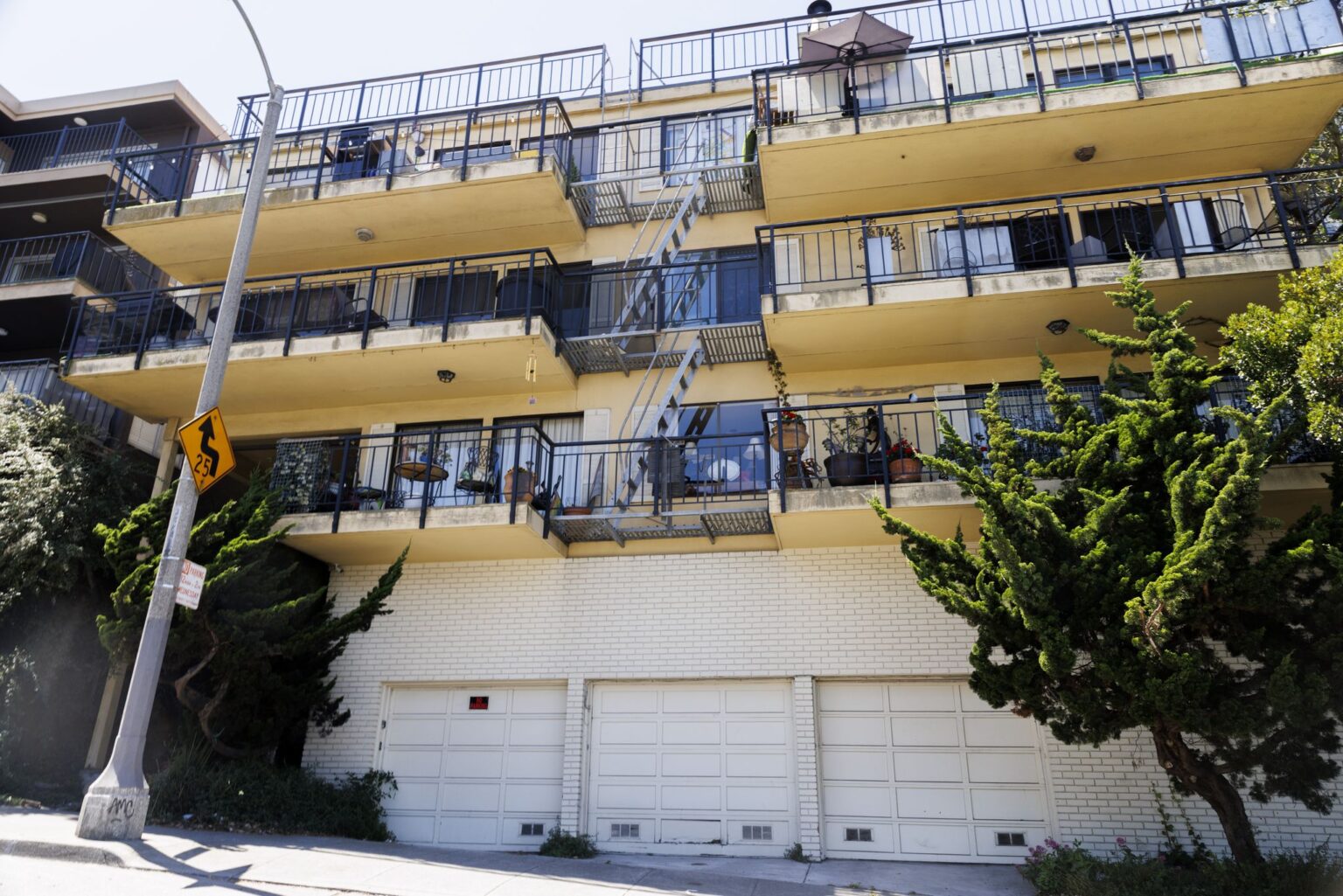
Long-term tenants of the building at 3450 Market St. in San Francisco say they enjoyed the space until a new landlord took over.
Santiago Mejia/S.F. Chronicle
The tenants of 3450 Market St. had loved living in the yellow brick and stucco apartment building perched partway up Twin Peaks.
The five-story complex had its faults: dingy hallways, fading paint. But its rent-controlled units featured sweeping views, garage parking and free cable. And for the residents of the five occupied units, it had been a tranquil place for a decade or more, where a hands-off landlord permitted custom renovations and tenants willingly took on much of the maintenance.
Then three years ago, a new owner, Laura Lee, took over the building. Within weeks, she scaled back trash services, ended free cable and asked all tenants to sign new leases, though they were not required to do so under San Francisco law. Failure to comply, Lee warned, could result in “just cause” evictions.
Article continues below this ad
The tenants feared that Lee was trying to force them out so she could charge higher rates or sell the building empty, making it more valuable.
But they didn’t know this was just the opening salvo in a now yearslong war over the building — part legal, part guerrilla — that illustrates the increasingly high stakes of San Francisco’s housing market and its strictly regulated world of tenant law. The conflict has stretched on three years, resulting in the tenants withholding more than $400,000 during a now-32-month-long rent strike.
The city’s eye-wateringly expensive rental market has long incentivized tenants to cling to rent-controlled units — and owners to force them out to reset rates. But the AI boom has supercharged that dynamic, pushing the median rent for a one-bedroom apartment above $4,000.
This particular fight would pit a group of highly motivated residents, armed with a new law protecting tenant unions, against a mysterious landlord who identified herself by different names and who they would learn had faced wrongful eviction lawsuits and allegations of forgery and criminal conduct.
Article continues below this ad
More lawsuits would be filed. Evictions attempted. Many times, police would wind their way up Market Street to referee what would become one of the longest local rent strikes in decades.
In a phone interview from Taiwan, Lee denied trying to force her tenants out of the building. Rather, they were trying to “take it over,” she said.
Lee, who is the managing member of the limited liability corporation that bought the building, accused the renters of lying, threatening her, sabotaging her efforts to operate the building and causing many of the problems they complained about.
“I didn’t do anything,” she said. “They just do what they want to.”
Ultimately, Lee said the tenants would either need to pay what they owe or move. “It depends on what the judge says,” she said, referring to one of the lawsuits she currently faces. She called their formation of a union “unlawful” and criticized the city’s robust tenancy rules.
Article continues below this ad
“It’s a very strange trait of society in San Francisco,” she said. “The lawmakers, the (Board of Supervisors), it’s a bunch of people who are renters, who themselves are not landlords. … They cannot step in the shoes of the landlord and understand.”
Gil Doron moved into 3450 Market St. in 2009 and by 2023 was paying about $2,300 a month for two bedrooms and two bathrooms.
A fast-talking tech worker in his 50s, Doron said he always mailed his rent check a week and a half before it was due. So when an unknown number texted him on July 1, 2023, asking for his rent, he was confused.
He soon learned his old landlord had died and the building had been sold to an Indiana-based LLC for roughly $3 million. Lee, Doron’s new landlord, wanted him to “pay today” using Zelle, the bank-to-bank transfer network, according to subsequent legal filings. If he did not, she would “take action.”
Article continues below this ad
Renters such as Gil Doron, who have lived in the complex for more than a decade, have accused their new landlord of tenant abuse and building neglect.
Santiago Mejia/S.F. Chronicle
Doron realized that Lee had visited his unit that spring while touring the building as a prospective buyer. A small woman with shoulder-length black hair who spoke with an accent and dressed in business attire, Lee struck Doron as rude: He asked her not to enter his sleeping roommate’s bedroom, but she barged in anyway, he said.
Doron paid Lee, who in text messages demanded fees for paying by check, which is illegal under San Francisco tenant law. But she soon came into conflict with other tenants, according to legal filings.
After Christopher Lee, a creative director and Castro bartender unrelated to the new landlord, complained about her request that he move some trash cans for her, she tried to raise his rent by $1,600. The city’s rent board later rejected the increase as a violation of rent control.
A few weeks later, Lee sent her message about new leases to the whole building.
Article continues below this ad
She announced she had closed the internal garbage chute and reduced trash pickups to “streamline” waste. She had cut the building’s cable, offering a $30 rent reduction to some tenants as a result — less than the more than $100 they would have to pay to continue service. And she wanted copies of vehicle registrations and Social Security numbers for everyone in the building, including roommates, spouses and young children. That, too, was illegal, tenant advocates said.
Farrah Sani pushed back. A buyer for Grocery Outlet who had lived at 3450 Market since 2006, Sani objected to providing Social Security numbers for her husband and then-3-year-old son. When she refused to reapply for tenancy, Lee called Sani’s relatives “unapproved occupants.”
“I have no idea who they are,” Lee told the Chronicle. “Do you think that’s fair? I own the building, not them.”
Christopher Lee shows water damage from a previous electrical light fixture in his apartment at 3450 Market St.
Giselle Garza Lerma/S.F. Chronicle
Lee raised Sani’s rent 8.5% by applying a “banked” increase that had not been imposed in past years, bringing her rent from about $2,800 to about $3,000. And she told Sani in a text message that she might have to “pay bk the TV service that u r never entitle to get it for free,” even though Lee hadn’t owned the property then.
Sani paid the new amount, but on Aug. 10, 2023, filed a petition with the rent board to lower her rent due to loss of services, which it granted. She also filed a preemptive wrongful eviction petition, citing threats by Lee.
Before Lee arrived, the tenants had been strangers. Soon, Sani, Doron and three other residents were chatting constantly in a WhatsApp group. They compared stories and communications from Lee and were convinced her plan was to drive them out of the building.
Lee denied this allegation. She sent Doron a “cease-and-desist” letter calling him a “chronic complainer” and demanding he stop discussing potential eviction.
Daniel Morrison, shown with his dog, Jordan, has been a tenant of the building for more than 20 years. “It really feels like home, and now I feel shaky and scared, I don’t know what’s going on,” he said.
Giselle Garza Lerma/S.F. Chronicle
The struggle felt existential. Daniel Morrison, a 64-year-old home health aide, had lived at 3450 Market since 2005, spending tens of thousands of dollars, by his estimate, to add chandeliers and a checkerboard marble floor to his first-floor apartment. Morrison couldn’t afford the current market, he said: “If I have to move out, I will probably have to move out of California.”
The tenants contacted the nonprofit Housing Rights Committee of San Francisco, which connected them with Tim Kelly, an eviction defense attorney, and suggested a novel strategy: banding together.
In 2022, city supervisors passed the Union-at-Home Ordinance, a landmark law requiring landlords to recognize and negotiate with tenant associations formed by residents of at least half the occupied units in buildings with five or more units.
Maria Zamudio, executive director of the Housing Rights Committee of San Francisco, estimated that her organization has helped tenants form unions in at least 80 buildings.
A little more than a month after Doron first heard from Lee, the five tenants filed paperwork to form the 3450 Market Street Tenants Association. Next, they emailed Lee to ask for a meeting.
But Lee consistently refused to meet with the union, messages show. She said its paperwork was incomplete and that she was treating everyone in the building as a subtenant who was “NOT APPROVED” under city law.
“To us, everyone in the building r 100% strangers,” Lee later wrote in a text message to the tenants.
The kitchen window of Farrah Sani, who has lived in the building since 2006 and is part of a lengthy rent strike.
Giselle Garza Lerma/S.F. Chronicle
While they waited for a meeting, the tenants alerted city building inspectors to problems. The building had water damage and mold. Inspectors visited in late August 2023 and observed the issues, later posting a notice of violation.
Around the same time, Sani texted Lee about one of the automatic garage doors, which didn’t work and had to be opened manually.
“Any normal or reasonable adult can manually lift a 1 car rolling garage dr. w/o extra help,” Lee responded.
If Sani was really concerned, Lee said, she should watch a YouTube tutorial and deal with it herself.
Tenants came to dread finding Lee in the building, sometimes accompanied by her daughter, a quiet woman in her 20s with long dark hair. Lee placed signs in the garage demanding tenants remove their cars. She installed surveillance cameras throughout the common areas. She roamed the halls in the middle of the night. That December, as Lee appeared even more frequently, tenants realized she had moved into the empty penthouse.
A few days before Christmas, Sani’s husband was rushing to drive their son to preschool when he found a bright green sticker obscuring the windshield of their 2006 Toyota Highlander. It warned that the car would be towed from where he’d parked behind the building after being unable to use his regular spot due to the garage door malfunctioning. He had to scrape the sticker off with a key, scratching the windshield.
Farrah Sani places a wooden stick in her son’s bedroom window due to a broken lock. “I feel like it’s a danger for him,” Sani says.
Giselle Garza Lerma/S.F. Chronicle
In an interview, Lee accused the tenants of parking in spots that weren’t theirs and blamed their lack of documentation.
“I post a sign and I put a sticker on the car because I don’t even know whose car is that?” she said. “I could tow right away, I don’t need to give (anybody) notice.”
Tenants again complained to the city about building conditions. On Dec. 27, 2023, inspectors visited and issued a notice of violation the next day, giving Lee 30 days to fix light fixtures and the garage door and add rodent proofing.
Initially, the tenants knew nothing about Lee. Then one night, after Sani put her son to sleep, she plugged Lee’s name into Google along with the Indiana address associated with the LLC where Lee told them to send rent checks.
She discovered one court case. Then another. And another.
“Holy s—,” Sani recalled thinking. “This woman is exactly who we thought.”
Lee didn’t have a footprint in San Francisco. But in Indiana, she was well known to authorities.
She had spent decades as a landlord accruing lawsuits, health code violations and allegations of improper management and criminal conduct.
Tenants place a notice of past and present alleged actions of landlord Laura Lee, who also used the name Laura Lei, in the 3450 Market St. apartment building.
Giselle Garza Lerma/S.F. Chronicle
Lee and trusts she was affiliated with owned more than 50 properties in Indiana, court records show. More than two-thirds had been cited for numerous health code violations, and multiple tenants had fought Lee, her trusts or her co-trustees in court over conditions at her properties.
Authorities charged Lee with operating an unlicensed trailer park and falsifying water quality records — though criminal charges were dropped after she completed a pretrial diversion program. A judge ordered Lee’s employee and frequent co-trustee, Kevin Hunter, to repay a tenant’s rent after finding she had removed the door to his room to make him leave the property.
Over the past decade, Indiana government agencies have sought more than $967,000 in fines against Lee or associated trusts, court records show. She has been charged with trespassing, criminal recklessness and falsely reporting a crime, though the misdemeanors were later dismissed.
In a consumer protection lawsuit against her, the state attorney general’s office accused Lee of operating under a slew of different names — Lei Zhao, Laura Falp, Laura Lee, Laura Zhao, Laura Lei and Laura Oria — to “obscure her ownership of various uninhabitable properties.”
In an interview, Lee said that the allegations in Indiana were “all fraud.” She described her alias as “an American name.”
“It really doesn’t matter,” she said. “Let’s see what the judge says.”
Indiana accused Lee of refusing to fix numerous health and safety issues, using leases that violated federal law by restricting the number of children in units, and requiring tenants to assume responsibilities for repairs.
An Indiana property owned by a trust affiliated with Laura Lee had fallen into disrepair, with a hole in the bedroom roof “where large possums and raccoons could enter,” according to a lawsuit.
Marion County Public Health Department/Marion County Public Health Depa
She was accused of renting out a home with a hole in a bedroom roof, “where large possums and raccoons could enter.” When a renter at the property told Lee that her child had suffered lead poisoning and became nonverbal, the attorney general’s lawsuit alleged, Lee told the renter that “she could receive ‘money’ — presumably government benefits — for having a child with special needs.” After the renter left, she went on to rent the home again, the lawsuit alleged.
In a separate lawsuit, the city of West Lafayette sued Lee and Hunter’s trust for renting properties without properly registering or inspecting them, and won a nearly $350,000 judgment in the case. The trust’s appeal was ultimately denied.
Lee has refused to pay fines and repeatedly stalled proceedings, often by claiming she was improperly served subpoenas or other legal documents, or by hiring new attorneys shortly before court hearings, forcing continuances.
When she learned of Lee’s history, Sani said she felt vindicated — and scared.
She texted her landlord in late December: “Now I understand who you are.”
Just before 3 a.m. on Dec. 29, 2023, Doron awoke to a frantic phone call from Sani’s husband.
Lee had called a tow truck, which was idling outside, already tethered to one of their vehicles. Half asleep, Doron jumped into a pair of shorts and raced outside barefoot to confront Lee, according to legal filings and video shared with the Chronicle.
Doron and Lee traded denunciations in the dark, both holding up phones to record the exchange.
“Stay away!” Lee yelled, dialing the police from a second phone.
“Why? You threatened me,” Doron shouted back, walking toward the landlord.
During the altercation, according to a video shared by Lee, Doron held a hammer, which Lee called menacing. Doron said he grabbed the hammer in the heat of the moment while running outside, unaware of what he would find. He later apologized to Lee, he said, and regretted the action.
“It was crazy that night,” he said.
Eventually the police arrived, and the tenants persuaded the tow truck driver not to take their vehicles.
Within hours, the tenants had made up their minds.
“I cancelled my January payment,” Doron wrote in the tenants’ WhatsApp group. “Please tell me if everyone else is.”
Tenant Gil Doron shows where a garage door is broken and stays open in the property at 3450 Market St.
Santiago Mejia/S.F. Chronicle
Tim Kelly, a tenants’ rights attorney representing the residents through the Housing Rights Committee, had planned to attend “Nutcracker” with his wife and children the next day. Instead, he left them downtown to watch the show, and drove up Market Street.
After the confrontation, Lee had changed the door code to one of the other garages, blocking access to their vehicles. Kelly texted Lee a warning. She needed to restore access to the garage or her tenants would sue and withhold rent.
“If a bully is trying to shove your head in the toilet,” Kelly said, “the first thing you do is stop giving them your lunch money.”
The tenants figured out how to reprogram the garage door keypad, and Kelly tore down the “No Parking” signs Lee had placed, leaving them on the doorstep of the penthouse unit.
“Don’t block (the) garages!!” he wrote in a text message, including a photo of the tattered sign.
Lee responded that it was the tenants who had actually blocked her access to the garage.
“This is unbelievable & out of control,” she wrote.
Kelly, a 42-year-old former teacher with a lean rock climber’s build, compared a rent strike to his recent ascent of Half Dome. “The consequences are high if you f— up,” he said. “But if you are doing the basics to protect yourself, it’s fairly safe. Eviction defense is the same.”
Under California law, landlords generally cannot demand rent when serious health or safety violations cited by inspectors go uncorrected for more than 35 days without good cause.
He advised the tenants to put their rent into escrow, because if they reached a settlement with Lee they would still probably have to pay her at least some of the money they’d withheld.
Kelly spoke from experience. He’d helped tenants wage a successful, yearslong strike against Veritas, once the city’s largest landlord of rent-controlled properties.
Tenants who contest an eviction by filing a legal response, demanding a jury trial and paying the required jury fee are very unlikely to lose their homes, Kelly said.
Over his career, Kelly estimated, he has defended 350 clients facing eviction proceedings. None has ever been evicted, he said.
Eviction defense attorney Tim Kelly, shown outside of the San Francisco Civic Center Courthouse, has helped the tenants band together.
Jessica Christian/S.F. Chronicle
Advocates for landlords agree they are operating in unforgiving terrain. The city’s rental ordinances, created in the 1970s, are widely seen to favor tenants, and sometimes criticized for creating an environment that encourages aggressive buyouts, maintenance issues and an adversarial relationship between organized tenants and corporate property owners.
Charley Goss, a spokesperson for the San Francisco Apartment Association, which represents owners, said the city can be a challenging place for landlords, with complicated laws they need to master and regulations that favor renters.
“Someone potentially could do things that they might do in Indiana, and find themselves in trouble,” he said.
In the days after the towing skirmish, Kelly warned Lee.
“You are woefully unprepared for the metaphorical brick ton of litigation I’m about to dump on you,” he wrote in a text message Dec. 31, 2023. “Happy New Years.”
The week after tenants began their rent strike, Lee served Doron with a “notice to pay rent or quit,” a step toward eviction. He shared it with the group chat.
“You have nothing to worry about since there is the NOV on the building,” Sani responded Jan. 8, 2024, referring to a notice of violation from city building inspectors.
After Lee formally filed an eviction lawsuit against Doron, Kelly argued in court that Lee had submitted the paperwork in the name of a trust, which can’t be a party to a lawsuit. When Lee’s lawyer tried again, Kelly challenged the filing on other grounds and got the case dismissed.
Then he filed five lawsuits against Lee on behalf of the tenants of each of the occupied units, arguing she was violating the city’s rent ordinance and in breach of contract.
In San Francisco, only one court handles evictions, meaning that if a slew of tenants demand jury trials — a tactic Kelly uses often — it creates a bottleneck that makes it challenging and expensive for landlords to evict tenants.
“It’s unparalleled in its effectiveness,” Kelly said. “For like $600, max, you can create a $30,000 minimum impediment before a landlord can try to evict someone. If you do it at scale, it is absolutely crippling.”
In early March, Kelly sent Lee an email attempting to resolve the standoff, asking her to reduce rent for the three months tenants had struck, fix the building violations and refrain from entering tenants’ units or garage areas without permission. The tenants also requested an in-person meeting “to agree on key points of landlord-tenant relations going forward.”
Lee rejected their terms and demanded all outstanding rent.
That month, Doron returned from a trip to Mexico to find his shower backed up with feces, spilling down the hallway to his bedroom. When he told Lee, she accused him in a text of lying about his trip to Mexico and colluding with Sani to jam the pipes. She demanded Doron’s boarding pass as proof of the trip and forbade him from initiating any building maintenance himself.
“Unfortunately & Obviously, this seems like an intentional man-made drain WIPER clog incident, it’s 100% avoidable,” Lee texted. “Beside it might be a well pre-planned & done on purpose repair scam on the building owner.”
Doron said he hired a plumber himself, spending about $1,000 to fix the issue.
For months, the legal standoff dragged on due to what Kelly called a game of “service tag.”
Tenants struggled to officially serve Lee with subpoenas, preventing the case from moving forward. She disappeared for months at a time, they said, and avoided her residents by reprogramming the elevator so it would go only to her penthouse floor, which led inspectors to red-tag it.
To assist her, Lee hired a building manager named Kevin Eugene. The tenants discovered he was the same Kevin Hunter who had worked alongside Lee in Indiana.
Still, during Lee’s absences, Sani said, “The joke around the building would be, ‘It’s so peaceful.’”
Tenants of at 3450 Market St. say the numerous cameras installed in common areas this year have been used to spy on them.
Santiago Mejia/S.F. Chronicle
But Lee’s cameras were always watching. Tenants said the lenses could peer into their apartments when their doors were open, including the bedroom of Sani’s son. That August, they covered the lenses with posters of Lee’s face and her daughter’s, emblazoned in large red letters with the word “slumlord.” Lee filed a police report in response.
At the same time, Lee told her tenants they would either have to turn over or remove cameras they had previously installed on their doorbells in response to repeated burglaries in the building.
“There will b no private cameras allowed inside of the common areas of this 3450 Market St building (with no exceptions),” Lee told the tenants in a text message Aug. 9, 2024.
When the tenants complained of additional issues in the building, including rodents, Lee texted them back: “Stop fabricating rat issue & all evil intended behavior.”
In an interview, Lee accused the renters of lying about the issue. When she hired exterminators, she said, they couldn’t find any sign of vermin. “There’s no trace of the mice,” she said. “I had a professional come in, and they all believe there’s no mice unless somebody (brought one in.)”
After failing to meet with Lee and struggling to move their lawsuits forward, Sani and her neighbor finally cornered Lee as she escorted an exterminator into the building. When she led him into the elevator, despite the red tag, Sani and her neighbor flung the subpoenas in after her.
“You’ve been served,” they yelled, Lee glaring at them as the elevator door closed.
Lee disappeared from the building the next day. She later contested the subpoenas by saying she hadn’t been properly served, a claim the court rejected.
As the 3450 Market Street tenants battled with Lee, she continued to fight multiple lawsuits in Indiana. After Lee failed to respond to the attorney general’s lawsuit, an Indiana judge issued a default judgment against her, barring her from unlicensed management of trailer parks; from engaging in real estate transactions without proper paperwork and inspections; and from using false names and pseudonyms during real estate dealings.
The judge also ruled that her leases were unenforceable and ordered her not to conduct real estate business without proof that her rental units had been independently inspected and complied with health and safety codes.
“I’m not going to talk more about that since it’s all fraud, it’s government fraud,” Lee said in an interview. “Just wait until the case is settled.”
In the Indiana attorney general’s lawsuit, Lee has asked a judge to set aside the default judgment entered against her. During a July 29 video hearing, Lee refused to tell the judge where she was, prompting him to strike her testimony from the record.
Last December and this January, the skirmish at 3450 Market St. erupted again.
Both sides called police repeatedly to mediate disputes, records show. Tenants accused Lee of tampering with their belongings in the garage and gluing notes onto their doorbell cameras, ordering their removal.
On Jan. 15, Lee called police to accuse tenants of twice covering an intercom buzzer with tape, activating the loud intercom in the penthouse until she went outside and removed it.
Video confirmed Lee’s account, police found, concluding the tenants “maliciously and willfully” disturbed her.
In an interview, Lee also accused Kelly of destroying one of her cameras.
Kelly declined to respond to the allegation, but said it was illegal to set up a camera that looked into a tenant’s unit.
“It’s a war,” he said. “We are Ukraine, and she is Russia. There are atrocities on both sides. It’s absurd that this is continuing this far.”
Lee’s eviction cases against her tenants remain at a standstill. The tenants have now gone more than 32 months without paying rent, withholding upward of $412,000, Kelly said. At the end of July, several violation notices decorated the building’s entrance.
If Lee brings the building up to code, Kelly said, she could seek to restart the eviction process, but would be able to claim rent only for the past year.
Lee has told the tenants they are welcome to leave. In doing so, she said in a text message to them, they would “voluntarily end the hell that (they) claimed to artificially ‘suffer’ by living there for FREE.”
Doron and his fellow tenants aren’t interested.
“I’m going to stay here,” Doron said, “and make her life as miserable as possible as long as she owns the building.”