
Earlier this year, Thomas Givens couldn’t answer the question of what he envisioned for his future. The 26-year-old had been involved in West Side street life for more than a decade and a half, had seen and felt the consequences of gun violence time and time again.
So that age-old ask of who he wanted to be when he grew up wasn’t something Givens had really considered before.
Lately, though, he’s been giving more thought to the idea. A year out, to start.
A pair of Chicago organizations have teamed up to help those most vulnerable to street violence prioritize a positive path forward by giving them a chance to create their own personal time capsules. The initiative — a collaboration between anti-violence organization Chicago CRED and local nonprofit Living Record — invites participants to stop and think about who they are and what’s to come, to envision what they want their relationships, their lives and themselves to look like in a year.
The time capsules are a product of weeks of hands-on exercises, from crafts to conversation.
The venture is an extension of a program launched during COVID-19 that initially helped kids make sense of the health crisis through time capsules that told their pandemic stories. Several iterations of the idea have since taken shape, expanding to refugees, students with intellectual and developmental disabilities, seniors with chronic illness.
Last summer, organizers began employing the concept for violence prevention and intervention, as community members and stakeholders continually seek new ways to combat pervasive gun violence. Since launching the new application just over a year ago, organizers say they’ve seen an impact. It’s in the tangible work, yes, but it’s also in participants’ dialogue, in how they connect and find joy in something as simple as crafting a vision board.
“(There’s so much) difficulty and challenge in their every day,” Living Record founder Stacey Gillett says. “What we’re wanting to do is help them say, this is a moment. This is one small moment in the longer arc of your story.”
Since 2020, Givens has lost two of his best friends to gun violence. He wants a different path for himself — prays every day he’ll be able to take care of his family. Working with Chicago CRED and Living Record, he says, has helped him concentrate on that future.
“I was focused on just making sure everybody else around me straight,” he said. “But I gotta focus on what’s gonna make me happy.”
It was back in 2021 when Gillett and her friend Stephanie Hodges, two Chicago moms with backgrounds in community development, saw a need in the city for some reflection. A year into the pandemic, the two women watched as the uncertainty and fear and toll of the emergency went documented month after month, but they felt a voice was missing from the conversation: kids.
Not that the impact on younger generations was going uncovered — certainly parents, educators and officials spoke out. But Gillett and Hodges wondered what the city’s youngest would say in their own words about what they were going through. So they asked.
The women launched a citywide initiative aimed at capturing that experience. Thousands of young residents were invited to create time capsules that embodied their lives during the pandemic and their aspirations for the future. Their stories were told through drawings, comic books, artwork, photographs, letters, even puppets. Collected capsules were then stored across the city, where they’ve remained for the past five years. Organizers are just starting to open those initial capsules up.
In the meantime, the operation has grown. The concept of a time capsule, Gillett and Hodges realized, is a well-worn tradition but when used effectively, can act as far more than an artifact.
“(It) actually can be a very powerful framework and tool for … processing (and) sharing who you are, what you value, what you think is important,” Gilllett said.
And through all that introspection, she continued, “you (also) have this forward-looking orientation, (knowing) this time capsule is going to be opened in whatever number of years — who do you want to be at that time? Where do you hope the world is at that point? How are you going to start to get there?”
Gillett turned the initiative into a full-blown organization called Living Record, and began expanding its reach. Two years ago, Living Record started a network to help teachers across the country implement the time capsule program in their own classrooms.
Earlier this spring, the organization worked with Chicago Public Library to establish an interactive installation at the newly opened Obama Presidential Center that invites visitors to document life in America today and what they hope the country will become.
A board member for Living Record suggested partnering with Chicago CRED last year. The collaboration fit with the organization’s larger programming, a holistic approach to interrupting violence that spans anything from conflict resolution and counseling to job training, according to Javon Grimes, a life coach at CRED.
Most CRED participants hail from the city’s South and West sides. Nearly everyone that comes through the organization is considered at high risk of gun violence involvement.
“Most of us,” Grimes said, “we don’t get an opportunity to dream.”
Givens was 9 years old when street life started to seep into his own. He said he’s been shot multiple times since he was a teenager.
“The streets was taking a lot from me,” he said. For nearly three months now, though, he’s been involved with CRED. He’s also a few weeks into making his time capsule.
Staged in small cohorts, the CRED capsule projects are created over the course of weekly hour-and-a-half-long sessions led by the Living Record staff. Capsules are completed after a total of 10 weeks. The projects are stored and opened after a year. The very first CRED cohort is set to open their capsules this fall.
Living Record — which tailors its programming to the different populations it works with — chose a one-year time capsule for CRED participants because “they’re all dealing with a lot of instability,” Gillett said. So a shorter time frame presented a more palpable chance to set some real goals participants could follow up on.
Each session starts with the same task: catch. The young men pack into a small classroom in West Town, stand in a circle and, one by one, pass a ball from person to person. With each throw, they say the next person’s name. They go around and around, until attendees are thoroughly introduced. It’s not a perfect system — tosses are overshot, catches go empty-handed.
But the men are quick to laugh off any slips of the wrist. It’s a bona fide icebreaker, before the work to come.
Topics and exercises change from week to week, each in service to filling their capsules. They talk relationships, identity, future goals. Discussion is accompanied by art-based projects on theme with the day.
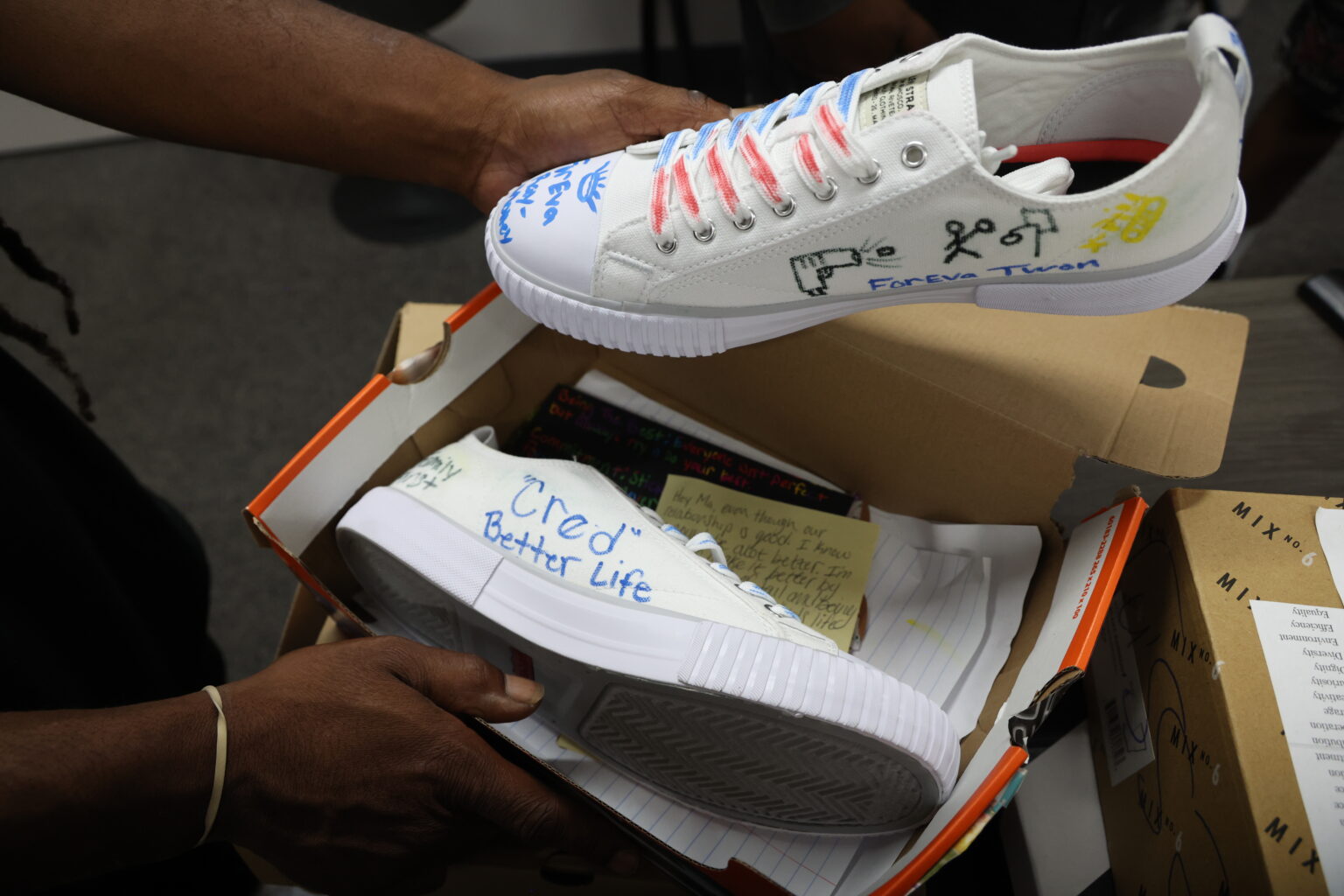
Though adapted to CRED, the programming still retains that tactile, imaginative approach that Living Record first used to engage kids during the pandemic. Participants make vision boards out of magazine clippings and shoe boxes, write letters to their future selves etched in marker.
“Wisdom,” one person scribbled on the inside of their shoe box. “Better life.”
The idea is to help participants tap into their inner child, to give them some time when they can just take a break and process without the pressure of heavy instruction.
“There is a large … amount of joy and life that is taken away from people that are system-impacted,” Living Record teaching artist Kevin Aoussou said.
Aoussou, who has helped lead Living Record’s work at CRED since the pilot program began, said every time he teaches, his sole goal and intent is to “bring joy back into this space, so people who have been dehumanized” can have a moment of fun and don’t feel like they have to worry. There’s a vulnerability in that too, Aoussou added, in asking participants to share a space and create together, to do something that they maybe haven’t done before. That gives way to more open conversation.
“Our sessions are about, hey — where are you right now? Where would you like to be? And let’s have a joyful time talking about it,” Aoussou said. “Because the reality is, when you’re trying to figure out how to get out of a tough situation, you’re always thinking about it. And it’s not a fun thing to think about.”
Semaj Shines still finds himself just trying to get through the day. It was two years ago that Shines, 24, was introduced to CRED through a friend. He fell in love with the organization and its work.
Shines has lived day by day for as long as he can remember, since he was a kid growing up in North Lawndale. His community isn’t one that sees a lot of investment, he said. He was in elementary school when he heard gunshots in his neighborhood for the first time.
“You gotta worry about where the next meal is going to come from,” he said, “how you going to buy your next set of clothes.”
But CRED and, in tandem, Living Record have helped him take a beat.
Shines went through the time capsule program for the first time last year. He doesn’t often get a chance to just sit down and work on an art project these days. It helped him connect, with himself and with peers going through something similar.
Shines is now an ambassador for CRED. He works with younger teens. He’s also helped propel the time capsule initiative forward, helping Aoussou and instructors teach new cohorts.
Grimes, the CRED life coach, said Living Record’s work with the organization has been immeasurable.
“The more we try to save some,” he said, “the more they’ll be able to save others.”
At a session on a recent weekday morning, the topic of the day was trust. Participants weighed if they had someone in their lives that they trusted, considered what it means to be and have a good friend, whether they have a difficult time trusting others. Then they were each given a foam figure and asked to make someone that they either trust or someone that trusts them. Equipped with cloth, markers, string and paper, the men fashioned their support systems with scissors and glue.
Givens made his brother. Tyshawn Tousant-Gill made his older sister.
Tousant-Gill started with CRED, and with Living Record, this summer. Recently incarcerated, the 21-year-old said he grew up around gun violence, remembers people close to him dying. Thinking a year out, even being able to envision that far ahead, is a testament to his growth, Tousant-Gill said.
“Not too long ago … I wasn’t really thinking about that,” he said.
He can’t wait to see how his mindset has changed in a year.
Asked what change he hoped to see, Tousant-Gill said he hopes that he’s back in school and focusing on himself.
He hopes he’s stable.