

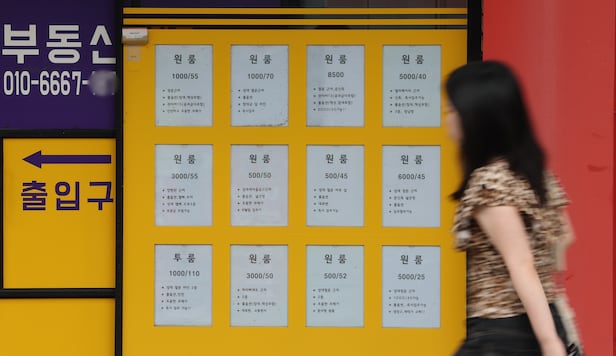
 Monthly rents for one-room apartments are posted at a real estate agency in front of Sungkyunkwan University in Seoul. /Courtesy of Yonhap News
It was notable that people entered Seoul alone and left Seoul as two or more. Last year, about 22,000 households that moved to Seoul alone were a net inflow, while households that moved with two or more people were a net outflow of about 19,000. Most of this net outflow went to Gyeonggi and Incheon. The growing housing cost burden in Seoul when finding a larger home for a family is cited as the reason for the moves.
According to the Seoul Institute’s “Seoul Urban Master Plan Monitoring Report 2025” on the 7th, last year about 326,000 households moved to Seoul alone, and about 304,000 households left Seoul. In-migration exceeded out-migration by about 22,000 households. In contrast, among households moving with two or more people, about 42,000 moved in and about 61,000 moved out, for a net outflow of about 19,000 households.
The difference was even clearer in movements with Gyeonggi and Incheon. Households of two or more moving from Gyeonggi and Incheon to Seoul numbered about 32,000, but those moving from Seoul to Gyeonggi and Incheon numbered about 50,000. In effect, about 18,000 households were a net outflow to Gyeonggi and Incheon.
 Passengers board a subway bound for Gimpo Airport Station at Geolpo-bukbyeon Station on the Gimpo Gold Line in Gyeonggi Province. /Courtesy of News1
There are also differences in living space between Seoul and Gyeonggi and Incheon. In 2024, the average residential area per household in Seoul was 60.8㎡, which was 11.2㎡ smaller than Gyeonggi’s 72.0㎡. Incheon was 68.1㎡.
By dwelling size, 49.5% of all dwellings in Seoul were small homes of 60㎡ or less. Dwellings over 60㎡ and up to 85㎡ accounted for 30.4%, lower than Gyeonggi and Incheon’s 38.8%. However, it is difficult to pin down the reason for the out-migration of households of two or more based only on regional average area and dwelling composition.
Lee Yong-gak, an adjunct professor at Konkuk University’s Graduate School of Real Estate, said, “People living alone have strong demand to live near their workplace or school, while newlyweds and others need larger living space, increasing the housing cost burden.” This, he said, leads to a tendency to move to Gyeonggi and Incheon, where home prices are relatively lower.
Lee said, “If redevelopment and reconstruction supply in Seoul increases, the phenomenon of two-person-or-more households leaving Seoul will be eased to a considerable extent.”
※ This article has been translated by AI. Share your feedback here.