
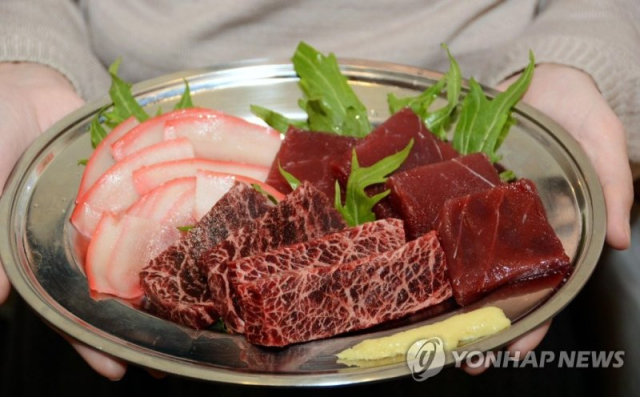
 A file photo of whale meat. Yonhap News
Meat from whales designated as protected marine species — which cannot legally be caught or sold in South Korea — is being served openly at restaurants, according to a lawmaker’s findings.
Rep. Yoon Jun-byung of the Democratic Party of Korea, a member of the National Assembly’s Agriculture, Food, Rural Affairs and Oceans and Fisheries Committee, said on the 6th that DNA testing conducted with the Korean Federation for Environmental Movements found protected whale meat at seven of 27 outlets examined, or 26% of the sample. The 27 were drawn from 115 whale meat vendors nationwide identified by the Ministry of Oceans and Fisheries.
The protected species detected were sei whale in five samples and Bryde’s whale and fin whale in one each. All seven restaurants where protected species turned up were operating in Busan.
Under the Marine Ecosystem Conservation and Management Act, protected marine species cannot be caught or harvested, and the processing, distribution and storage of dead specimens are also strictly prohibited. Minke whales caught incidentally during lawful fishing operations may be sold after set procedures are followed. Minke whales sometimes fetch more than 100 million won ($70,000) per animal at auction, earning them the nickname “the ocean lottery.”
The current system for overseeing whale meat does not connect the stages of distribution. Whales taken as bycatch pass through a coast guard investigation and an auction run by the fisheries cooperative, and DNA samples from each animal are registered with the National Institute of Fisheries Science. But there is no deadline for completing the analysis, making prompt comparison with meat on the market impossible. In this survey as well, 20 minke whales were individually identified, but the genotype data was not fully linked, so investigators could not immediately check whether the meat came from lawfully auctioned animals.
Illegal hunting also continues. Korea Coast Guard data show 33 cases of illegal whale hunting were uncovered from 2022 through August of this year, with 148 people taken into custody. The cases involved 52 whales. Among those caught, 25 offenders had been caught again for the same or similar acts, and 13 fishing vessels had been used again for illegal hunting before being caught.
Calls for a Whale Meat Tracking System
The coast guard, meanwhile, has said it does not separately track its enforcement against illegal distribution at whale meat restaurants and retailers over the past decade.
“Illegally caught whales keep turning up at sea, and meat from protected marine species is being found openly in the market, yet the oversight systems of the oceans ministry, the coast guard and the whale research institute each operate on their own,” Yoon said. “If the DNA information obtained at the auction stage is not carried through to the final point of sale in real time, illegal whale meat cannot be screened out.”
“Whales should be approached from the standpoint of protecting marine life, not simply as a fisheries resource,” he added. “Along with prompt deliberation on a special act on the protection and management of marine mammals — which would require sales facilities to register, mandate regular inspections and restrict processing and distribution for human consumption — a complete tracking system running from capture to the dinner table must be built.”