
Many believe that sourdough is the definitive San Francisco food. Some suggest that it’s Dungeness crab. Others might argue that it’s garlic noodles or cioppino. They’re all wrong.
The city’s answer to New York pizza, Philly cheesesteaks and Nashville hot chicken, the burrito inspires tribalism in the Bay Area like no other, fueling infinite bickering about the biggest, the cheapest, the most tightly rolled. Burritos are self-contained meals that are synonymous with the Mission, the historic Latino barrio that birthed the region’s burrito culture and prevailing style: the Mission burrito. It appeals to locals and tourists; NIMBYs and YIMBYs; techies that moved to the neighborhood after the tech boom (take your pick) and organizers fighting gentrification. In a city defined by perpetual change, the burrito is a rare constant.
Article continues below this ad
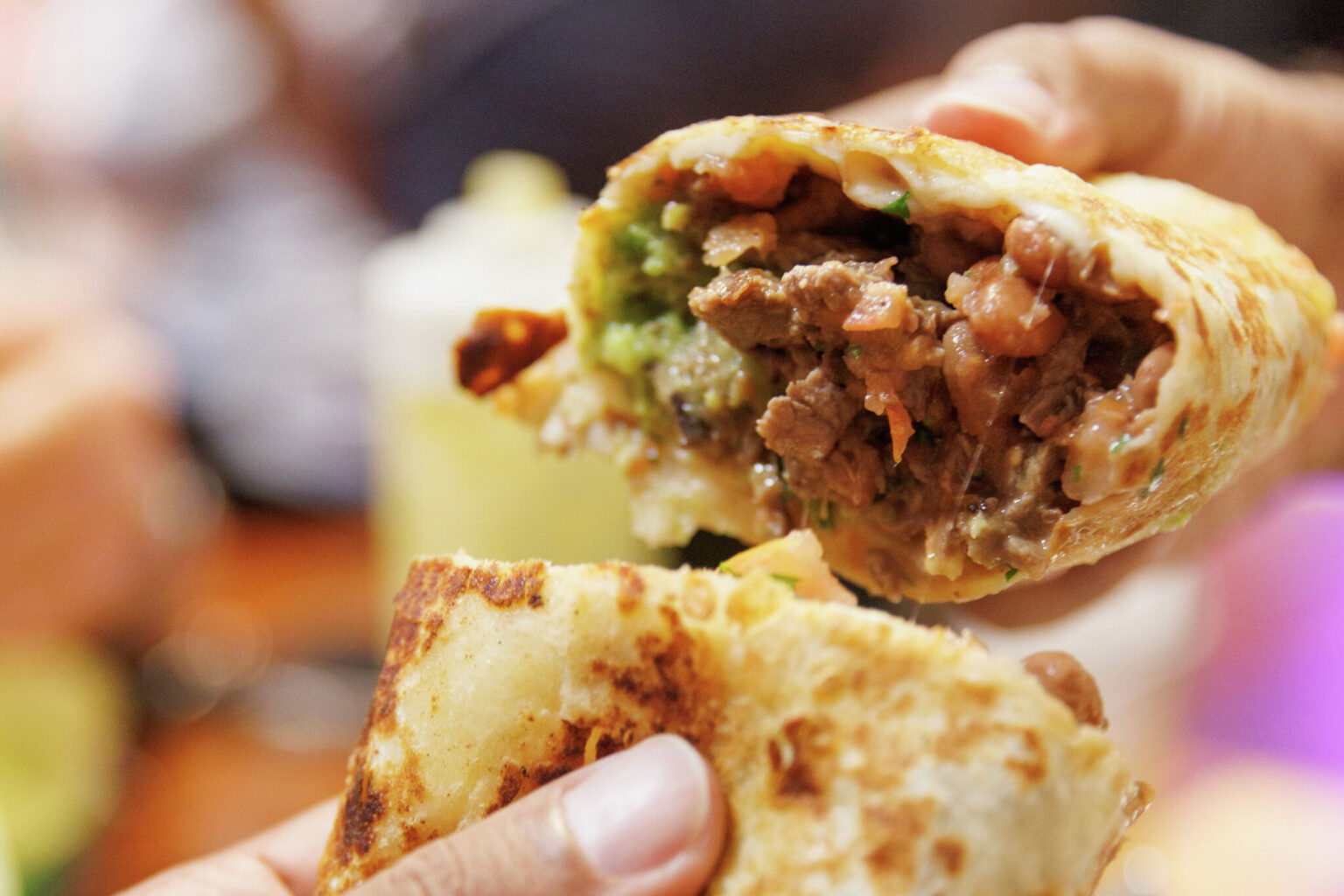
La Taqueria’s bestseller is the carne asada burrito, which is made with choice-grade top sirloin steak — an upgrade from the diezmillo (chuck) found at the average burrito spot.
Santiago Mejia/S.F. Chronicle
In the last five years, I’ve eaten enough burritos to build a skyscraper that could eclipse the Salesforce Tower, and in my experience few, if any, are as distinctive as the ones made by La Taqueria. A La Taqueria burrito is as timeless as any of the city’s landmarks. If forced to choose between the Golden Gate Bridge or La Taqueria’s carne asada burrito, I hope Marin County residents enjoy the ferry.
Burritos reveal a distinct tension in San Francisco: They give cultural identity to the city and make neighborhoods such as the Mission an attractive place to live, which, in turn, makes those communities a target for displacement. The tech industry is the biggest driver of gentrification in the Mission, where coders and creatives largely settled during the first and subsequent tech booms. U.S. Census data indicates that the Mission saw a nearly 15% decrease of its Latino (“Hispanic”-designated) population from 2010 to 2020, while the median income went from $77,500 in 2015 to about $148,000 in 2024, according to the American Community Survey. In that time, the burrito has transformed from a working-class food to one that costs roughly $12 at most spots; more than $15 at many; and beyond $20 at a handful.
Older Mission District taquerias, El Faro and La Cumbre, both lay claim to the creation of the Mission burrito with oft-repeated origin stories, but only La Taqueria has become more relevant than ever. And while newcomers may feature more refined fillings and techniques, La Taqueria’s burritos still consistently outperform the competition. It remains an anchor in the itineraries of visitors because it is among our very best burrito diplomats. More than anywhere else, La Taqueria makes clear that burritos demand celebration and that the barrio forged the burrito culture of the region — the entire country, really.
The interior of La Taqueria is half monument to the restaurant’s storied success, with a gallery of accolades under the glow of its neon sign, and part art gallery, with a mural that spans an entire wall.
Santiago Mejia/S.F. Chronicle
Left: General manager Julietta Martinez, center, like many on the staff, is a longtime employee — 40 years, in her case.
Right: To visit La Taqueria is to wait in line. But it moves quickly, and diners are guided every step of the way after reaching the door.
Photos by Santiago Mejia/S.F. Chronicle
Above: General manager Julietta Martinez, center, like many on the staff, is a longtime employee — 40 years, in her case.
Below: To visit La Taqueria is to wait in line. But it moves quickly, and diners are guided every step of the way after reaching the door.
Photos by Santiago Mejia/S.F. Chronicle
Owner Miguel Jara, a Casanova-like figure known to hand out roses to women, opened La Taqueria in 1973, and from day one, the inside of his burritos have never seen a grain of rice. Some say that the omission prevents it from being a “true” Mission burrito — defined, according to those parameters, by a shield-sized flour tortilla wrapped around a base of meat, beans and rice, with the default for many being a “super,” shorthand for the addition of guacamole, sour cream and cheese — but that label is an external categorization. “I didn’t call it the ‘Mission burrito,’ the people who write about La Taqueria gave it that name,” Jara said. “To me, it’s just a burrito.” (Jara, originally from Jalisco, grew up in Tijuana, where burritos are also riceless; he claims it had no bearing on his burrito. “It’s my style, which is neither from Tijuana or Jalisco.”)
Article continues below this ad
Harmony can be elusive for the Mission burrito, especially supers, as some spots pile on excess without consideration of distribution, resulting in a roulette of clashing bites: a chilly patch of sour cream in one, mushy rice in the next and dry, mulchy carnitas in another. The glory of La Taqueria’s burritos is in the simplicity of its riceless construction — meat, beans, salsa. Without rice, they gain a lucidity that heightens the homey tenderness of slowly stewed pinto beans, the juiciness of carne asada that actually tastes like fire, the sting of salsa verde.
La Taqueria offers a half dozen fillings, including bouncy lengua, vinegar-spiked chorizo (made in-house) and carnitas, the filling that won first place in FiveThirtyEight’s much-discussed national burrito bracket in 2014. But none come close to carne asada, which is justifiably the bestseller. Jara, who previously owned a butcher shop, prizes quality beef, so the restaurant uses choice-grade top sirloin steaks, an upgrade from the diezmillo (chuck) found at most taquerias.
Left: Like every other taqueria in the Bay Area, La Taqueria uses pre-made flour tortillas, which it sources from Tortilleria Ozuna.
Right: The steaks are seasoned with salt then brushed with “sabor,” or flavor, a baste made of garlic, tomatoes and onions.
Photo by Santiago Mejia/S.F. Chronicle
Above: Like every other taqueria in the Bay Area, La Taqueria uses pre-made flour tortillas, which it sources from Tortilleria Ozuna.
Below: The steaks are seasoned with salt then brushed with “sabor,” or flavor, a baste made of garlic, tomatoes and onions.
Photo by Santiago Mejia/S.F. Chronicle
My affinity for the asada derives in part from the exhilaration of seeing the kitchen’s intricate machinery: The parrillero (grill cook) drapes thick beef slabs over a gas grill that’s layered with lava stones beneath the grates to convincingly simulate the taste of a charcoal grill. He hits the sizzling steaks with salt, then brushes them with “sabor,” or flavor, a baste made of garlic, tomatoes and onions.
If it’s your first time at La Taqueria, go with the asada super burrito dorado ($16.20) — the latter tells the kitchen you want it griddled in oil, like a shallow-fried chimichanga. (“Dorado” used to be a complimentary off-menu designation, but it officially joined the menu this summer for 25 cents.) The toasting reinforces the structural integrity of the tortilla and re-equalizes the heat distribution following the addition of cool crema and avocado. The resulting interior is a molten hash of jack cheese, smoky bits of beef, toothsome beans, buttery avocado and tangy cream, finished with a dab of smooth, prickly salsa verde.
Article continues below this ad
For years, the asada super dorado was my go-to, but lately I’ve come around to the standard asada burrito as the ideal. Without the extra inclusions of the super, the burrito is smaller, but it has superior clarity of flavor. It’s elemental, just the creaminess of the home-style pinto beans and the beef’s taste of live flame, enlivened with the mellow freshness of pico de gallo. The weakest element at La Taqueria tends to be the latter, a stock addition for nearly everything on the menu, but in the standard burrito it’s all but required for balance. This is a time-tested blueprint that feels as fresh today as I imagine it did 53 years ago.
Arguably the defining feature of La Taqueria’s burritos is that, unlike most Mission-style burritos, they do not include rice.
Santiago Mejia/S.F. Chronicle
Like virtually every other taqueria in the Bay Area, La Taqueria uses pre-made flour tortillas, which it sources from Tortilleria Ozuna, and they are more functional than flavorful. I can count the (mostly inactive) taquerias in the Bay Area that use freshly made tortillas on one hand. Would using a better tortilla improve the quality of the burrito? Certainly. But it would also force prices to rise, making it less accessible to the community.
Longtime patrons will tell you that before burritos became the draw, tacos were the move. Sadly, they’re soggy and the moisture causes the doubled-up corn tortillas to disintegrate. To make them viable, order the super tacos, loaded with the works (including beans), but request them dorado, which replaces one of the tortillas with a fried one covered in melted cheese. These aren’t tacos like you’d find on Mission Street — they’re a La Taqueria specialty: palm-sized, indulgently over-stuffed and undeniably delicious.
In the constantly changing Mission District, La Taqueria, and its long line, seems to be a fixed point. To visit La Taqueria is to wait in line. It is both deterrent and enticement — are you in or out? Jara claims La Taqueria has known lines opening day, even though, he said, the Mission was “decaido,” depressed, in 1973 as the “trench and tunnel” construction of the then-soon-to-open BART station on Mission Street left long-time merchants devastated.
Article continues below this ad
Left: Tacos are best ordered as “super,” loaded with the works, and dorado — which replaces one of the tortillas with a fried one covered in melted cheese.
Right: Chips with avocado and pico de gallo are one of La Taqueria’s vegetarian options.
Photos by Santiago Mejia/S.F. Chronicle
Above: Tacos are best ordered as “super,” loaded with the works, and dorado — which replaces one of the tortillas with a fried one covered in melted cheese.
Below: Chips with avocado and pico de gallo are one of La Taqueria’s vegetarian options.
Photos by Santiago Mejia/S.F. Chronicle
What keeps people coming back to subject themselves to the line, beyond the promise of San Francisco’s defining food, is an efficient system and a gracious staff. On average, I waited no less than 10 minutes and no more than 25 minutes to place an order, then another 15 minutes to get my food. Unsurprisingly, weekends have the longest waits, with lines tailing around the block, but staff keeps it moving forward.
How can an experience defined in part by the wait be hospitable, as some more high-brow diners might ask? Whereas you might have to fend for yourself in — or after making it through — most other lines that zig-zag throughout the city at any given moment, at La Taqueria, the staff gently guides you through the entire experience. You’re taken care of. When the line gets truly long, additional workers take orders in line. Inside, you don’t need to battle other people for a table, there’s an eagle-eyed line coordinator, who will promptly find you a spot in the bustling dining room, which could be a corner four-top or in between an arguing couple at a communal table. The interior is part monument to the restaurant’s storied success, with a gallery of accolades under the glow of its neon sign; part art gallery, with a mural spans an entire wall; and part live show, as men wielding acoustic guitars serenade patrons with love songs and “Las Mañanitas.”
It would be easy to think that the secret sauce of La Taqueria, as at so many iconic establishments, is its charismatic founder, but after operating the restaurant for nearly half a century, Jara, 83, retired from day-to-day operations in 2020. Now running the business are his sons, Angel, Jesus and Ricardo, who handle administration, management and social media, respectively. Jara maintains that what makes La Taqueria special is its staff, including Miguel Ruiz, a taquero for 43 years, and Jose “Pepe” Gonzalez, an assembly cook for 26 years — both can be spotted on the line, turning steaks into bite-size cubes with precise whacks of their knives and nimbly churning out enough burritos to feed a football team. Carmen Gutierrez, kitchen staff for 36 years, handles the drinks and salsa, while general manager Julietta Martinez, an employee of 40 years, holds down the register.
Article continues below this ad
Men wielding acoustic guitars who serenade patrons with love songs and “Las Mañanitas” for tips are a staple of the La Taqueria dining room experience.
Santiago Mejia/S.F. Chronicle
There’s good reason to believe Jara: La Taqueria achieves a level of consistency that’s hard to find, even at numerous other excellent taquerias — making a La Taqueria burrito one of the surest bets in the Bay Area.