

Once built for industry. Now built for experience. Ironworks arrives with warehouse grit, festival-scale ambition and the potential to reshape London’s electronic music landscape.
—

—
London’s appetite for proper warehouse culture has never really disappeared. It’s simply been waiting for the right space to come along. Enter Ironworks: a sprawling new industrial playground in the Royal Docks, opening its doors with a statement of intent that feels every bit as ambitious as the city’s clubbing legacy demands.
There’s a fitting history behind the name, too. This part of East London’s industrial landscape is closely connected to the Thames Ironworks and Shipbuilding Company, whose works team, Thames Ironworks FC, was formed in 1895 before becoming West Ham United in 1900. More than a century later, that industrial identity is finding a new expression. Once built for industry. Now, built for experience.
Taking over a vast former industrial site on the Thames, Ironworks arrives with serious scale. Spanning more than 150,000 square feet of indoor and outdoor space, the venue combines raw warehouse architecture with open-air riverside areas and striking skyline views. Its location in the Royal Docks is another major draw: accessible from across London while offering a sense of escape from the city’s familiar clubbing circuit. It feels removed enough to be an experience in its own right, without requiring a mission to get there.
Developed by the teams behind LWE and PROJEKT, Ironworks feels designed for more than simply putting a DJ in a room and turning the lights down. This is a venue built around the spectacle of electronic music, with the scale to accommodate ambitious production without losing its industrial character.
—

—
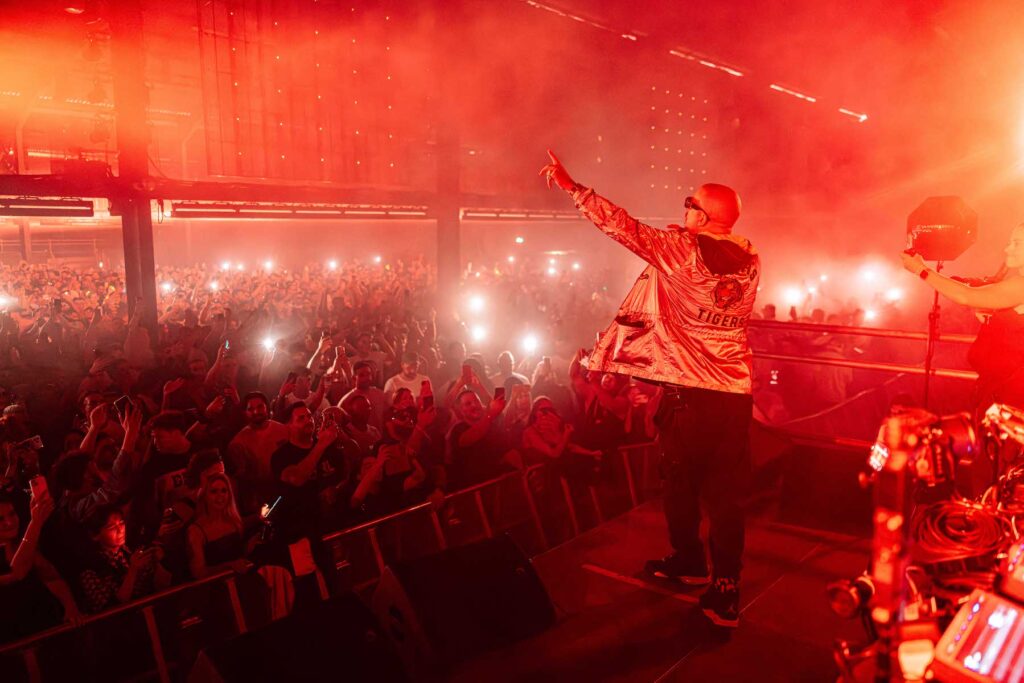
Jamie Jones was handed the keys for the opening party, unveiling Voyager — a concept tracing different eras and influences across his career. A nostalgia-heavy journey through his 2010s tech-house era gave way to live vocal performances from collaborators including Camden Cox and Constance Power, before pushing into newer, unreleased material. With Seth Troxler, Adam Ten, Manda Moor and Goosey b2b Florentia also on the bill, the lineup brought plenty of firepower to the occasion.
The production matched the ambition. Monumental lighting rigs, expansive staging and the sheer industrial scale of the space created a festival-sized atmosphere without abandoning the warehouse aesthetic. There’s something compelling about seeing a venue of this magnitude come alive for the first time; Ironworks feels less like another club opening and more like London reclaiming a piece of its industrial landscape for contemporary music culture.
Adam Ten was a particularly welcome addition, bringing the eclectic, groove-led approach that has established him as a distinctive presence on the international circuit. His ability to move fluidly between house, deeper techno and indie dance made him a natural fit for the occasion. A rework of the ’90s classic ‘Baby’ proved a standout moment, going down an absolute treat with the crowd, while Fuego’s ‘Want Me’ added another infectious moment to the set. Both tracks delivered exactly the kind of collective dancefloor energy a venue opening should inspire.
Seth Troxler brought his unmistakable personality to the occasion, sporting a colourful striped polo that felt every bit as characterful as the man himself. Behind the decks, he delivered a run of infectious, groove-heavy selections, with Luke Alessi’s ‘Sex Machine’ among the highlights. It was the kind of set that prioritised rhythm, movement and a playful connection with the crowd — a reminder that, amid Ironworks’ monumental production, a great groove remains the main event.
Crucially, the appeal extends beyond the dancefloor. Speaking to a local attendee, I was told that “this is what London needed” — a space of this scale that can operate not just through the summer months, but throughout winter, too. With its substantial indoor warehouse complemented by outdoor riverside areas, Ironworks has the potential to offer something London’s seasonal event calendar often struggles to balance: large-scale experiences that don’t depend on the weather.
Naturally, opening weekend wasn’t without its rough edges. Early attendee feedback flagged uneven sound, with bass occasionally overwhelming the midrange and highs, alongside microphone issues and intermittent audio dropouts. Crowd movement and post-event transport also proved challenging, while locker pricing and limited outdoor seating raised questions around the wider guest experience. These are significant considerations for a venue operating at this scale, even if some are the familiar growing pains of a brand-new operation.
But the potential is unmistakable. Ironworks has the physical presence to host genuinely large-scale electronic music experiences, while its riverside setting and accessible location offer something increasingly rare in London: room to breathe without feeling disconnected from the city. With Eric Prydz, CamelPhat, Appetite and Charlotte de Witte completing the venue’s limited five-show opening season, the programme demonstrates an ambition to establish Ironworks through carefully curated, artist-led events rather than capacity alone.
Ironworks doesn’t need to reinvent London clubbing overnight. It needs to prove that its extraordinary space can be matched by equally considered sound, production and crowd management. The opening weekend offered a glimpse of what that could look like — occasionally imperfect, undeniably ambitious and full of promise.
—
—
The verdict: Ironworks is a serious new contender in London’s electronic music landscape. Its industrial heritage, accessible riverside location and festival-scale production give it a compelling identity of its own. Smooth out the operational issues, sharpen the sound and this could become one of the capital’s most exciting destinations for large-scale dance music — in summer, winter and everything in between.
—
Words: Josh Crowe
Photo Credit: Louis Nesbit // @louisnesbitt
—