
Rescission of 389 maintenance areas from 2012-2020
Annual average of 29,000 units → 15,000 units → 77 areas designated after the return of Oh Se-hoon → 172 areas
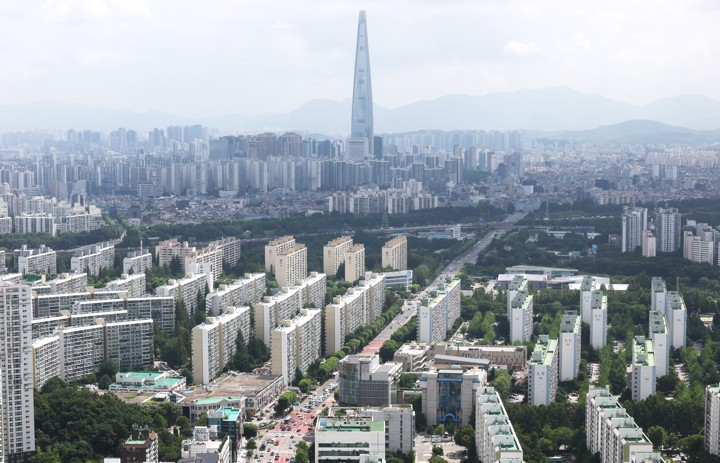
 사진 확대 A panoramic view of the apartment complex in Gangnam, Seoul. [Yonhap News]
The Seoul Metropolitan Government analyzed that about 430,000 housing opportunities were eliminated as 389 of the 683 maintenance areas for former Mayor Park Won-soon’s tenure were lifted. It is explained that there is a continuous demand for redevelopment and reconstruction to improve the old residential environment, with maintenance projects being promoted again in 177 of the areas that were lifted at the time.
According to the maintenance industry on the 19th, the Seoul Metropolitan Government announced on the 16th that it will publish a white paper titled “20 Years of Evaluation and Reflection on Seoul Housing Supply Policy” and held a press briefing presided over by the head of the housing office, Myung Noh-joon.
“We have been preparing for the publication of the white paper since last year,” said Kim Sung-bo, deputy mayor of the administration, who attended the briefing. “We prepared the white paper and briefing because we thought we needed accurate evidence, statistics and figures as some political circles are talking about housing supply issues.”
According to the Seoul Metropolitan Government, the white paper analyzed the process from expanding the supply base through new town and maintenance projects in the 2000s to lifting large-scale maintenance zones after 2012, changing policies centered on urban regeneration, and restoring the supply base after 2021.
Starting with three pilot new towns in 2002, the first phase of Oh Se-hoon’s municipal administration prepared a total of 309,000 supply plans in 35 districts and 297 maintenance districts in the New Town and Balanced Development Promotion Zone. However, from 2012 to 2020, during the Park Won-soon correction period, 389 of the 683 maintenance areas at the time, or 57%, were lifted.
The Seoul Metropolitan Government analyzed that it lost about 430,000 supply opportunities in the process.
Of the 389 sites that have been lifted, 177 are currently carrying out maintenance projects again. It is explained that many areas have turned to redevelopment and reconstruction as residents continue to demand to improve the old residential environment even after the suspension of the project.
Procedural issues in the release process were also included in the white paper. According to the white paper, 66 places were lifted without a resident opinion survey through the revision of the ordinance, and 264 places went through a resident opinion survey, but some had procedural problems. 59 places were lifted due to the application of the sunset system.
For example, Sajik District 2 in Jongno-gu was lifted ex officio on the grounds of preservation of historical and cultural values, but the Supreme Court ruled that the disposition was illegal. In Jangwi District 15 in Seongbuk-gu, opinion survey mail was not properly delivered to some absentees, and in Singil District 1, the voting participation rate was only 12%.
A total of 1.96 trillion won was invested, including about 911 billion won for urban regeneration revitalization projects and 185 billion won for residential environment improvement projects, which were promoted as an alternative to maintenance projects.
The white paper evaluated that many of them were converted back to maintenance projects after urban regeneration, revealing the limitations of financial input.
The amount of construction of the maintenance project also decreased from an annual average of 29,000 units in 2016-2020 to 15,000 units in 2021-2025.
The Seoul Metropolitan Government pointed out that due to the nature of the maintenance project, which takes many years from district designation to construction, the impact of past district cancellation and new designation contraction has led to a decrease in construction with a time lag.
Although the number of people living in Seoul has decreased by about 18% over the past 15 years, the number of households has increased by about 14% due to the differentiation of households due to the increase in single-person households. It is estimated that about 1.93 million old houses need to be renovated within the next 10 years.
 사진 확대 Mayor Oh Se-hoon looks around a reconstruction complex in Yangpyeong-dong, Yeongdeungpo-gu. [Yonhap News]
The white paper evaluated that after 2021, when Mayor Oh returned to correction, the policy was put on restoring the supply base.
The housing maintenance index system was abolished, rapid integration planning was introduced, and the supply foundation was laid by promoting business feasibility correction coefficients, recognition of current area ratio, and Moa Housing and Moa Town. As a result, the city explained that the designation of maintenance areas more than doubled from 77 in 2016-2020 to 172 in 2021-2025.
The Seoul Metropolitan Government aims to build 310,000 units by 2031, focusing its policy capabilities on linking the recovered supply base to actual construction and occupancy.
Manager Myung No-jun said, “The disconnection of housing supply eventually results in damage to citizens. The same supply disconnection as in the past decade should not be repeated, he said. “We will continue to promote regulatory innovation for housing supply by establishing a cooperative system with the private sector, construction companies, and the central government.”