
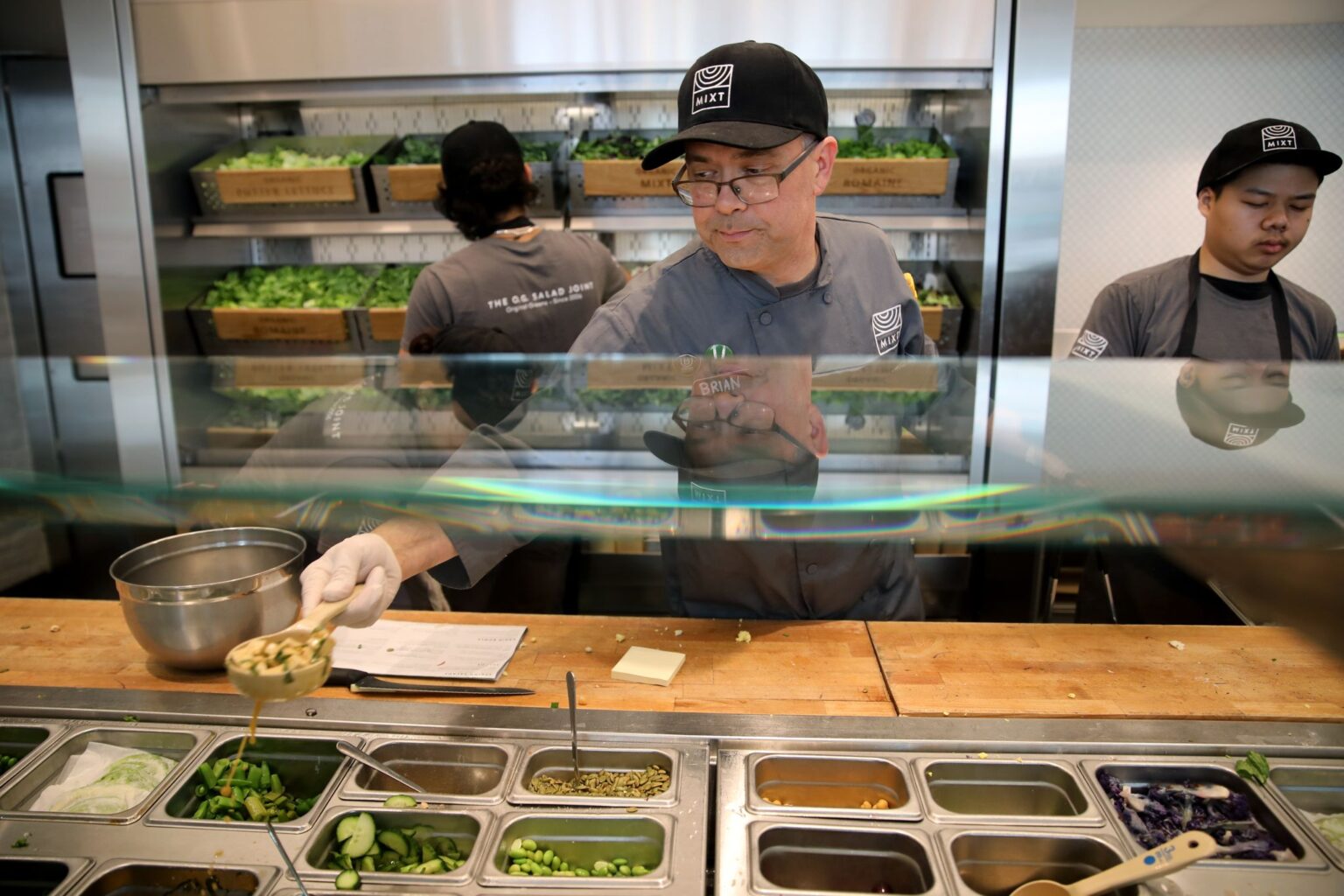
Mixt is one of the most common chain restaurants in San Francisco.
Yalonda M. James/The Chronicle
San Francisco is famously averse to chain restaurants. But when it comes to coffee, the city still has a bit of a penchant for them.
A Chronicle analysis found that, even with waves of closures in recent years, Starbucks remains the city’s most common chain establishment, with 28 locations excluding ones located in stores like Safeway or Target.
In fact, coffee chains make up four of the city’s five most common chain establishments: After Starbucks, Blue Bottle, Peet’s and Philz fill out the ranks. The only non-coffee chain in San Francisco’s top five was Subway, which came in second and is the most common chain in the U.S.
Article continues below this ad
Further down among the top ten, though, are many healthy-ish local fixtures of the downtown lunch circuit, like Proper Food and Mixt — not a surprise, as a pedestrian walking the mile between the Chronicle’s old and new offices would breeze by no fewer than five Mixt locations. Andytown, the S.F.-only chain famous for its coffee confections, is also on the list.
Overall, San Francisco has few chains: Just 10% of the food establishments in the city met our criteria. That’s because most neighborhood shopping corridors in the city have restrictions on chain establishments — be it restaurants or stores — to varying extents. Some, like parts of North Beach and Chinatown, have outright bans, while others allow them only with a special approval that requires a public hearing.
This analysis also differs from a 2023 one that found that 17% of S.F. restaurants were chains — in part because the methodology for categorizing restaurants differed (the data in that study was collected nationally by the Georgia Institute of Technology), but largely because many chain locations have closed. At that time, for instance, there were 56 Starbucks locations.
To determine which restaurants were part of chains, the Chronicle cross referenced a list of San Francisco restaurants built from city records against a list of the top 500 largest chains in the U.S. with the help of AI. A restaurant was considered part of a local chain if it had at least four locations in the city (like Souvla), or else belonged to a well-known Bay Area chain (like Ike’s Sandwiches). Capturing them all required several manual checks, and it’s still possible the AI model and our manual checks missed some.
Article continues below this ad
Cases of multiple distinctly branded restaurants owned by the same restaurant group, like the various establishments owned by the Flour + Water Hospitality Group, were counted as independent restaurants. Restaurants with three locations or fewer, like Foghorn Taproom, were also not counted.
Unsurprisingly, chains are relatively concentrated in neighborhoods with fewer restrictions.
Lakeshore, the home of Stonestown Galleria’s booming food court, has by far the highest share of chain restaurants of any neighborhood, with at least 50. Of those, a third are national chains and another 10% are local or regional chains, adding up to about 44% all together. FiDi comes in second at 23%, with about 15% being national chains and 8% being local.
The Western Addition and Mission Bay were the only other two neighborhoods where more than 15% were either a national or local chain.
Article continues below this ad
Most neighborhoods had far fewer chains than that. In more than half, fewer than 8% of all restaurants or cafes were categorized as a chain. That number shrinks even further when looking at just national chains: Fewer than 5% of restaurants in most neighborhoods were chains.
While no neighborhood lacked chains entirely, several came close — Haight Ashbury, Potrero Hill, the Castro, Noe Valley and Japantown all had just one national chain establishment each. And in terms of the share of all restaurants, Bernal Heights and the Inner Richmond ranked lowest, with around 3% of restaurants belonging to national and local chains.