
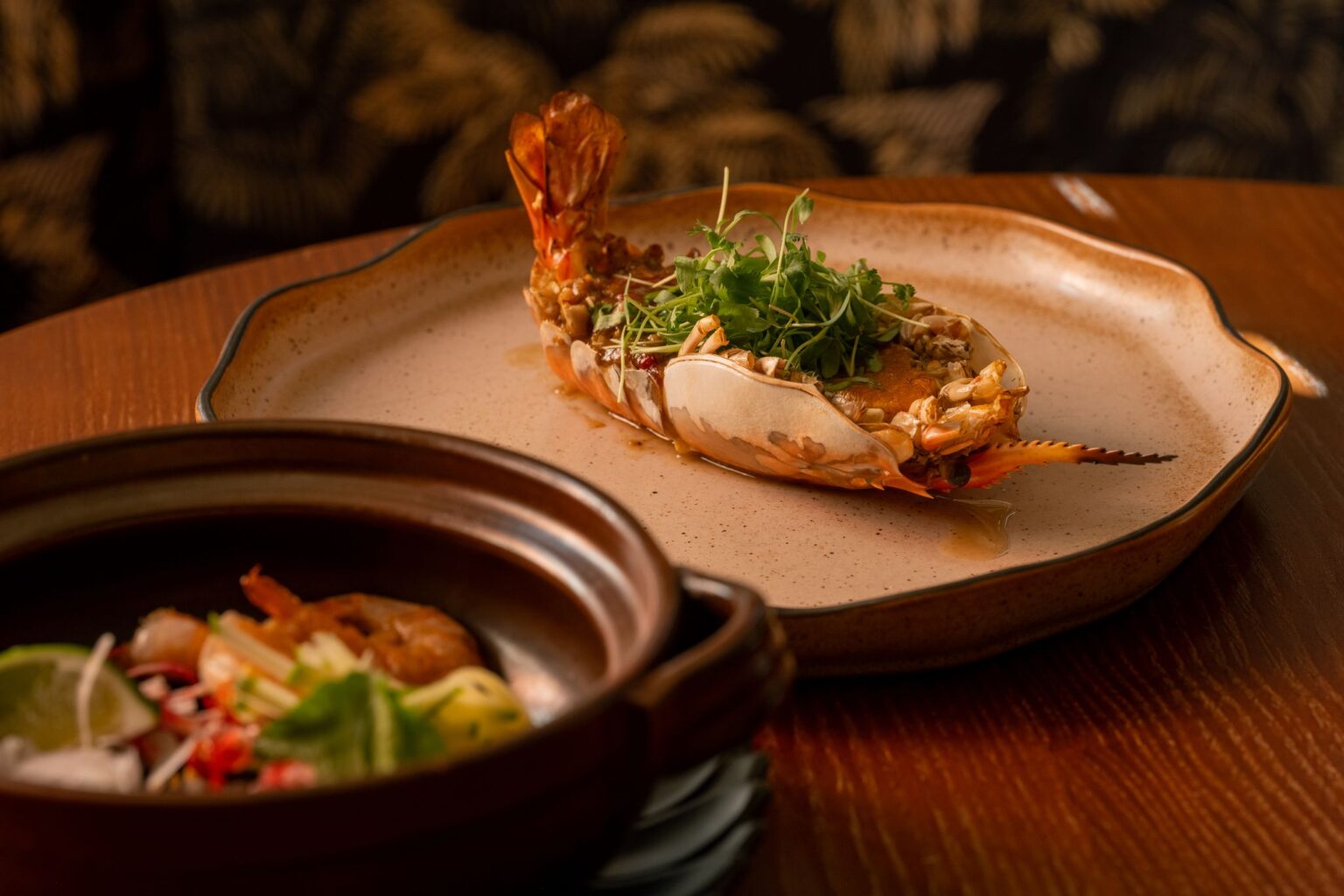
Goong mae nam yang, a river prawn dish, at Saam in San Francisco.
Kelsey McClellan/For the S.F. Chronicle
Recently, I reviewed Saam by celebrity chef Thitid “Ton” Tassanakajohn, which I argue is the Bay Area’s best new Thai restaurant. Working on it left me with questions: Why is great Thai food in San Francisco so closely associated with the Michelin Guide? And what role do I, and food media at large, play in that alignment?
Part of what makes Saam significant is its chef, who runs a pair of Michelin-starred joints in Bangkok. The restaurant’s name translates to “three,” which references the cuisine’s three priority flavors (salty, sour, spicy) and the trio of Saam’s collaborators, including chef de cuisine Ty Choosuwan and Tee Atthapon, owner of several Bay Area Thai spots. Atthapon said Saam is vying for a star — though the name wasn’t intended to suggest that it might be Tassanakajohn’s third Michelin-starred restaurant. “But we certainly wouldn’t mind if it turned out to be a lucky coincidence,” he said. “To get the Michelin star for Saam will fulfill my mission here.”
Saam certainly has the ambition, seen in its knack for creative yet boundary-pushing dishes imbued with funkiness and tongue-numbing heat. It’s the next step forward in the Thai food scene of San Francisco, whose biggest contribution to the cuisine in California is producing not one, but two Michelin-starred restaurants: Pim Techamuanvivit’s Kin Khao and Nari, the only Thai restaurants to currently hold the distinction in America. Michelin and I agree — Nari and Kin Khao are the Bay Area’s Thai food role models.
Article continues below this ad
If Saam were to get a star, “that wouldn’t be a surprise,” said Mark Padoongpatt, author of “Flavors of Empire: Food and the Making of Thai America” and associate professor of Asian American Studies and Interdisciplinary Studies at the University of Nevada, Las Vegas. “Because he has the capital,” both financial and social, and “he knows the market,” he said of Tassanakajohn.
San Francisco’s Thai food scene has seen notable growth in recent years, and not only at the high end, with brunch spots and chicken rice counters. Techamuanvivit is opening a casual noodle shop focusing on khao soi. I’ve sampled the breadth of newcomers and found that while they strengthen the range of options, only Saam, which is by far the most expensive with several dishes that cost more than $60, rose to be a true contemporary to Kin Khao and Nari.
I wondered if, by upholding Saam, I was sending an unintentional message. While I celebrate it for taking the scene in a new direction, it’s hard not to think that I’m also cementing the notion that great Thai food in San Francisco can only come from high-end places.
For contrast, consider how Los Angeles defines excellence in Thai food: street food stalls, strip mall stalwarts, mid-priced restaurants by second-generation Thai chefs and a few high-end spots. The L.A. scene’s diversity reflects the city’s longer history as the center of Thai America. Compared to San Francisco, high-end Thai dining doesn’t cast as long a shadow in L.A.; its tastes are more varied in price point and presentation, and its best Thai restaurants are largely divorced from Michelin.
Perhaps the difference is just a reflection of how San Francisco eats, as its best Thai restaurants prefer high-quality, local ingredients. But the biggest contributor is likely the city’s astronomical operating costs, which have led many chefs to adopt more predictable tasting menus or increase their prices, only to still have to close.
Article continues below this ad
How did San Francisco Thai food become this way? One place to start might be 2015, the historic year that, for the first time in America, Michelin awarded one star to three Thai restaurants, Kin Khao, and Pok Pok and Zabb Elee in New York City (both now closed). The distinction brought a new kind of prestige to the cuisine, signaling a shift away from “what white Americans or Europeans think is good,” Padoongpatt said.
It also recalibrated diners’ preconceived notions around value. “The idea behind price point — what Thai restaurants, Mexican restaurants, ‘ethnic restaurants’ should charge — is so intertwined with race, in that certain cuisines are just not going to be seen as ‘expensive’ cuisines,” Padoongpatt said. Places like Kin Khao and Nari helped establish a path for Saam, which, to be clear, I believe is worth the price, given its level of sophistication and quality of cooking.
In the 2010s, new San Francisco restaurants led by chefs of color including Kin Khao, Mister Jiu’s and Besharam marked a shift for representation of marginalized communities. Representation discourse, though, has its own side effects. “Minoritized communities are only going to become visible when they become palatable to power,” Padoongpatt said. “And in this context, it’s whiteness, right? If you can appeal to whiteness, you will get recognition, you will get representation, you will get visibility.”
In many ways this is a discussion of what talent is most visible. And no other Thai restaurant in the city has as many eyes on it right now as Saam, given Tassanakajohn’s celebrity, as a TV darling and restaurateur with a dozen restaurants. It deserves that attention, but so do restaurants that have no cultural cache to trade. Brilliance and innovation in Thai food shouldn’t come from one direction. This is not a plea that Thai food should only be cheap. Rather, I long for variance, diversity and, above all, surprise in the cuisine’s leading voices.
Article continues below this ad