

Korea’s antitrust regulator said Baemin and Coupang Eats abused market dominance with terms that restricted competition and raised restaurant costs.
Coupang’s office in Gwangjin District, eastern Seoul, left, and Woowa Brothers’ headquarters in Songpa District, southern Seoul, on Nov. 9, when the Fair Trade Commission said it will fine the operators of Coupang Eats and Baemin over pricing demands on partner restaurants.
YONHAP
Korea’s antitrust regulator said Monday it will fine Woowa Brothers, the operator of delivery app Baemin, 331.1 billion won ($243 million) and Coupang 300.8 billion won for abusing their market dominance to restrict competition.
The two companies, which operate Baemin and Coupang Eats, respectively, pressured partner restaurants to offer terms at least as favorable as those available on competing platforms, according to the Fair Trade Commission (FTC).
The watchdog said the so-called most favored nation (MFN) requirements undermined competition, drove up food prices and made it harder for new players to enter the delivery app market.
Baemin and Coupang Eats accounted for 58.45 percent and 34.44 percent of Korea’s food delivery app market by order value in 2025, respectively.
According to the FTC, Coupang enforced the requirements from July 2023 to January 2026 by stripping restaurants of their “Wow restaurant” status if they failed to comply with conditions covering menu prices, minimum order amounts and other trading terms.
The status allowed customers subscribing to Coupang’s Wow membership program to receive delivery-related benefits when ordering from participating restaurants.
Baemin imposed similar requirements from May 2024 to October 2025, limiting delivery fee discounts for Baemin Club subscribers to orders from restaurants meeting its conditions.
The FTC pointed out that restaurants had little choice but to accept the requirements, as exclusion from the membership programs could lead to a “significant” decline in sales.
Accordingly, the proportion of partner restaurants designated as Wow restaurants rose from 13 percent in July 2023 to 94 percent in October 2025, while the corresponding figure for Baemin Club stores increased from 63 percent in May 2024 to 80 percent in January 2025.
“The FTC has concluded that Baemin and Coupang abused their dominant market positions by imposing unreasonable conditions on partner restaurants that deviated from conventional trade practices, disrupting the business operations of both partner restaurants and competing platforms,” the watchdog said.
With the two businesses accounting for more than 90 percent of the market, the FTC said their simultaneous imposition of MFN requirements and alignment of trading terms restricted competition in a manner similar to collusion.
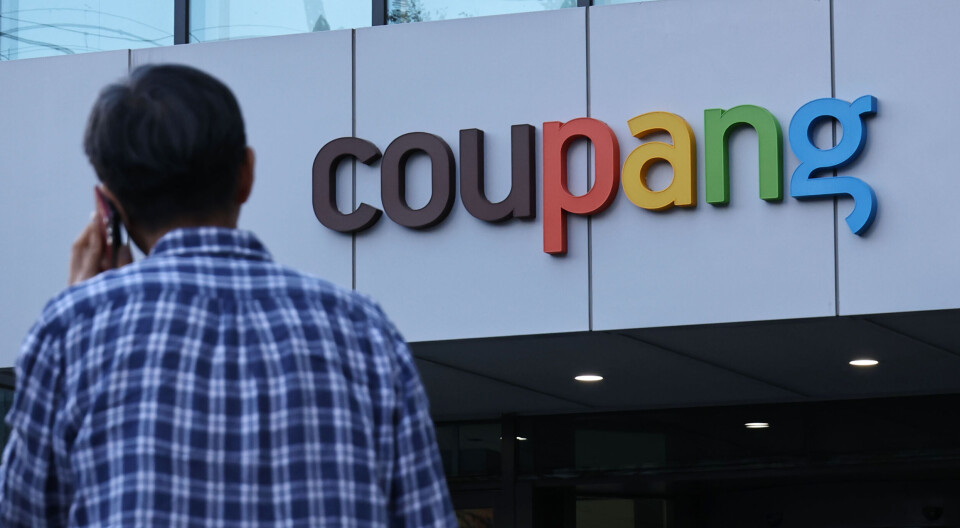
A person walks in front of Coupang’s office in Gwangjin District, eastern Seoul, on Oct. 22.
YONHAP
The watchdog also sanctioned Baemin for effectively forcing restaurants to switch from its “Market Place” (MP) service, under which restaurants arrange deliveries themselves, to its “Own Delivery” (OD) service, under which the platform handles deliveries.
According to FTC estimates, Baemin’s revenue as a share of transaction value stood at 28 percent for OD orders in 2024, compared to 7.8 percent for MP orders.
To expand the share of OD orders and eventually phase out MP, Baemin reduced or blocked the visibility of MP services on its app and displayed estimated delivery times in a way that made MP appear slower, according to the watchdog.
The FTC added that the shift toward OD had increased commission costs for partner restaurants, leading them to raise minimum order amounts and menu prices to protect their margins.
The FTC said the measures were expected to give partner restaurants greater freedom to set menu prices and minimum order amounts across platforms based on their own business judgment and encourage new platforms to enter the market.
The fine amounts are provisional, the watchdog added.
The FTC, meanwhile, ordered a re-examination of a separate case involving Coupang’s alleged tying of delivery and streaming services to its Wow membership program, citing differences in interpretation over what constituted the primary and tied products.
Yonhap