


Circular Online brings you live updates from the ISWA World Congress 2026 as it returns to London for the first time in 30 years.
Hosted by CIWM, in partnership with the International Solid Waste Association, ISWA 2026 is bringing together over 1,000 international leaders, policymakers, and resource management professionals for three days of strategic knowledge sharing and tangible solutions.
The Minister for Waste Crime & Circular Economy Emma Hardy MP will deliver a keynote address. She is joined by leading sector figures including Sebastian Munden, Chair of WRAP, Gareth Roberts, Member of the London Assembly, and Jeremy Blake from PackUK.
Elsewhere on the programme Nicola Hopley, Deputy Director for Circular Economy Growth Plan Delivery at Defra, and Dr Sally Uren OBE, Executive Director and Chief Acceleration Officer at Forum for the Future, will share critical policy and sector insights at a key moment for UK and international resource strategy.
Check out our live updates below:
Citizens of a Water World | Helen Czerski

“The ocean sets the context for the entire planet itself,” Helen Czerski said to open the ISWA World Congress 2026.
Most people know that 70% of the Earth’s surface is covered by water, but many of us have no idea how this impacts our everyday lives.
Physicist, Oceanographer, and Broadcaster Helen Czerski told Congress delegates that the ocean is part of a global engine that drives the planet’s ecosystem and economy.
“We prioritise the land we live on, not the water we live beside,” Czerski explained. “The oceans are connected, they are one global ocean.”
This connection is exemplified by the Humboldt Current. Named for the geographer Alexander von Humboldt, it is a cold water current that runs northwards along a narrow strip of ocean off the western coast of South America, from southern Chile to northern Peru.
While most people will not have heard of this phenomena, it’s impact has been felt globally for decades.
Because it is a cold-water current, the small islands it runs past rarely experience any rainfall. This means that the bird’s who populate these islands are a valuable commodity, but not for the reason you may think.
Known as Guano, the bird’s poo is chemically pure due to the islands’ dry conditions. Between 1840-160, around half of Peru’s guano harvest was exported to England for fertilizer.
The guano became a valuable resource, which, as you can imagine, caused it be a source of conflict for years, eventually escalating into the 18th-century Guano Wars.
And it wasn’t just Guano, Czerski explained. The Current’s unique flow means that the bottom layer of ocean water, which is usually not exposed to sunlight, can rise to the surface. This creates the conditions for Peruvian anchoveta to thrive.
These very small, very oily fish were harvested by the British to be used as pig food. Between 1950 and 1973, the world fish harvest tripled, while the amount of fish consumed by humans remained the same. Instead, half of all fishmeal was being used as pig food by 1960 – as people’s appetite for bacon increased.
By 1964, Peru was responsible for 40% of the entire global fish harvest. As you might expect, this food source collapsed in 1972, causing the price of British bacon to double overnight.
Czerski highlighted that this is why the ocean is a global engine – a relatively small strip of water has the power to spark global trade wars and geopolitical shocks.
This is just a small example of how the Earth creates resources for humanity to use and why, Czerski believes, we are citizens of a water world. She explained that, so often, humanity is an expert at extracting the planet’s resources: off-ramping. Where we struggle is when the time comes to on-ramp, and give back to the Earth.
Czerski believes we are part of a planetary life support system that combines civilisational infrastructure and nature – the planetary engine. For this system to function, both nature and the planet need to take from the other and then replace what was taken.
After all, if the planet really is an engine, humanity can’t just keep driving, at some point we need to refuel. When this process is embedded into our everyday lives, that’s when a truly circular economy will exist.
London needs ‘greater consistency’ to tackle fly-tipping
 London Assembly Environment Committee Chair Gareth Roberts AM has called for better hotspot targeting, intelligence-sharing and coordination between enforcement bodies.
Gareth Roberts AM has urged London boroughs and enforcement agencies to adopt a coordinated, London-wide response to rising levels of fly-tipping.
Speaking at the ISWA World Congress 2026 in London, Roberts described fly-tipping as an increasing problem, with waste blighting streets across the capital.
He called for “greater consistency across the capital”, alongside more effective targeting of fly-tipping hotspots.
Roberts also highlighted the challenges created by large-scale illegal waste sites, which require a different response from smaller incidents on streets and footpaths.
He said tackling these sites would require better intelligence-sharing and coordination involving councils, the Environment Agency and police. Authorities must target those responsible as well as clear illegally dumped material, he added.
London Assembly Research Unit data shows that local authorities in the capital dealt with 481,088 fly-tipping incidents in 2024–25, an increase of 8.2% on the previous year.
The number of incidents reported in London has increased by 48% since 2018–19, compared with a 31% increase across England over the same period.
London recorded 53 incidents per 1,000 people in 2024–25, more than double the rate of any other English region.
The London Assembly Environment Committee is currently investigating the causes and impacts of fly-tipping, differences between boroughs and the effectiveness of existing enforcement measures.
Its investigation is also examining the responsibilities of London boroughs, the Environment Agency, Defra and police in tackling large-scale illegal dumping, as well as the potential role of the Mayor of London in coordinating action.
WRAP Address | Sebastian Munden CBE
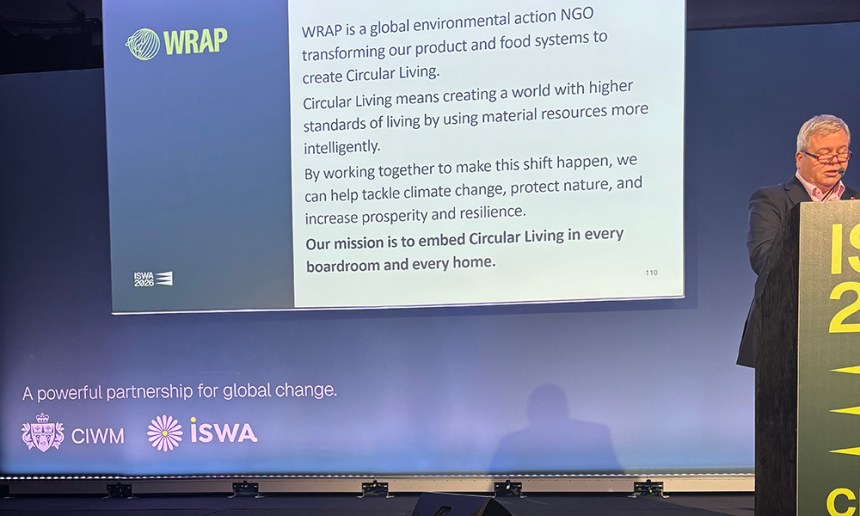
As part of an international call to action, Sebastian Munden CBE, Chair of the global board of trustees for WRAP, spoke to the Congress about the need for the sector to invest in tangible solutions that will have an immediate impact.
WRAP is a global action environmental NGO dedicated to transforming our product and food systems to create circular living.
“WRAP is focused on solutions that can deliver a generational shift and create a sustainable economy,” Munden told delegates.
We all know that there is a wide variety of ideas and systems that are ready to scale. Munden was keen to emphasise that the solutions exist, we just need to take action.
One example of tangible solution operating today is WRAP’s Food Pact Network, which supports action in countries representing 20% of global food waste and 38% of global GDP.
“The economics must be clear, so businesses see opportunity,” Munden said. “This is nowhere more clear than in the food industry.”
By collaborating with government, industry, and citizens, WRAP supported countries to reduce food waste throughout the supply chain. This means there is less waste to dispose of, and more food for people to eat. It’s easy to see the economic benefit, not only the environmental one.
Munden explained that the Food Pact Network taught him that, ultimately, the circular economy is about people, not only materials.
“Shared understanding, shared goals, and transparent reporting, created market wide change,” Munden said. “Shared solutions always move faster than isolated change.”
Nowhere is this concept more clear than in Wales. Over 30 years, Wales has become one of the nations with the highest recycling rates in the world.
Munden believes this success came through long-term collaboration between government, industry, and citizens.
“It is driven by consistent policy decisions, practical support, and local ownership. Policy becomes real through local deployment and continuous improvement,” Munden explained to conclude his fascinating talk.
Open environmental treaty talks to the public, Potočnik urges

Former European Environment Commissioner calls for greater scrutiny of governments’ negotiating positions to strengthen accountability over decisions affecting the planet.
Janez Potočnik has called for formal international environmental negotiations to be opened to the public, arguing that governments should be held accountable for the positions they take behind closed doors.
Speaking at the ISWA World Congress in London, the former European Commissioner for the Environment and Co-Chair of the International Resource Panel said greater transparency could help strengthen international efforts to address environmental challenges.
He described global summits as effectively hosting two separate events: negotiations behind closed doors, followed by public promises, and gatherings of civil society bringing energy and pressure for change.
“They are discussing in those rooms about our joint future,” he said.
Potočnik argued that the public should be able to hear formal negotiations and understand governments’ positions directly, rather than relying on statements made to journalists afterwards.
“I think we need to put these things more transparent and more public, and that I think would make some change,” he said.
The call came during a panel discussion examining whether global treaties could deliver progress on waste and resource management amid political divisions and competing short-term interests.
Despite his criticism, Potočnik defended international agreements, highlighting the Montreal Protocol as a successful example and arguing that the world would be worse off without the Paris Agreement. However, he warned that existing efforts were not going far enough.
From agreements to action
ISWA President James Law highlighted the gap between securing international agreement and delivering practical change.
“A treaty itself doesn’t implement anything,” he said.
Law argued that treaties could bring countries together and establish a framework, but progress still depended on the people and organisations responsible for implementing commitments on the ground. Countries also faced substantially different challenges in providing basic waste management services.
Isabel Martínez, Deputy Executive Secretary of the Basel, Rotterdam and Stockholm Conventions, also defended international agreements, emphasising the importance of protecting scientific evidence from short-term economic and political interests.
She said agreements contained mechanisms to inform decisions through science while allowing countries flexibility in how they implemented commitments, reflecting their circumstances.
That flexibility needed to go hand in hand with accountability, supported by monitoring, reporting, transparency, traceability and digital tools, she explained.
Martínez stressed that responsibility extended beyond governments to citizens, researchers and institutions.
“We all have a part to play in that accountability,” she said. “It’s a shared accountability.”
From London to Antalya: Waste Management as Climate Action at COP31

Acting as a bridge between COP31 and the ISWA World Congress, this fascinating session explored how waste and resource management can be an immediate, cost-effective climate mitigation lever capable of cutting up to 20% of global emissions.
Two huge events in waste and circular economy are taking place this week: the ISWA World Congress and COP31. This session, chaired by ISWA’s Aditi Ramola, helped connect the dots on how these events are linked.
As part of a video message delivery on-the-ground from COP31, Immediate ISWA Past President Carlos Silva Filho explained how this year’s conference in Antalya, Türkiye, is the first entirely dedicated to zero waste and circular economy as priority topics.
Today is focusing on food waste and loss, while Wednesday is zero waste day. However, one of the key challenges being discussed over the whole event is methane production.
Speaking as part of the ISWA panel, Anja Schwetje, Geman Environment Agency, explained that while methane production is a very large waste stream, it is only organic waste disposed of in the wrong place.
The challenge is reintroducing organic waste back into the system, so it isn’t a problem for a waste manager, but an economic opportunity, Schwetje highlighted.
Corinne Trommsdorff, French Solid Waste Partnership and ISWA Board Member, said the two big challenges for reducing methane: closing dumpsites and managing landfills (the areas where emissions are occurring right now), and developing prevention mechanics that reduce the amount of organic waste disposed of in these locations.
She emphasised that this link, between waste infrastructure and waste prevention, is crucial to tackle the methane emissions challenge.
Trommsdorff continued that a key message from ISWA is that functional waste management systems are a core component of a circular economy.
Any circular system will need to dispose of what doesn’t fit in a recycling or product stream, and what doesn’t reach the designated quality standards.
The intersection between ISWA and COP is vital to connect policymakers with resource and waste management professionals. A solid link allows the sector to inform governments of the reality on the ground and demonstrate tangible solutions to the challenges we face today.
This is why Peter Simoes emphasised the importance of the sector speaking with one voice. He argues that this will be crucial to ensure resources and waste professionals attract the political commitment and financial support needed to deliver meaningful change.
This is a live story and will be updated throughout the day.