
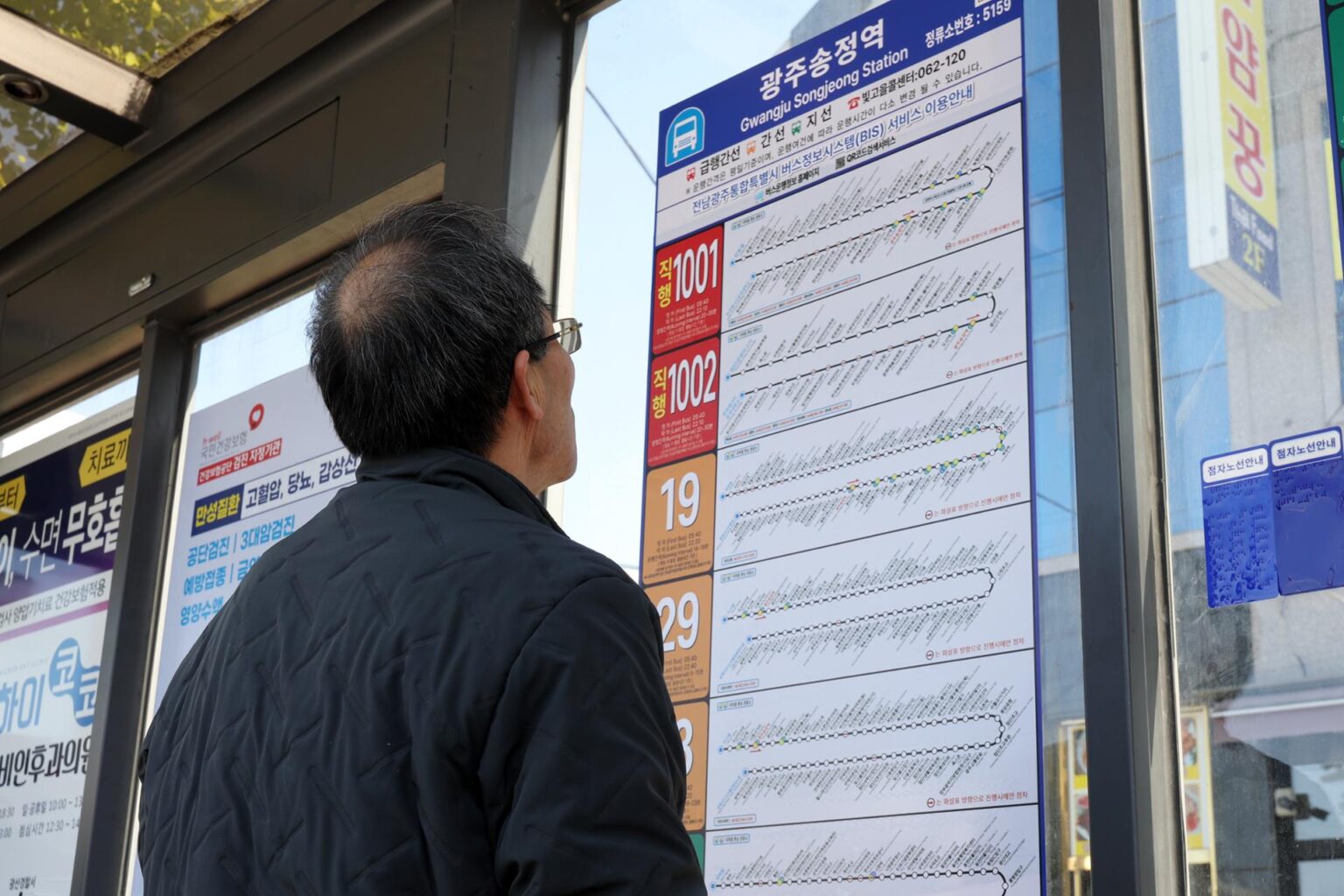
A passenger checks a bus route map at a bus stop in Gwangju, Oct. 31. Yonhap
Older people struggle as banks, buses, cafes increasingly turn away cash
A 67-year-old man surnamed Cho living in Bucheon, Gyeonggi Province, recently tried to pay for a cup of coffee at Starbucks with cash, only to be told that the store accepted only credit cards and mobile payments.
“I just wanted to pay in cash, but they told me it had been the store’s long-standing policy not to accept it. I knew most people paid by card these days, but I never expected a store to refuse cash altogether,” he said. “Since then, I’ve made sure to always carry a card.”
His experience comes as cash is becoming harder to use in everyday life in Korea, with more cafes, buses and even bank branches moving away from physical payments.
For many consumers, paying by card or mobile phone has become the new normal as Korea moves toward a cashless society. But for those who still rely on cash, the growing number of places that no longer accept it is making everyday purchases increasingly difficult.
The shift has been underway in the retail sector for years. Starbucks Korea introduced cashless stores at 103 locations nationwide in November 2018, accepting only cards and mobile payments. The practice has since expanded.
In the public transportation sector, the Seoul Metropolitan Government began piloting cashless buses in 2021. As of April this year, 180 of the city’s 394 bus routes were operating without cash payments.
The move is now reaching the banking sector, with some banks operating branches that do not handle cash and checks.
KB Kookmin Bank, which opened its first cashless branch in Gimpo, Gyeonggi Province, in 2019, now operates six such locations after adding four this year.
iM Bank opened a cashless branch in Wonju, Gangwon Province, in 2024, while BNK Busan Bank launched two such branches in Seoul in January last year. Citibank Korea is also set to stop handling cash and checks at its Gangnam branch starting in December.
Stacks of new 50,000-won banknotes prepared for the Chuseok holiday cash supply sit at the Bank of Korea’s currency storage facility in central Seoul, Sept. 30. Joint Press Corps
However, data shows that cash remains an important payment method for some Koreans, particularly older people and lower-income households.
According to the Bank of Korea’s 2025 Payment and Settlement Report, individuals spent an average of 324,000 won ($240) in cash per month, accounting for 17.4 percent of their total spending.
The share was higher among people aged 70 and older, at 32.4 percent, compared with 14.7 percent among those in their 20s.
The gap was wider across income groups. People earning less than 1 million won a month spent 59.4 percent of their monthly expenditures in cash, compared with 15.1 percent among those earning 9 million won or more.
A 2025 central bank survey conducted among 2,000 adults suggested that many consumers are reluctant to give up cash. Among them, 45.8 percent opposed a cashless society, compared with 17.7 percent who supported it.
The central bank warned that consumers with limited digital literacy could suffer more as an increasing number of businesses and services refuse to accept cash.
“Consumers with lower levels of digital literacy are expected to experience greater declines in consumer welfare as cashless stores and services become more widespread. Elderly people, in particular, are likely to be disproportionately affected, as they tend to rely more heavily on cash and have lower levels of digital literacy,” it said in a report published in 2025.
“Policy measures should be introduced to promote cash acceptance. In the long term, there also should be measures to ensure that digitally disadvantaged groups can easily use new payment methods.”