

Okutama, Japan —
Most people know about wasabi. The bright green Japanese paste famous for its sharp, nose-clearing heat, inseparable from sushi, is now so widespread it inspires cocktails and snacks. But even the most avid sushi eater has probably never had real wasabi; instead, they are usually served a mix of horseradish and green food coloring.
The vast majority of wasabi sold in the US and elsewhere is fake. But traveling to Japan won’t necessarily help, as real wasabi accounts for only a small fraction of that market. That makes Michelin-starred Mutsukari, in the heart of Tokyo’s Ginza district, an exception: it has used “hon wasabi,” or real wasabi, since opening in 2004.
“Fresh wasabi has pungency and aroma at first, but it ends up soft, smooth, and creamy on the tongue,” chef Yoshihisa Akiyama told CNN, comparing it to the usually aggressive and harsh fake green paste. His Omakase menu digs deep into locally sourced ingredients, with an accent on native vegetables. This makes him very particular about his supply chain: pairing the Japanese herb with the right dish, he says, will transform its flavor.
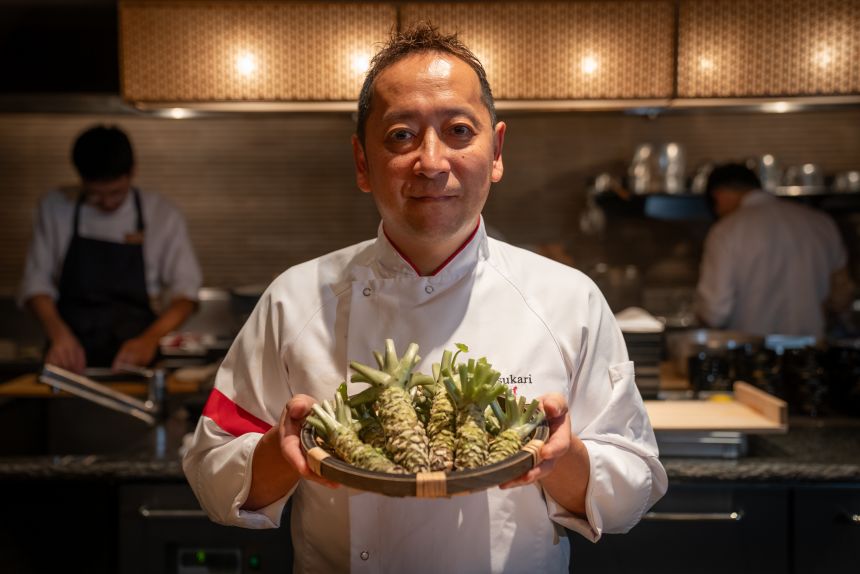
But good Wasabia japonica has become increasingly rare. Supply has fallen sharply over the past two decades: not only does Japan have an aging farming population and a shortage of successors, but climate change and rising temperatures of the streams in which it grows have also stressed the plant.
Throughout its two-year growth cycle, wasabi needs a stable water temperature and sun exposure, which makes cultivating it challenging. These days, wasabi costs between $100 and $200 per pound and is best used within a week of harvest — which is why many turn to cheap imitations that last for months instead.
“Freshly picked ingredients have a strong flavor of their own, so serving them quickly after harvest is important,” Akiyama said. “With wasabi, freshness is a must.”
Luckily for him, he doesn’t have to travel far: in Okutama, less than 50 miles from Tokyo, farmers have been cultivating the Japanese plant since the Edo period (1603 to 1868). There, he said he found “a treasure” in the form of stone-terraced fields. His latest suppliers are two brothers, Hitoshi and Tatsuya “Tacchan” Tsunoi, and their associate Momo Oshida.
Okutama has historically been the third-largest wasabi-cultivating region in Japan, but this has been challenged in recent years.
“In 2019, in Okutama, we had a devastating Typhoon Hagibis which destroyed 150 wasabi farms. To this day, only 50 of these places have been restored,” explained Tacchan Tsunoi, 40. “There weren’t enough people left to take over the farms, so my brother and I thought that if we stepped in, we could help preserve Tokyo’s wasabi. That’s how we got started.”

Dedicated to safeguarding Tokyo’s long wasabi history, they founded Tokyo Wasabi in 2020, a private wasabi farm cultivating around 5,000 wasabi plants, and offering one guided tour a day to “taste wasabi fresh from the stream.”
Cultivating wasabi takes time and patience. Following the traditional “Okutama style,” the brothers have been “building terraced fields to follow the shape of the mountains, using small stones found in the area to construct the planting beds,” Tsunoi said. “Eventually, the surrounding trees’ roots bind the stones together, and we can plant the wasabi.”
“When the sun is too strong, we provide shade. We need to remove the leaves falling into the stream. In winter, we take measures to protect the plants from the cold, warming the water using ‘kanreisha’ (a lightweight, black synthetic fiber mesh),” Tsunoi explained, adding that climate change has made their work much more unpredictable: “In summer, the sun has become too strong, making the plants more likely to rot. Sudden heavy rain can also wash the wasabi away. And in winter, the snowfall has decreased, changing the water conditions.”
After attending to all the “scattered small patches, deep in the mountains” regularly for two years, the brothers can finally harvest the plant. Despite having a stronger taste in the winter, which is preferred, wasabi is harvested year-round, making cultivating it a tedious process

“Once harvested by hand, we wash the plant, clean it with a knife to make it look presentable,” he said. “We call it ‘putting on makeup.’ After that, we trim the stems to about 45 centimeters (about 18 inches), pack everything into cardboard boxes, and ship it (directly to restaurants). Since wasabi is a fresh vegetable, it’s best to use the rhizome within about a week. The fresher it is, the more vitality and flavor it retains.”
At the moment, Tokyo Wasabi supplies chef Akiyama and a few other businesses, including their own food truck, Wasabi Shokudo, and its coffee brand, Wasabi Coffee. But eventually, they would like to scale up.
The global market size for real and fake wasabi was valued at approximately $468.8 million in 2025, according to one estimate, and is expected to reach nearly $924 million by 2034. “Research has highlighted many potential benefits,” Tsunoi said, “including antioxidant and anti-inflammatory effects, possible cancer-preventive properties, benefit memory functioning, hair-growth benefits, and relief from hay fever symptoms.”
That rising demand, both locally and globally, is prompting broader changes in the wasabi supply chain. The priority for the brothers is to increase production — and eventually to use technology to do so.
“Even though we’re in a major metropolitan area, we’re growing wasabi outdoors in a natural environment, and everything is done by hand,” Tsunoi said. “Eventually we’d like to combine these traditional, hands-on methods with advanced agricultural technology, like drones.”
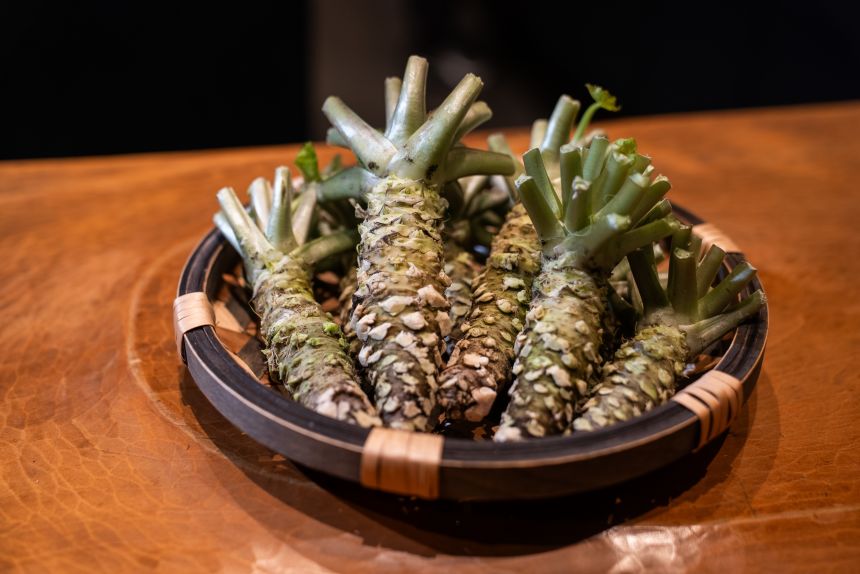
Across the industry, drones for monitoring, precision sensors, and automated environmental controls have been increasingly used, but in Okutama, connectivity and 5G need to improve first. Tsunoi said that once that happens, scaling up while conserving their methods would be possible.
In the meantime, that same remoteness is part of what draws tourists. About half of the visitors who come for the team’s mountain tours are from overseas. People abroad seem to love this Japanese herb more each year, Tsunoi said, making him hopeful for the future export potential of the plant.