

 Culture, Sports and Tourism Minister Choi Hwi-young speaks at a roundtable on nurturing indie music with indie musicians, live club operators and officials from related agencies at the live club “Avant-garde” in Nam-gu, Busan, on Nov. 19. Photo courtesy of the Ministry of Culture, Sports and Tourism
BUSAN — Culture, Sports and Tourism Minister Choi Hwi-young visited the live club Ovangarde in Busan’s Nam-gu district on the afternoon of the 19th and discussed ways to nurture indie music with musicians, club operators and officials from related agencies, the ministry said.
Choi said live clubs are where musicians first meet an audience and are valuable spaces for enjoying culture in daily life, noting that the Beatles also started out at a small live club in Liverpool. “We will pursue both regulatory improvements and expanded support so that the industry, musicians and audiences can all enjoy themselves with peace of mind,” he said.
He also said the ministry plans to establish criteria for “live clubs” in the Music Industry Promotion Act and other related statutes, and to discuss with relevant ministries how to reasonably ease related rules. The ministry said it will form a consultative body including participants from across the indie music sector to bring key issues into public debate and draw up alternatives.
Attendees included Kim Young-deung, head of the live club Bbang; Lee Seung-chul, head of Ovangarde; Lee Woo-jin, head of the audience group Audience Solidarity; Choi Su-mi of the Busan-based indie band Say Sue Me; Lee Yu-mi of Tetrapod; and an official from the Busan Music Creative Center.
 Culture, Sports and Tourism Minister Choi Hwi-young speaks at a roundtable on nurturing indie music with indie musicians, live club operators and officials from related agencies at the live club “Avant-garde” in Nam-gu, Busan, on Nov. 19. Photo courtesy of the Ministry of Culture, Sports and Tourism
Live clubs, the main stages for indie musicians, serve as on-site incubators in the popular music scene, where artists grow together through new musical experiments and exchanges, according to the ministry. But critics have long said current rules fail to properly define live clubs and therefore do not reflect conditions on the ground.
Ovangarde, where the meeting was held, was ordered to suspend business for two months in August because it allowed concertgoers to dance, and Choi had earlier used his social media account to signal his intent to overhaul rules governing live clubs. Under the current Food Sanitation Act, general restaurants may host live performances but customers are barred from dancing — and most live clubs are registered as general restaurants.
Other business categories where patrons may dance while watching a performance are entertainment bars and registered performance venues. Entertainment bars, however, face an additional tax equal to 13% of sales and cannot admit teenage audiences. Performance venues must meet a threshold of at least 90 days of performances a year or 30 consecutive days — a standard that is difficult for live clubs, which are small venues, to satisfy.
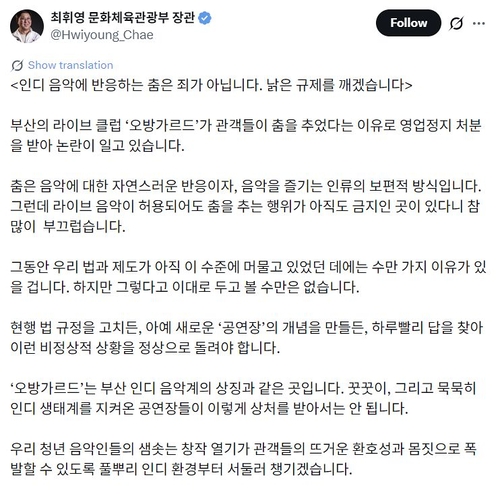 Culture Minister Choi Hwi-young points out regulations on live cafes via social media in September. Captured online.
Participants said this precarious legal status makes stable operation difficult, calling for measures to prevent indiscriminate complaints and for a proper institutional footing. They also stressed the need to actively protect and foster live clubs as basic cultural facilities for the sake of diversity in popular music.
The meeting also covered support policies for indie music, including new programs reflected in the 2027 government budget proposal such as one to build an indie music ecosystem. “For the sustainable development of popular music, we need to nurture indie music and revive regional music ecosystems,” Choi said. “We plan to work to keep the popular music ecosystem healthy through a range of institutional and policy support,” the ministry quoted him as saying.