

Lately, Liz has been jolted awake at night in a panic when her ankle monitor starts to vibrate. The buzzing reminds her of her greatest fear: that immigration agents will barge into her small apartment on Chicago’s North Side and take her away to a detention center.
“ICE agents told me the monitor would vibrate if it’s broken or tampered with,” she says crying. “ ‘We’ll look for you right away,’ ” she says they told her, “ ‘because we know where to find you.’ ”
The Guatemalan asylum-seeker has been living in a constant state of anxiety since she, her husband and daughter were asked to show up for an unexpected immigration check-in last August. Her husband was taken into immigration custody while Liz was fitted with an ankle monitor and released with her 15-year-old daughter. Neither she nor her husband have criminal records.
WBEZ is not using their full names because they fear government retaliation.
“I asked the immigration agents, ‘Why? Did we do something wrong?’ ” Liz says in her native Spanish, adding that since the family arrived in the United States in 2024 from Guatemala they’ve been trying to follow every step of their asylum application process by the book.
Like Liz, more than 53,000 noncitizens nationwide in 2026 have been fitted with ankle monitors under the Department of Homeland Security’s Alternatives to Detention program, according to government data. That number has more than tripled since 2024 as the Trump administration has ramped up immigration enforcement. It’s the same trend locally, a WBEZ/Sun-Times analysis found. So far this year, ICE’s Chicago field office — which oversees Illinois, Indiana, Wisconsin, Missouri, Kentucky, and Kansas — has issued nearly 3,800 ankle monitors — a nearly 40% jump since 2024.

The surge has raised concerns among immigration advocates over the mental health toll they say the constant surveillance takes on those who wear the ankle device and pose no risk. Advocates argue the use of ankle monitors was supposed to be an alternative to detention but as more people have been fitted with them, detentions have also increased.
“We have seen so many people across the country who have been complying with their immigration cases, who have families, who have jobs, who have strong community ties, no significant criminal history, going to their regular appointments and suddenly getting shackled with ankle monitoring,” says Lauren Hodges, senior attorney with Amica Center for Human Rights, a legal advocacy group.
Advocates like Hodges point out that the upward trend began soon after an internal Trump administration directive last year ordering immigration agents to fit noncitizens with ankle monitors “whenever possible.”
Her organization filed a class action lawsuit that accuses the Trump administration of requiring noncitizens to wear an ankle or wrist monitor without providing justification for why such “harmful and invasive” monitoriing is warranted. The lawsuit says people fitted with the devices have experienced health problems as result, such as high blood pressure, as well as anxiety and depression.
The Department of Homeland Security did not answer specific questions about its increased use of ankle monitors or any other questions about this tracking device. In a statement, the agency defended the ATD program as a critical tool to ensure “compliance with release conditions, and regular check-ins.”
The agency says people without a flight risk or criminal history are enrolled because it is the most “cost-efficient way to ensure compliance with their immigration proceedings.”
Effects on mental health
Alternatives to Detention was started more than 20 years ago as a way to keep track of immigrants who were released under supervision while facing deportation.
But advocates say the continual surveillance is just a different form of detention.
When the Trump administration stripped Haitians of their Temporary Protected Status in June — which allowed hundreds of thousands of immigrants fleeing natural disasters or political conflict back home to live and work in the U.S. temporarily — many were later fitted with ankle monitors. Among them was Pierre Damas Bel, a college student and star soccer player. News reports say he struggled deeply with the humiliation of the device, even sharing his frustrations on social media before taking his own life.
Liz and her family have also struggled with shame and anxiety around the device. At that August check-in, Liz says immigration officials openly debated putting an ankle monitor on her 15-year-old daughter, even though federal guidelines restrict ICE from placing tracking devices on minors.
Overhearing the agents, the high schooler, who plays flag football, began sobbing. She worried about being bullied at school or perceived as a criminal.
“When I saw her little face and she started crying, she said to me, ‘Mommy, I won’t be able to play anymore.’”
Agents ultimately let the teen go without one.
Since then, Liz says the shame of wearing an ankle monitor has been devastating. Strapped tightly to her leg, the device is bulky and uncomfortable.
“When I go to church, I like to wear a skirt or a dress, and now I can’t,” she says. “I have to wear a long dress so people don’t stare at me. It’s embarrassing.”
“We’re making the act of being an immigrant a criminal state,” says Jennifer Babaie, associate director of the Adult Detention Project at the National Immigrant Justice Center. “The majority of the people being arrested are folks that are applying or [are] otherwise in a legal status … now you’re on an ankle monitor, and you’re suddenly in a completely different category. “
Not only are more people wearing ankle monitors, but they are wearing them for longer.

ICE has increasingly imposed GPS ankle monitors on immigrants even after federal judges have ordered they be released from custody because the government has failed to justify the detention, Anthony Enriquez, vice president of U.S. advocacy and litigation at the Robert & Ethel Kennedy Human Rights Center, said during a recent panel led by data journalist Austin Kocher.
Human rights advocates argue that the federal ankle monitor policy is not necessary and is driven by cruelty and the profits the companies who supply the ankle monitors are making. The cost of the technology rose from roughly $25,500 per day in 2022 to more than $145,000 in 2026.
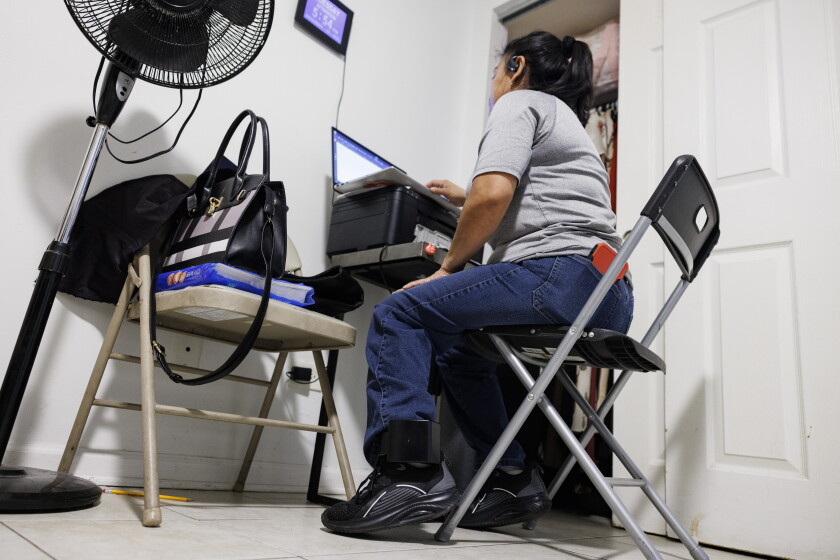
Liz sits at her computer while wearing her ankle monitor at her home on the North Side. She is currently studying English.
Anthony Vazquez/Sun-Times
Constant anxiety the monitor won’t work
Liz says her family has always been under some form of federal surveillance. Her husband was fitted with an ankle monitor when he first arrived in the United States in 2024. Still, the family managed to find work and build a life in Chicago after fleeing violence and street crime in Guatemala. He worked as a scrap metal collector, and she cleaned homes.
Now, Liz is trying to hold the family together on her own.
But she’s struggling.
In late October, Liz received an unexpected message ordering her to report for an immigration check-in at the same building where her husband was arrested. She worried agents would accuse her of tampering with her ankle monitor and take her into custody.
“I’m coming here prepared for anything, because I don’t know what could happen to me inside,” she says.
On the morning of her appointment, Liz’s attorney could not attend, so she arranged for a pro bono lawyer to accompany her. Before heading to the check in Liz spoke with relatives about the possibility that she might not return. She says her 15-year-old daughter was crying as she walked out the door.
But this time that appointment went OK.
A technical glitch had caused her ankle monitor to stop sending location data to ICE, triggering the urgent check-in to verify she had not cut it off. Officials adjusted the device and told her she must wear it for a year and a half of full compliance before she can be moved to a phone-based check-in app.
“I think the fear is also that if you don’t do everything perfectly, even with all these barriers, that something’s going to happen to you,” says Gabriela Nicolau, the pro bono attorney who accompanied Liz.
Outside the federal building, Liz says she felt relieved — for the moment. Maybe this time, she got lucky, or bringing an attorney made a difference.
But that relief is temporary. The tracker — and the anxiety and fear it brings — isn’t going anywhere.
Contributing: Keenan Chen