
Writer: Philip Van Doren Stern (adapted by Anthony E. Palermo)
Director: Jessica Lazar
There are all sorts of reasons why one would not want to adapt Frank Capra’s 1946 movie It’s a Wonderful Life for the stage. The film itself is near perfect. Its bleak narrative and emotional architecture depend heavily on techniques unique to cinema. The sprawling ensemble of townsfolk, children, bankers, and angels demands either cuts or relentless onstage doubling. Few screen performances are as embedded in collective filmgoer memory as Jimmy Stewart’s protagonist, George Bailey, leaving the lead actor in a bind: play the role as a karaoke caricature, or play against it and disappoint audiences anticipating Christmastime nostalgia.
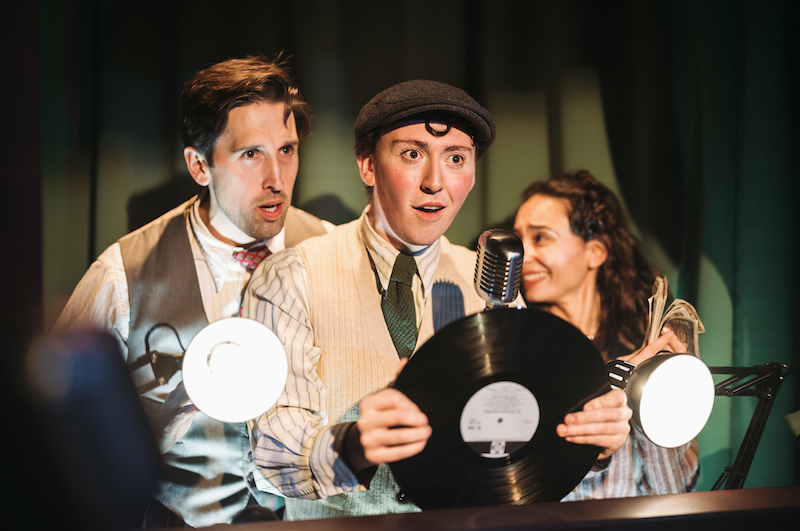
Anthony E. Palermo’s 2005 stage adaptation addresses the conundrum with some metatheatrical framing. It’s a Wonderful Life becomes a 1940s live wireless broadcast, delivered by six multi-rolling performers and utilising a ragbag of Foley effects to suggest action and place.
Jessica Lazar’s atmospheric revival by the “Jermyn Street Theatre Radio Studio” delivers an impeccably executed celebration of the craft of radio-play-making, while paying strict homage to the source material and delivering laughs along the way. The piece is enjoyable, comforting, festive fare, with a political message about predatory capitalism that is as pertinent today as ever. Yet, at the back of one’s mind, a question just will not go away, amplified by the fact that most of the dialogue seems to be taken directly from the film. Why bother?
It is Christmas Eve. Compassionate but frustrated George Bailey (Griffin Stevens) stands on the edge of an icy bridge, mulling over whether to jump into the river below. He has spent his entire life sacrificing his own dreams to run Bedford Falls Building and Loan, shielding local working-class families from the ruthless greed of town capitalist Henry Potter (Mary Higgins, firmly in Cruella De Vil territory). Yet now he faces ruin. Absent-minded Uncle Billy (Stefan Bednarczyk) has lost $8,000 of the company’s funds, money his wife Mary (Iniki Mariano), he surmises, will be able to replace from George’s life insurance.
Before he can jump, George’s bumbling, second-rate guardian angel, Clarence (Stefan Bednarczyk, again), intervenes at the behest of the Superintendent of Angels (David Webber). He grants George’s bitter wish that he had never been born, plunging him into a bleak alternate reality where Bedford Falls has become the dark, vice-ridden Pottersville, his brother Harry (Lachlan Werner) drowned in childhood, and Mary is a lonely spinster librarian. Confronted with the stark reality of his absence from those he loves, George chooses to return to life, facing shame and arrest. But how will his neighbours and friends respond?
Stevens’s George references the folksy, gravelly Jimmy Stewart stammer without, thankfully, trying to replicate it. His Bailey comes across as a little more cynical than one might expect, but that may be no bad thing. Bednarczyk fluffs a fair few lines, but this being a radio play it matters not a jot, and his onstage background piano playing is tremendous. Perhaps he should have stayed on book as the genial Webber does early on, shifting between playing the local doctor, police officer and bank teller with consummate confidence. Mariano is great, too, breaking the fourth wall early on in a clipped English accent, before submerging into Mary’s well-rendered Midwestern drawl.
Much of the evening’s comedy, however, comes from the impressively kiss-curled Werner, who renders many of the female characters with a kind of near-pantomime drag energy. It ought not to work in a piece that is so wholesomely American, but it does, brilliantly. His savings and loan clerk, Tilly, carries shades of TV’s Hyacinth Bucket and is a particular delight.
Lazar’s pacey direction brings plenty of well-judged movement to what threatens to be a static radio piece. Yet the performers’ rapid switches from microphone to microphone, and from character to character, never feel too busy, something of a feat in Jermyn Street’s intimate setting.
Tina Torbey’s set, with wood panelling, a realistic-looking sound booth stage right, and a host of Foley effect machines – complemented by Anna Lewis’s costumes in a palette of russet browns and cream – captures the 1940s vibe perfectly. When the dreamlike Pottersville sequence arrives, the set transforms into a louche, curtained down-market speakeasy, pulling the production out of the radio milieu and into something approaching realism.
Watching six talented performers conjure an entire town out of thin air using only vintage microphones and theatrical ingenuity makes for an engaging evening. Yet this production never entirely silences that nagging question of necessity. Should you stay in and watch the movie on TV or pop down to Piccadilly for this? If you do, come for the impeccably-executed demonstration of the art of radio theatre-making, for nothing will match up to Capra’s celluloid classic.
Runs until 3 January 2027
The Reviews Hub Star Rating
70%
Well-executed but necessary?