People with borderline intellectual functioning who have similar IQ scores differ widely in how well they cope with daily life, an analysis by the Seoul city government found, pointing to the limits of using IQ alone to decide who needs support.
The Seoul Lifelong Learning Support Center for People with Borderline Intellectual Functioning, known as the MEME Center, analyzed data on 1,000 members to examine the relationship between IQ ranges, cognitive traits and the ability to function in everyday life, the city said on the 26th. IQ scores were available for 936 members, and 224 had taken a social maturity test.
Among the 147 members with an IQ of 70 or higher who took the social maturity test, 58, or 39.5%, scored below 75 on the social quotient index. The index measures how well a person manages daily life independently and interacts with others, covering practical skills such as using public transportation, handling money, communicating and building social relationships.
The findings indicate that some people need continuing help in daily life even when their IQ is above a given threshold. Two people with comparable cognitive ability can differ in practical functioning depending on their living environment, past experience and opportunities to communicate, the center said. The analysis covers only the subset of center members who took the test, so the results cannot be generalized to all people with borderline intellectual functioning.
People with borderline intellectual functioning do not meet the criteria for an intellectual disability but can face difficulties in learning, employment and social life. Critics have said the current support system lacks a clear definition of who qualifies and clear screening criteria, leaving some people without help.
Some experts argue that eligibility should be determined by weighing daily-life functioning, developmental history and living environment alongside IQ. Lawmakers are also debating related legislation. At a National Assembly Health and Welfare Committee hearing in November 2025, members discussed the definition of eligible recipients and diagnostic criteria across seven bills, and another bill was introduced in September this year.
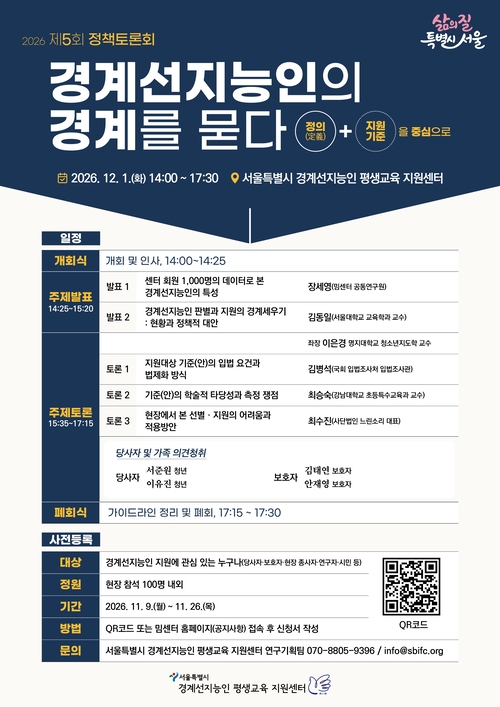
Drawing on the analysis, the city will hold a policy forum at the MEME Center in Seoul’s Jung District on Dec. 1 to focus on how eligibility for support should be set. In the first presentation, Jang Se-yeong, a co-researcher at the center, will explain the findings from the data on 1,000 members. Kim Dong-il, a professor of education at Seoul National University, will then propose criteria that take both IQ and daily-life functioning into account.
Specialists in legislation, special education and front-line services will examine how the proposed criteria could be written into law and applied in practice. Two young adults with borderline intellectual functioning and two guardians will also join the discussion to describe the difficulties they have encountered in seeking support, and participants will discuss ways to prevent the stigma and discrimination that can follow a diagnosis.
“This forum matters because it brings together experts from different fields to build an effective legal foundation based on empirical evidence,” said Lee Hae-sun, director general of Seoul’s Lifelong Education Bureau. “We will work to set a direction for eligibility criteria that reflect the characteristics of people with borderline intellectual functioning and their need for support.”