
The people of ancient China believed that music could purify the human mind. More than three millennia ago, ancient China already had some seventy types of musical instruments. The royalty and aristocrats had their own orchestra at their disposal. For them, music was also a way of displaying authority, position and distinction from common people. But as there was never a legal prohibition on music in the lower classes, musical know-how was always percolating down. This process also had a tendency to make it less homogenously solemn, and to produce exciting new works prized for their value as entertainment. Chinese traditional instruments be mainly classified into three categories: string, wind and percussion. Here’s a brief introduction to the “greatest hits” of Chinese musical instruments.
1. Xun(埙)

The xun is one of the oldest musical instruments yet identified in China, evidently going back about 7,000 years. With some slight variations, the xun is a globular (egg-shaped) flute. There are usually six holes for six tones, and the effect is similar to that of an ocarina but without the mouthpiece. The xun started appearing around the time of the Xia Dynasty, presumably after hunters developed an interest in the sounds one of their weapons was making. The weapon in question is a rock or piece of bone attached to a string, hurled as a projectile. Sometimes these objects were hollowed out, and depending on the number of holes, they would whistle when used in the field. After thousands of years of refinement, the timbre produced by the xun is similar to that of the human voice, and is suitable for performing some lamenting arias.
2. Pipa(琵琶)

One of the most popular of all Chinese instruments, the pipa has been played for nearly two thousand years. The pipa is sometimes called the Chinese lute, and does operate on the same basic principals of its western cousin. Each pipa has four strings and thirty frets, with the body pear-shaped. The pipa player holds the instrument upright and plays with five small plectrums – one attached to each finger of the right hand. The instrument is renowned for its wide dynamic range and is remarkably rich and expressive in the hands of an artist. One legend has the pipa invented to allow a Han princess to play from horseback, giving vent to her homesickness while traveling.
3. Liuqin(柳琴)

Another pear-shaped chordophone, the liuqin perhaps most resembles the western mandolin. It’s distinguished by its small size, almost a miniature of the pipa. The range of tones producible is much higher than that of the pipa, and has its own special place in Chinese music – standing out in both orchestral or solo situations. Modern times have also seen a gradual elevation of the status of the liuqin from an accompanying instrument in folk Chinese opera, to an instrument well-appreciated I its own right, for its own unique tonal and acoustic qualities.
4. Drum(鼓)

Although its exact origin is still disputed (and basically unknown), the drum occupies a central position in the story of Chinese music and a prominent place in the culture at large. According to ancient texts, the drum has been with Chinese identity from the very beginning.
During its development, the Chinese drum has undergone many regional as well as ethnic variations. As a result, today they produce many different visual impacts and bring to the viewers different senses of beauty. Some drums are masculine, giving off a sense of invincible might, and some are more delicate, made to be played with a lighter touch.
5. Lusheng(芦笙)

The lusheng developed and is found today primarily in rural parts of southwest China, such as Guizhou, Guangxi and Yunnan, as well as in nearby countries like Laos and Vietnam. It is a persistent part of the Miao, Hmong and Dong cultures, with performers often dancing with the instrument, or swinging it from side to side, while playing.
The lusheng incorporates multiple bamboo pipes – usually five or six, each producing a different pitch – each fitted with a free reed, which are in turn fitted to a long blowing tube made of hardwood. It comes in sizes ranging from very small to several meters in length.
6. Bianzhong(编钟)
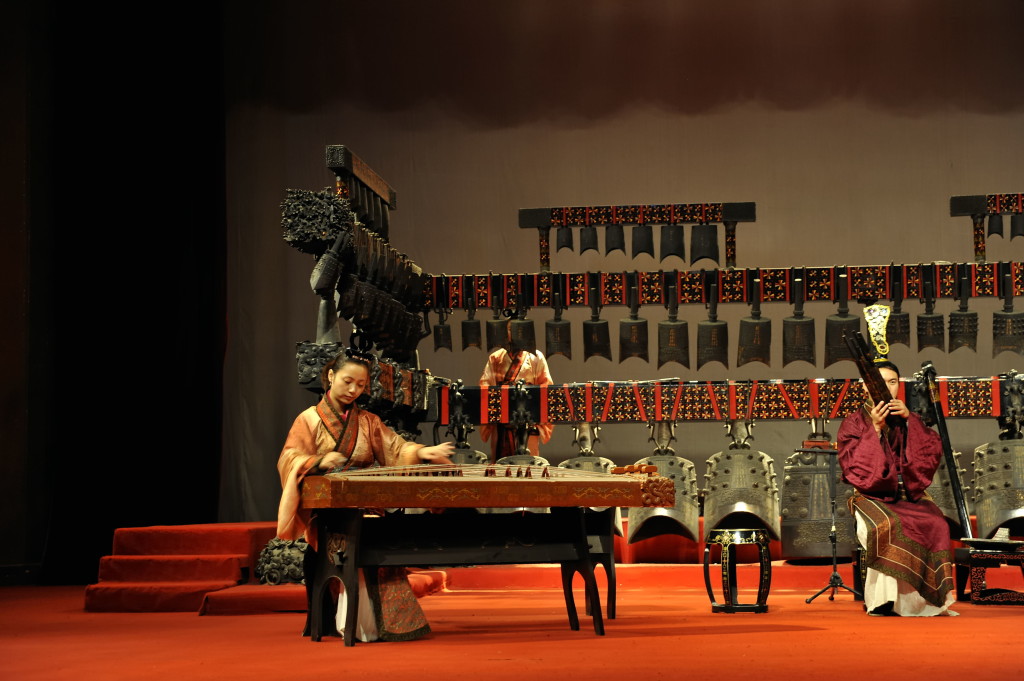
The bianzhong is an ancient Chinese instrument consisting of a set of bronze bells, each producing a different tone, which can then be played melodically. These sets of chime bells have been used as a polyphonic, cohesive musical instrument for at least 3,600 years. They were originally hung in a wooden frame and then struck with a mallet. Along with stone chmes known as bianqing, the bianzhong was an important instrument in the development of China’s ritual and court music culture, going back to ancient times.
7. Xiao(箫)

The xiao is another very ancient Chinese instrument usually thought to have developed from a simple end-blown flute used by the Qiang people of Southwest China. Usually made from bamboo, the tones and timbres produced by this instrument are now tangled up in Chinese cultural notions of nostalgia, homesickness, ennui, and generally gazing at the moon on a cold night. The sound is also associated with nature.
8. Paiban(拍板)

The paibian is a kind of clapper made from several flat pieces of hardwood or bamboo. It is used in many different forms of Chinese music, and as such there are several different types of paibian to suit different occasions. Adding to some confusion, the paibian is also sometimes known as the ban, tanban, muban or shuban. Typical materials used to make high quality paiban include zitan (rosewood or red sandalwood), hongmu, hualimu, or bamboo, with the slats tied loosely together by cord. In performance, the instrument is held upright with one hand and clapped together with the other, producing a sharp clacking sound, useful for staccato effect.
9. Erhu(二胡)
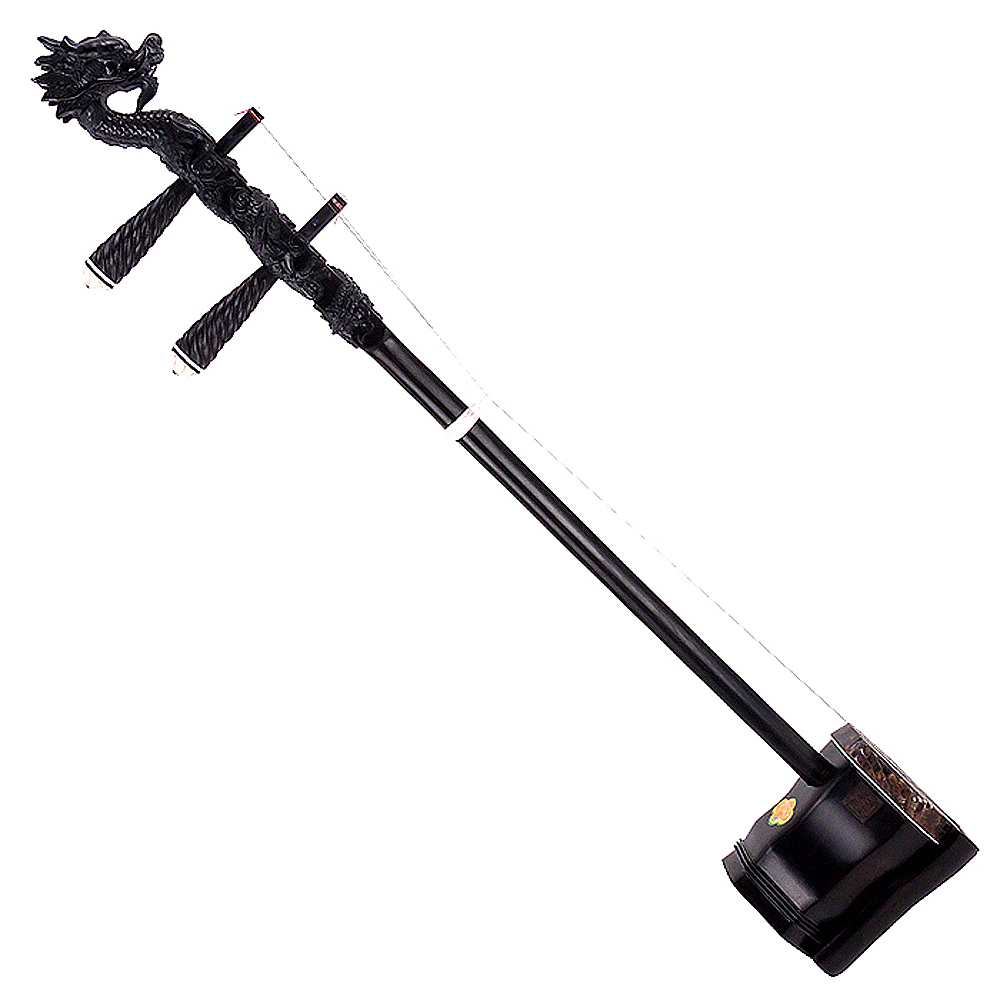
The erhu is one of the most popular Chinese stringed instruments. Sort of a two-stringed upright violin, the erhu has been played for at least 1,000 years in China. Capable of an expressive and haunting sound, the erhu is very popular in contemporary China as a medium for both traditional and contemporary music. It can also be played solo or in orchestral arrangements. The tone of the erhu has been said to resemble the human voice, and a skilled musician can use it to reproduce the effect of other sounds from nature, like that of a bird or a horse. An erhu player usually sits with the instrument on his or her left thigh or quadricep, right in front of the left hip, and plays the instrument by moving the bow horizontally over the two strings. The erhu’s considerable range spans three octaves and the tone sounds something like a violin, gentle but firm and slightly nasal.