
People come to China for numerous and diverse reasons, but exploring the country’s Buddhist and Daoist culture is a popular draw. China is a multi-religious country. Taoism, Buddhism, lslamism, Protestantism and Catholicism have all developed quite a following in this country. Freedom of belief is a government policy, and normal religious activities are protected by the constitution.
Daosim
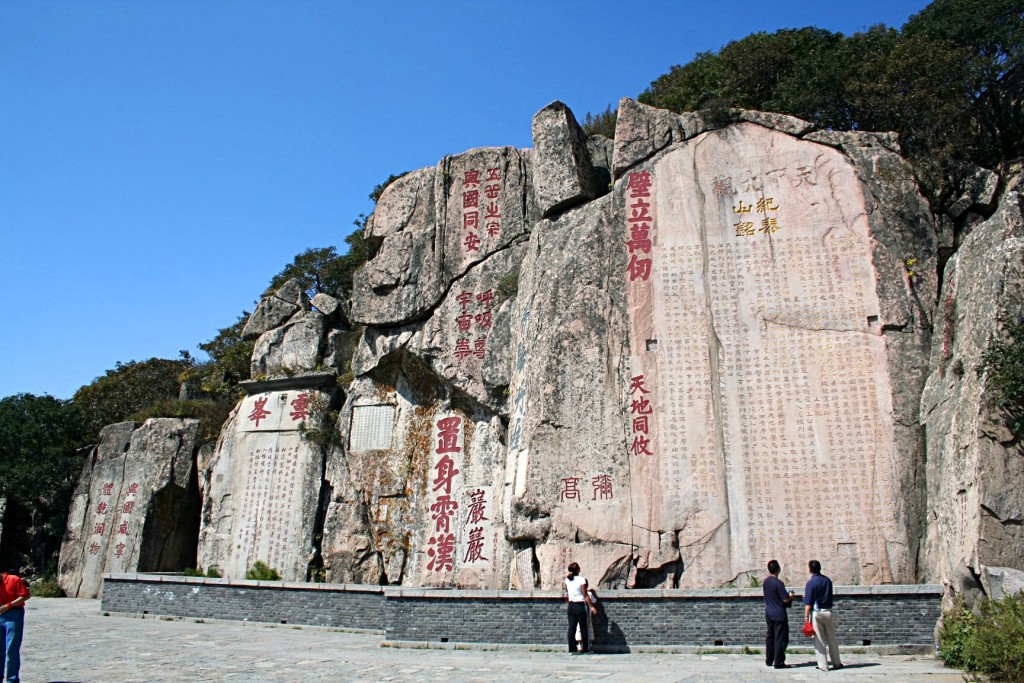
Daoism (often Romanized as Taoism) is the ideas and ideologies of one of China’s great thinkers – Laozi (often Romanized as Lao-Tzu). Though many contemporary scholars believe that Laozi was never actually a single person but rather a collective of intellectuals over time, history tags him as a record-keeper in the courts of the Zhou emperor (somewhere around the 600-500 B.C.E.).
There are few theologies that are as widespread as Daoism. In fact, written by Laozi, Daoism’s primary source book – the Dao De Jing (Tao-te Ching) – loses out only to the Holy Bible as the most translated piece of literature. However, it is not the only tome of Daoist thought. Another Daoist philosopher and contemporary of Laozi, was Zhuangzi (4th century B.C.E.), who wrote the second seminal book of classic Daoist reading – simply titled Zhuangzi.
The Dao, or ‘Way’, is a concept that relays that all things adhere to a simple principle or force that guides naturally and without effort. The crux of Daoism is Wu Wei, or non-action, the idea that through letting nature flow the way it is intended, and ourselves flowing with it, we can reach a harmonious and balanced life.
Longevity is an important practice in Daoism and it is the Daoists that the world can thank for traditional Chinese herbal medicine and the extremely popular Tai Ji Quan (or Tai Chi).
Recommended Taoist Sites
Mt. Tai in Shandong Province
Mt. Huangshan (the Yellow Mountains) in Anhui Province
City God Temple in Shanghai
Buddhism
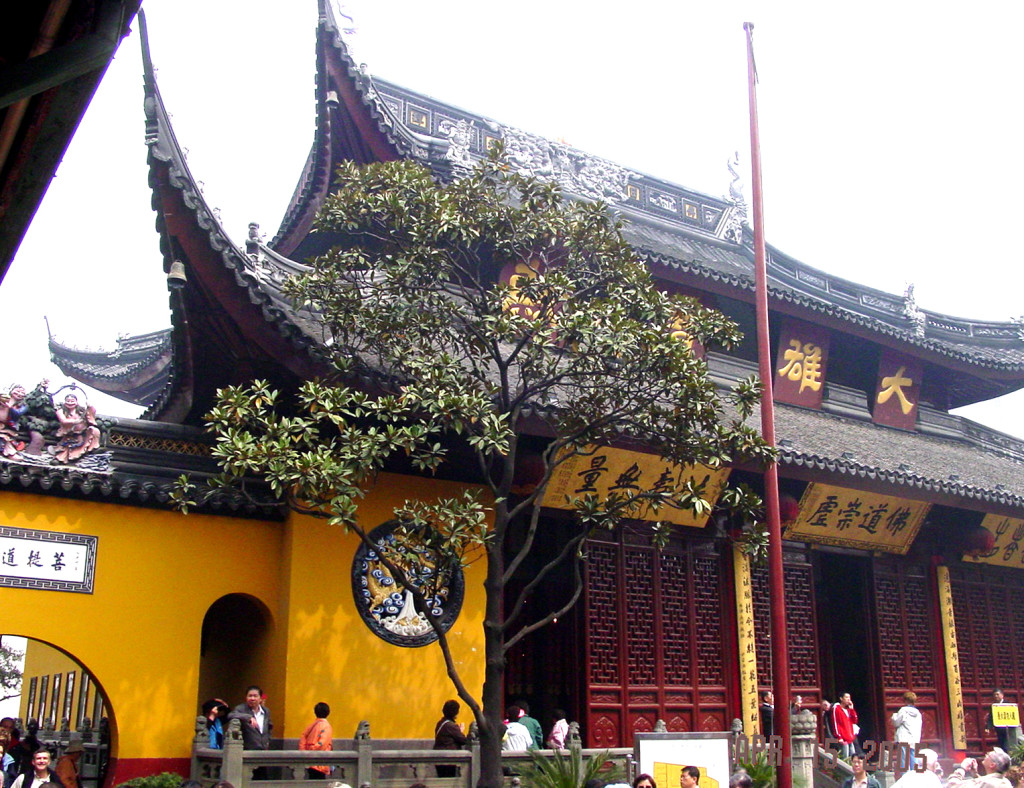
Extremely popular throughout all of Asia, Buddhism came to be about 2,500 years ago when Guatama Siddhartha left the comforts of being son to a chief in Northern India (modern day Nepal) to discover the “middle way” – halfway between being an ascetic and an average person – while meditating under a tree in the city of Varanasi. After this he donned the title “Enlightened One” or “Buddha” and began teaching the cornerstone of the religion
Though no one is sure, Buddhism is thought to have come to China via the same route as many other imports from the West – the Silk Road. In the first few centuries B.C.E. there was a blending of China’s borders in the western Indo-China regions, and as such many Buddhists found themselves living under Chinese rule. Then in the Tang Dynasty (618-907 C.E.), with its religious-tolerant Daoist Emperors, Buddhism spread and flourished for nearly three centuries. At the end of the Tang Dynasty the competition between the two paths of thought became too much and many Buddhists were persecuted or killed, with their texts and temples burned and destroyed.
Recommended Buddhist Sites
Jade Buddha Temple in Shanghai
Yonghe Palace Lama Temple in Beijing
Bid Wild Goose Pagoda in Xi’an
Dazu Rock Carvings in Chongqing
Potala Palace in Lhasa, Tibet
Mt. Emei in Sichuan Province
Confucianism
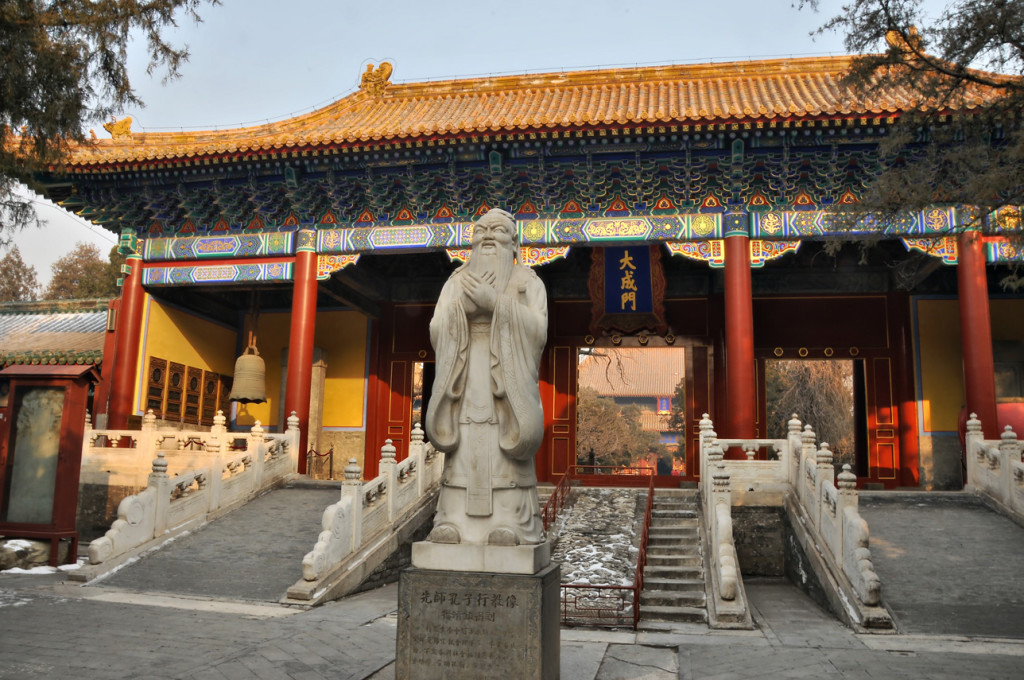
Confucianism is more a system of thoughts and ideas for living a moral and just life than giving belief to a higher or supernatural power – but a ‘Chinese Religion’ section certainly wouldn’t be complete without mentioning perhaps the most influential teacher on Chinese culture and the Chinese mind.
Kongzi (Confucius, 551-479 B.C.E.), was born in what is modern day Qufu, a small city in Shandong province. It is thought that Kongzi’s ideas grew to such popularity due to their compatibility with common Chinese sensibilities. Firmly based on the value of relationships, strong ethics and high morals; he promoted strong family ties, respect for elders, ancestor worship, and public obedience of civil authority.
In order to commemorate this great sage, Chinese people built Confucian temples in honor of his great contribution to Chinese culture. Confucian temples are called Kong Miao in Chinese; they are famous for their large scale, rich cultural relic collection and their artistic value. Among these holy temples, the Confucian temple in Qufu in Shandong Province, which consists of Cemetery of Confucius (Kong Lin), Temple of Confucius (Kong Miao) and the Confucius Family Mansion (Kong Fu) is regarded as one of the holy cities in the world. The Temples of Confucius in Beijing, the Confucian Temple in Nanjing and the Confucius Temple in Shanghai are also well worth visiting.
Islam

It may surprise some that Islam has a strong hold in China, and has been present in the Middle Kingdom for quite some time. It is said that in the 7th century C.E. a delegation of Muslims led by the Prophet Muhammad’s maternal uncle, Sa’ad ibn Waaqas, came to China to ask the Emperor to espouse the followings of Islam.
Though largely concentrated in China’s northwestern Xinjiang Autonomous Region, you can find mosques in most major cities, including the largest in Xi’An and the oldest in Guangzhou. The Muslims do not not eat pork, dogs, horses, donkeys or mules.
Recommended Islamic Sites
The Great Mosque in Xi’an City
Idgar Mosque in Kashgar City, Xinjiang Province
Grand Kuqa Mosque in Kuqa City, Xinjiang Province
Dongguan Mosque in Xining City, Gansu Province
Christianity

Catholicism and other forms of Christianity began to make their way into China very early. In 635, a missionary of the Nestorian sect came to China from Persia, the then called JING. The religion withered long before gaining a strong foothold in China. It was after the Sino-British Opium War in 1840 that the Christian developed rapidly in China. After the founding of New China, Chinese Catholic and Christian communities took the path of independence and self administration. Now there are more than 3.3 million catholic and nearly 5 million protestants in the country.
In addition, there are also members of the Orthodox Eastern Church and of other religions among minority groups.
Recommended Christian Sites
St. Ignatius Cathedral in Shanghai
St. Sophia Orthodox Church in Harbin, Heilongjiang Province
St. John’s Cathedral in Hong Kong