
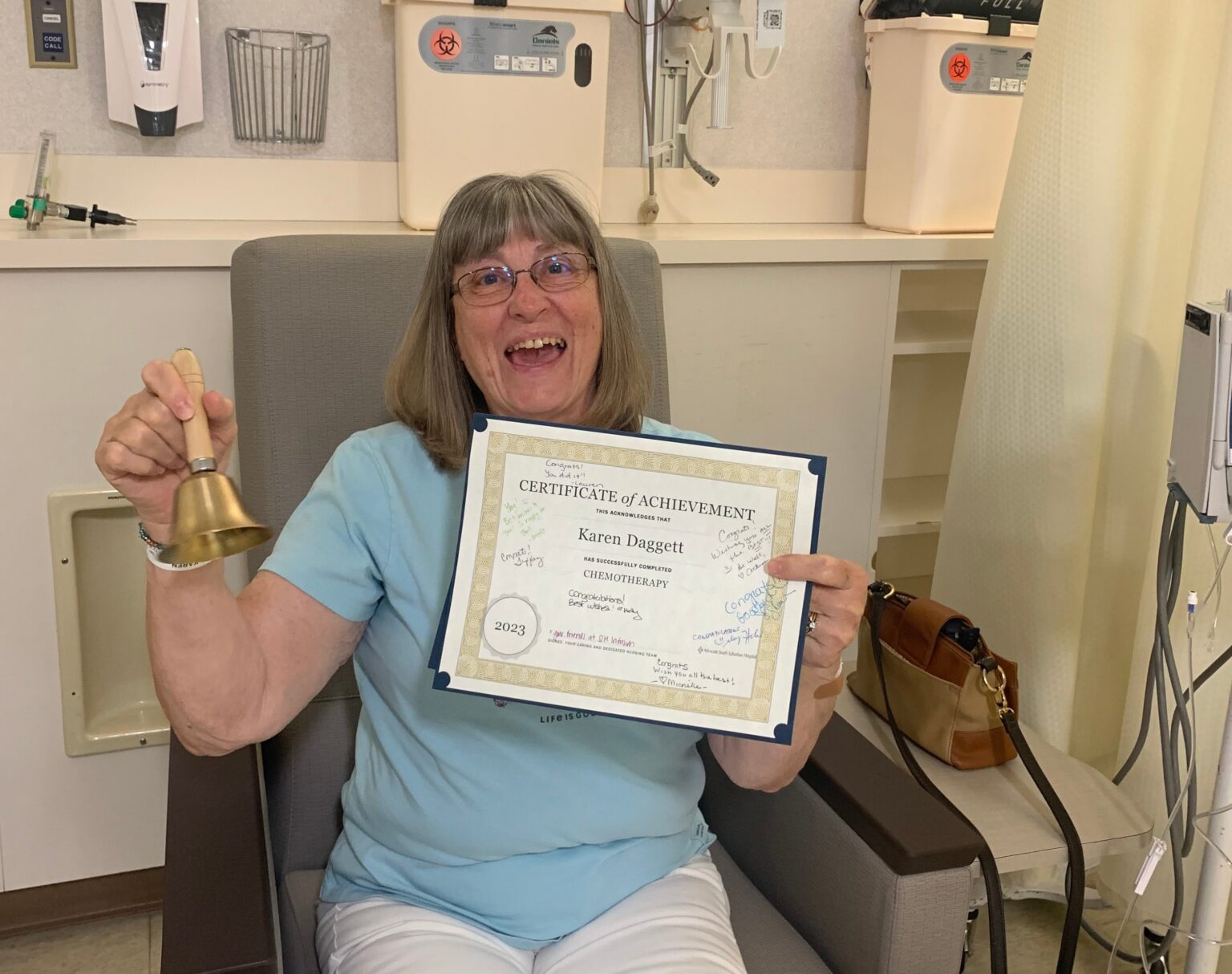
These days when Karen Daggett goes to see her doctors at South Suburban Hospital in Hazel Crest, she’s known as the “dog patient.”
For Daggett, of Chicago Heights, it’s a bittersweet reminder of a family pet that may have saved her life.
Zeki the dog, who has since died, belonged to Daggett’s granddaughter, Anastasia Shriver, a professional handler who had trained Zeki to visit residents in a nursing home. But beyond those regular duties, Daggett believes Zeki helped diagnose her melanoma while she and her family were vacationing in Louisiana in 2022.
“He came over and stuck his nose right into my armpit,” Daggett said. Zeki wouldn’t budge, and a family member had to pull the dog away. “I was surprised he did it.”
When Zeki, a black labradoodle, pressed his snout into the area, Daggett noticed it hurt and afterwards she felt something that didn’t seem like it should be there.
“If it hadn’t been for Zeki, I don’t know how long it would have been before I found the lump,” said Daggett.
Daggett saw her primary care doctor, and after a mammogram and ultrasound three cancerous growths were found in her lymph nodes. She then had surgery to remove 17 lymph nodes and began a course of immunotherapy.
Now cancer free, Daggett, 74, still sees her dermatologist, oncologist and surgeon every six months.
Dr. Ari Seifter, the oncologist/hematologist at Advocate Christ Medical Center in Oak Lawn who has been treating Daggett, said the first time he discussed her cancer diagnosis, she told him, “My dog found this.”
 Karen Daggett, of Chicago Heights, sits with her granddaughter Anastasia Shriver and labradoodle Zeki. Daggett said Zeki helped her discover malignant melanoma under her arm when the dog pushed its snout into the area and wouldn’t stop. (Advocate Health Care)
Seifter said he’d read anecdotes about dogs sniffing out various maladies, but, he said, a canine being able to detect cancer would likely be hard to verify with the same “rigor” as other scientific questions.
But that doesn’t mean he’s a total skeptic.
“It seems like something that could be possible,” said Seifter, a dog lover himself. “Any chemical can be detected by olfactory means and there are definitely proteins and things produced by cancer (that might emit an odor).
“We know some animals have a more keen sense of smell than we do,” said Seifter.
He also said there was something to Daggett’s experience with Zeki sniffing the exact spot where the lump was.
“It doesn’t seem like a coincidence,” he said.
Either way, it led to the cancer being identified early, which was a big factor in the successful treatment.
He also said it was no surprise if more cases of melanoma were found now in older people, because in the past there wasn’t the same knowledge and vigilance about avoiding the sun or using sunscreen.
“My kids probably spend too much time on their tablets,” said Seifter. “It’s not like they go outside (all the time) and play with their friends.”
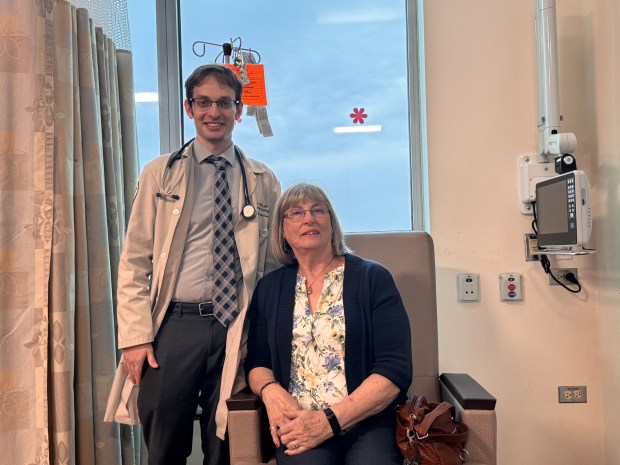 Dr. Ari Seifter gathers with his patient Karen Daggett in the infusion room at South Suburban Hospital in Hazel Crest. Daggett was treated for melanoma under her right armpit, which she said was discovered after family dog Zeki pointed it out. (Advocate Health Care)
Patients at Advocate are advised to see their primary care doctor if they notice different skin abnormalities, including a new lump, lesion or swollen lymph node, a mole or skin spot that changed size, shape or color, had unexplained pain or tenderness, or had a wound that did not heal. He said one reason for Daggett’s successful treatment was that she went to the doctor soon after finding the lump.
Seifter also said patients like Daggett were fortunate to get immunotherapy, which has been used increasingly for different forms of cancer in the past decade, because chemotherapy doesn’t help melanoma. Side effects aren’t usually as painful, either.
“It has become a major mainstay for treatment of several types of cancer,” he said.
Besides being thankful for Zeki, Daggett said she was grateful for all of Seifter’s help as well as for advances in medical research, saying she was told “If this had happened 10 years ago, they would have given you six months.”
Janice Neumann is a freelance reporter for the Daily Southtown.