
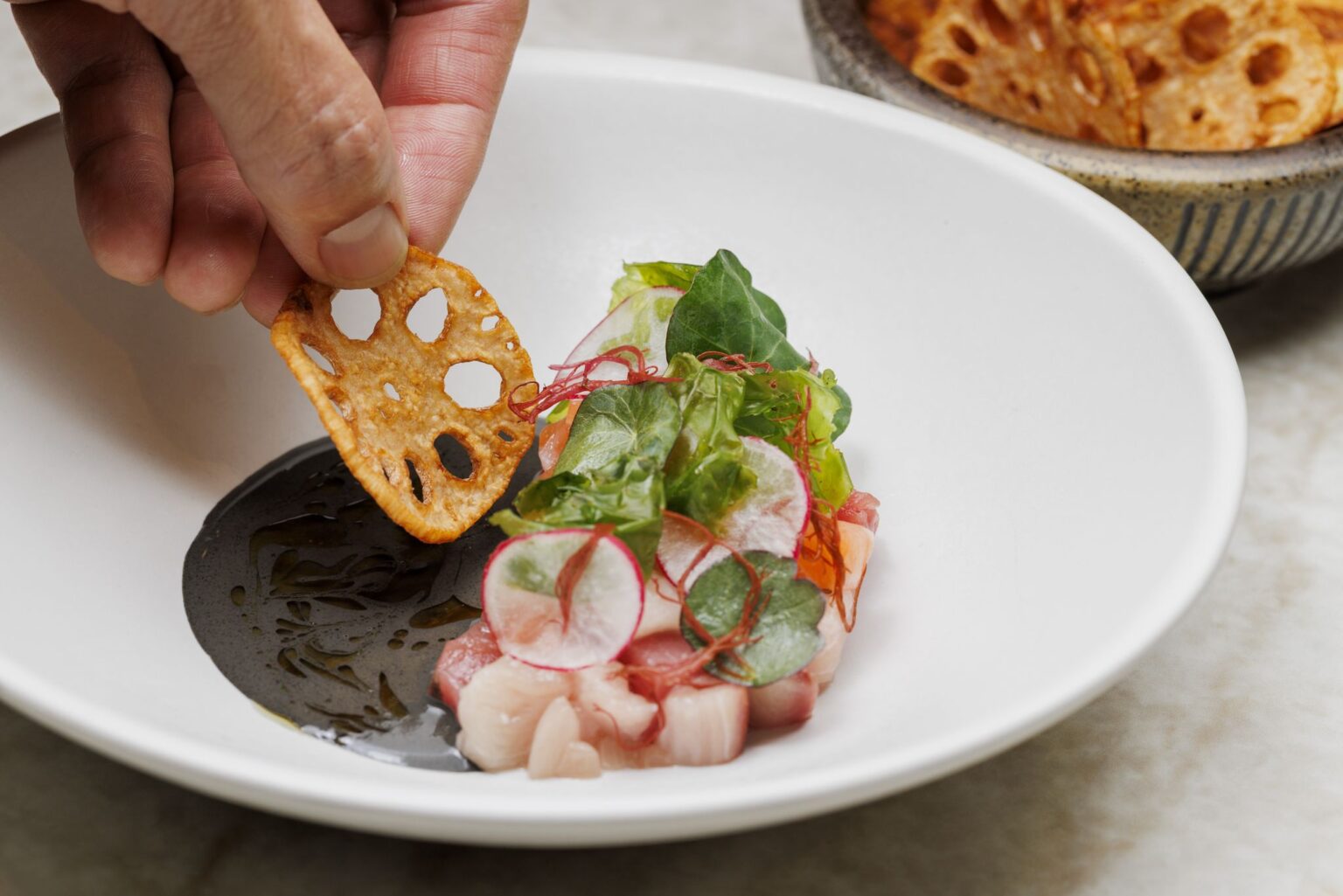
The Nikkei ceviche at Yutori’s new Palo Alto restaurant comes with three kinds of cured fish with a black sesame sauce and roasted kombu oil.
Santiago Mejia/S.F. Chronicle
Owners Linh Tran-Ito, left, and Jerome Ito opened Yutori earlier this year, with a café, konbini, marketplace and now a restaurant.
Santiago Mejia/S.F. Chronicle
The new restaurant has outdoor seating that looks onto a Japanese garden.
Santiago Mejia/S.F. Chronicle
Yutori’s non-alcoholic bitter Yakult fizz is named for and incorporates the Japanese probiotic milk drink, plus mango, orgeat, cream and soda.
Santiago Mejia/S.F. Chronicle
When Yutori opened in Palo Alto this spring, the 5,000-square-foot hub for Japanese food, coffee and goods fast became a popular destination for miso lattes, bento boxes and 7-Eleven-inspired egg salad sandwiches. Starting Thursday, it added a contemporary sit-down restaurant serving Japanese dishes that incorporate Californian and Italian influences.
Just like the rest of Yutori, the restaurant is inspired by the many trips that owner Jerome Ito — a former Google sushi chef and the owner of local udon shop Taro San and poke chain Go Fish Poke Bar — and his wife, Linh Tran-Ito, have made to Japan.
The restaurant’s menu is geared toward family-style dining, such as a bone-in tonkatsu for two or whole roasted branzino lettuce wrap with shiso salsa verde and rayu chili oil, meant for two to three people to share. The Nikkei ceviche ($32), a style developed by Japanese immigrants to Peru, comes with tuna, salmon and halibut cured in lime juice, sitting atop a pool of black sesame sauce and roasted kombu oil. A Japanese mustard greens salad ($22) features a medley of vegetables and herbs, such as shiso, sugar snap peas and Tokyo turnips, from Hikari Farms, a family-owned farm in Watsonville specializing in Japanese produce.
Article continues below this ad
A salad features mizuna, snap peas and other vegetables from Hikari Farms in Watsonville, which specializes in Japanese produce.
Santiago Mejia/S.F. Chronicle
Itameshi pastas, a style that melds Italian and Japanese influences, are also on offer, such as a mentaiko-topped seafood pasta with lobster, clam and scallops in a lobster dashi broth ($58). A maitake mushroom pasta ($38), meanwhile, incorporates nori into beurre monté, a classic French butter sauce. Main dishes include a 3-ounce Japanese Shinshu Wagyu cut ($98) served with golden egg yolk, ponzu and fresh-grated wasabi; and a vegetarian spin on katsu made with cauliflower and a Japanese curry mole sauce ($34).
Ito would like to eventually introduce a tasting menu at the restaurant — not omakase sushi, but rather a mix of existing dishes plus a few special-off menu items. Brunch is also in the works; expect fluffy soufflé pancakes and a Japanese breakfast set that would come with around a dozen small bites such as grilled fish, miso soup and pickled vegetables.
Ito hired Jason Lee, an alum of his restaurants as well as fine dining pop-up venue Ritual at Manresa and the now-shuttered Bar Bon Mot in Santa Clara, to be Yutori’s chef de cuisine. “Finding the right chef was critical. I needed someone who had a similar vision and style as myself,” Ito said. The team also includes business partners Lily Peng, also a partner at Taro San, and Adam Nguyen, Go Fish’s general manager.
The ume Chuhai with shochu, elderflower, ume and tonic is one of several Japanese-inflected drinks at Yutori’s bar.
Santiago Mejia/S.F. Chronicle
Yutori’s bar director Francisco Carranza, an alum of prominent bars including San Francisco’s Pacific Cocktail Haven and Oakland’s Viridian, created a cocktail list threaded with Japanese influence. The bright green Melon Cream Soda cocktail mixes honeydew and lemon juices with pisco and, just like its namesake soft drink, comes with whipped cream on top. The Hannya is made with coconut-kombu-infused tequila, pineapple gum and yuzu bitters. Other drinks feature ingredients such as ume, kombu and sakura.
Article continues below this ad
Sake sommelier Charles Choung, formerly of Michelin-starred restaurants Protégé in Palo Alto and SoMa edomae sushi spot Omakase, crafted a sake list that includes traditional, modern and high-end bottles from Japan. The bar is well-stocked with premium spirits, including a vast lineup of Japanese whiskies. The wine list spans California, France and Italy.
The 70-seat, modern dining room is outfitted with white tables, curved birch banquettes and soft lighting from hanging Japanese lanterns. An outdoor area that looks out on Yutori’s Japanese garden has another 30 seats.
Almost six months after opening, Yutori’s café still draws long lines, and the sunny outdoor patio is often packed with people eating black sesame scones and onigiri. Tran-Ito said that business has been great between the café, konbini and market. “People have been enjoying their time here. That is the best thing that has come out of Yutori so far,” she said.
Yutori. Restaurant opening Sept. 24. 3375 El Camino Real, Palo Alto. yutori-pa.com
Article continues below this ad