
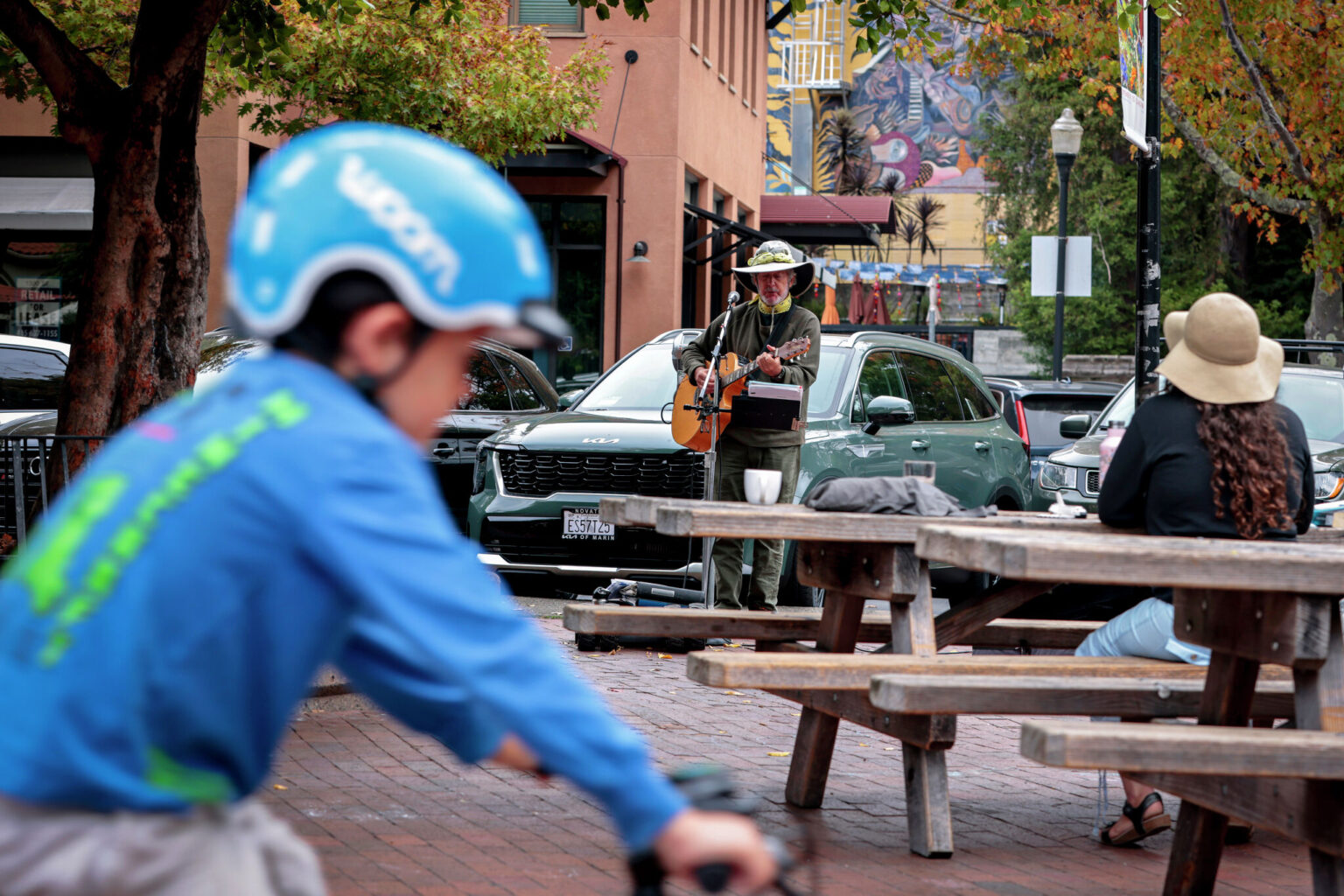
Live music and picnic tables in Mill Valley’s downtown plaza. A group of neighbors has repeatedly sued the city over a proposal for affordable housing.
Brontë Wittpenn/S.F. Chronicle
Mayor Max Perrey points to a sign with a proposed affordable housing project near Hauke Park in Mill Valley. The proposal is the subject of ongoing litigation.
Brontë Wittpenn/S.F. Chronicle
Mill Valley Market in downtown Mill Valley is one of several natural food stores in the city.
Brontë Wittpenn/S.F. Chronicle
Mayor Max Perrey speaks with Mt. Tam Community Land Trust vice chair Karen Pelham at the Mill Valley Falls Arts Festival. Perrey has supported the Bayfront Terrace project as necessary for Mill Valley’s future.
Brontë Wittpenn/S.F. Chronicle
Ten miles north of the Golden Gate Bridge, Mill Valley has long offered wealthy liberals a redwood-shaded haven. It’s a place where pro-democracy stickers adorn Tesla bumpers, natural food stores cater to health-conscious shoppers and the verdant trails of Mount Tamalpais beckon weekend explorers.
But behind the lush scenery and bohemian vibe is an uncomfortable paradox. Despite its progressive politics, this Marin County enclave is strikingly homogeneous: About 80% of its roughly 14,000 residents are non-Hispanic white, making Mill Valley the whitest town its size in the Bay Area. As of the 2020 census, it was also the region’s third-most segregated municipality, a pattern rooted in exclusionary housing practices that trace back to the early 20th century.
In recent years, city officials have tried to confront this fraught legacy by promoting diversity initiatives and planning the town’s first fully affordable housing development in three decades. Proposed on a city-owned parking lot serving a popular park, Bayfront Terrace would be a 45-unit apartment building for families earning roughly $40,000 to $140,000 a year, depending on household size.
Article continues below this ad
Some neighbors oppose plans to convert a parking lot at Hauke Park, a waterfront complex of sports fields and green space in Mill Valley, into an affordable housing complex.
Brontë Wittpenn/S.F. Chronicle
Though Mill Valley’s City Council unanimously approved the project in January, lawsuits filed by a neighborhood group have left the development in legal limbo. Friends of Hauke Park argues that building Bayfront Terrace in one of the town’s more racially diverse — and less affluent — neighborhoods would perpetuate the very segregation officials say they want to dismantle.
The debate is about far more than three stories of income-restricted homes that would help Mill Valley meet its state housing targets. Initially envisioned as a way to make this historically exclusive haven more economically and racially diverse, Bayfront Terrace has raised a harder question: What should inclusion look like in a place where affordable housing is already concentrated on one side of town?
“This feels like an extremely important moment,” said Urban Carmel, a City Council member who has been closely involved in planning the project. “If this complex isn’t built, we won’t just struggle to meet the state’s housing requirements. Our yearslong effort to become a more diverse community will take a huge, huge hit.”
Friends of Hauke Park contends that affordable housing should be spread more widely across Mill Valley. City officials considered several locations west of Camino Alto, in wealthier parts of town, before proposing Bayfront Terrace for 1.6 acres of city-owned land just east of the road.
Article continues below this ad
Opponents call the unofficial area East Mill Valley. It is home to all six of the city’s existing income-restricted developments. Though less wealthy and white than Mill Valley’s west-side neighborhoods, it remains affluent by regional standards, with a median household income of about $147,000, a median home price of about $1.5 million and a non-Hispanic white population share of about 65%.
“We are in favor of affordable housing,” said Gary Batroff, president of Friends of Hauke Park, which includes hundreds of members, many of whom live in the Enchanted Knolls neighborhood that overlooks the proposed site. “But if the point is to be inclusive, where do you want to include people? Do you want to include them on the edge of a park, on the edge of town? Or do you want to put them on a main street?”
A sign from a neighborhood group that opposes the Bayfront Terrace project.
Brontë Wittpenn/S.F. Chronicle
City officials counter that the proposed site’s surrounding neighborhoods are not as economically or racially distinct from the rest of Mill Valley as Friends of Hauke Park suggests. Mill Valley’s own assessment describes the “entire city” as “a segregated community based on its low percentage of non-white populations,” not just the area around Hauke Park.
Article continues below this ad
The longer the lawsuits drag on, the harder it might be to build any affordable housing in the city. City Attorney Inder Khalsa fears that prolonged delays make it harder for developers to secure funding for these types of projects.
Under its state-mandated housing plan, this small city nestled along Richardson Bay is supposed to accommodate 865 additional homes by 2031, about half of them affordable for very low- and low-income households. If Bayfront Terrace fails, it might embolden other neighborhood groups to block future affordable housing proposals with lawsuits.
City officials acknowledge they would be hard-pressed to find another project as ready-made as this one. Since Bayfront Terrace is proposed for city-owned land, its developer, San Rafael-based EAH Housing, could focus on financing the apartments.
Despite the litigation, the project has drawn considerable support. Mill Valley committed $1 million in local and state funds to the proposal and agreed to lease the property to EAH for 99 years.
Mill Valley Mayor Max Perrey sits for a portrait at the Mill Valley Falls Arts Festival. The city has committed itself to adding affordable housing to bring in more diversity.
Brontë Wittpenn/S.F. Chronicle
“We really do feel that, outside of that one group, everyone in town believes in this project,” Mayor Max Perrey said.
Article continues below this ad
The question of who gets to live in some of the Bay Area’s most affluent communities extends far beyond one project — or one town. According to the latest census data, six of the region’s seven whitest cities were in Marin County, where Black residents make up 2.9% of the population.
The county’s history of exclusionary zoning helped shape its current racial makeup, and decades of limited housing construction have kept middle-class families from many of Marin’s communities. Few are more expensive than Mill Valley, where modest bungalows can sell for more than $2 million, and average one-bedroom rents approach $3,000 a month.
It’s not hard to understand why people pay a premium for the community’s highly regarded schools, temperate climate and small-town charm. Just steps from the boutiques and galleries of Throckmorton Avenue, Cascade Creek tumbles past the old mill that gave the town its name. Narrow pedestrian paths wind between hillside homes. The Dipsea Trail climbs through redwoods to Stinson Beach.
Carmela Davis grew up imagining she would raise a family in her picturesque hometown. But after leaving for college eight years ago, she gradually abandoned that dream as she followed one housing battle after another across Marin.
Despite its liberal reputation, the county has become a symbol of NIMBY intransigence. Marin consistently ranks at or near the bottom among Bay Area counties in meeting state-mandated housing production goals. In November, opposition to a 243-unit apartment complex in Fairfax helped prompt a recall election targeting two elected officials, whom opponents accused of surrendering local control to state officials.
Article continues below this ad
Davis, 25, now works remotely from her Portland, Ore., apartment. As a housing specialist for a San Rafael-based nonprofit, she advocates for affordable housing in the county she cannot afford to call home.
“Marin is a place that really does represent progressive ideals,” Davis said. “It’s a sad reality that, when it comes to building low-income homes in their community, some people immediately change their tune.”
Downtown Mill Valley, home to shops and restaurants, maintains a small-town charm.
Brontë Wittpenn/S.F. Chronicle
As many cops, teachers and firefighters have been priced out, more workers commute into Mill Valley each morning, adding to traffic on Highway 101. With cars still the main means of transit, officials now estimate that around 15,000 vehicles enter Mill Valley daily. On East Blithedale Avenue, one of the town’s main arteries, afternoon commute times rose by about 40% over the past decade.
Along the way, Mill Valley’s housing shortage has become a more pressing policy issue.
A turning point came in 2013 when voters elected two vocal housing advocates, John McCauley and Jessica Jackson, to the City Council. They championed an affordable housing fund, helped revise zoning to allow in-law units and established a housing advisory committee.
Still, the city had not made any significant headway on new fully affordable housing by 2020. That year, then-Mayor Sashi McEntee’s viral response to a public-meeting question about Black Lives Matter — that the issue was not of “immediate local importance” — brought renewed scrutiny to Mill Valley’s lack of diversity and previous racist incidents at Tamalpais High School.
“It can be hard for people to be truly welcoming to other backgrounds and cultures when they haven’t ever really been exposed to them,” said longtime resident David Levin, a vocal supporter of Bayfront Terrace. “It’s been clear for a while that something needs to change.”
In September 2020, two weeks after the mayor’s dismissive remark, the council approved a DEI Task Force that recommended identifying public land for affordable housing. Within months, Mill Valley officials had short-listed four sites: three west of Camino Alto, on the town’s wealthier and less racially diverse side, and just one east of it, the Hauke Park location, which they ultimately chose.
They said it offered a relatively flat building area outside mapped flood zones, while still being within walking distance of schools, shops and public transit.
Friends of Hauke Park, though, argued the project would intrude on adjacent wetlands and wildlife habitat and unfairly concentrate affordable housing. In June 2023, the group took its objections to court, suing over the city’s housing plan and related environmental review.
A Marin County judge rejected the group’s first lawsuit in April. He denied Friends of Hauke Park’s housing claims, because they didn’t show that the project would reduce opportunities for lower-income residents or racial minority groups, and found its environmental claims moot after the city adopted a revised plan in January.
But in the wake of that January approval, the group sued again. That case and another are pending, and, if successful, could jeopardize the project’s affordable housing financing and even make it unfeasible.
Still, Paula Weaver, one of Friends of Hauke Park’s most vocal activists, objects whenever someone suggests she is anti-housing.
“The real NIMBYs here are the people who eliminated possible sites for this project on the west side of town,” Weaver said. “This really does feel targeted.”
Visitors shop at the Mill Valley Falls Arts Festival. About 80% of Mill Valley’s roughly 14,000 residents are non-Hispanic white, making Mill Valley the whitest city its size in the Bay Area.
Brontë Wittpenn/S.F. Chronicle
Samir Gambhir, an author of the 2020 study that ranked Mill Valley among the Bay Area’s most segregated towns, said the argument might carry more weight in a lower-resourced community such as Vallejo or Richmond.
“I don’t buy the notion that putting affordable housing anywhere in Mill Valley would increase segregation,” Gambhir said. “A project like Bayfront Terrace would open the community up to lower-income families, including more people of color, who can actually benefit from being in that neighborhood.”
On a recent morning, Mayor Perrey stood in the Hauke Park parking lot and nodded toward the condominium complex on a nearby slope where he lives.
For eight years after graduate school, Perrey lived with his mother to save for the down payment on a $530,000 condo there. Despite earning about $150,000 a year, the 35-year-old health policy executive now spends more than half his monthly income on his mortgage and homeowners’ association fees.
“I’ve saved zero money, and I’m just a single guy with no kids,” Perrey said. “Still, I know how lucky I am. I not only got to grow up in a place like this, I got to come back. Now we just have to ensure that others who want to live here can live here — even if they make less.”