
Cranes don’t lie. Look at the skyline and count the cranes, and you will learn a lot about the state of development in your city. In San Francisco, the political winds have shifted in favor of building housing — but the cranes haven’t shown up yet.
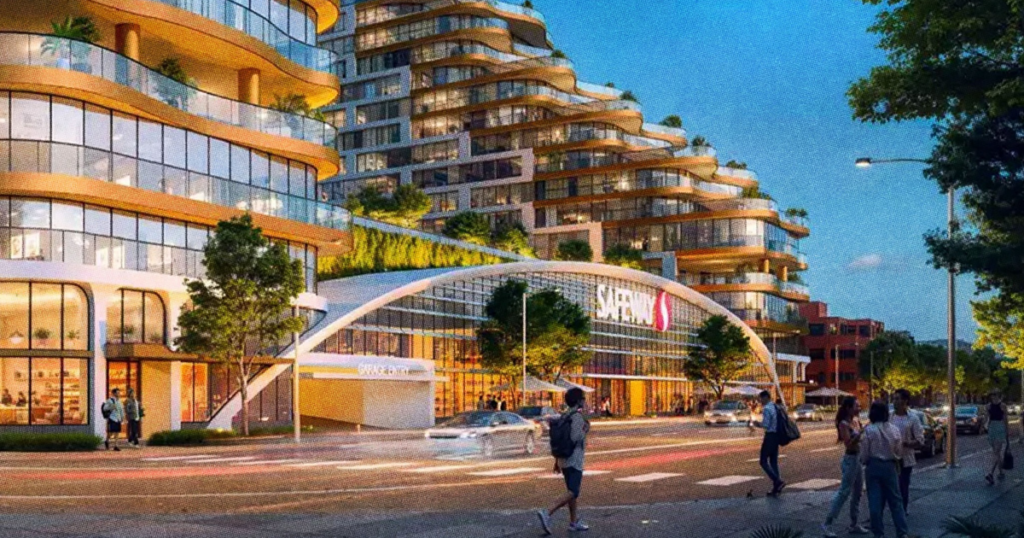
Well, a bunch of cranes will soon be interrupting tourists’ selfies in front of the Golden Gate Bridge in the Marina. That’s because Align Real Estate has gotten approval to build two towers — 22 and 18 stories, roughly 258 and 219 feet tall — with 848 apartments on top of the Safeway there.
And though many residents don’t want it, the days when that would be enough to kill the project are over.
On this week’s episode of “PST,” I sit down with Conor Dougherty, housing reporter for The New York Times, who explains why mega projects like this are coming to cities across California — no matter what. But first, SF Standard business reporter Kevin Nguyen, who’s been tracking the Marina Safeway saga since Align quietly filed its plans last year, joins me to go deep on the specifics of the monster development in the Marina. We get into how the developer outmaneuvered City Hall, why Mayor Daniel Lurie’s YIMBY credentials are suddenly being tested, and what this fight tells us about the future of development in a city that just passed an upzoning plan.
Here are four takeaways from the episode. Listen to the full episode of “PST with Emily Dreyfuss” wherever you get your podcasts, or watch on YouTube.
The Marina Safeway project can’t be blocked by residents
Opposition to the project is robust, as evidenced by more than 250 people showing up to that community town hall last month, but there is nothing residents or local politicians can do administratively to stop the project from getting approved by city planners.
That’s because Align Real Estate is invoking state housing laws, which either bypass or override local zoning measures. As long as the developer is following state laws it is invoking, the city has no choice but to grant ministerial or automatic approval. Therefore, that town hall for area residents — despite going viral (opens in new tab) — amounted to nothing more than a group therapy session.
 Roughly 250 people met at Fort Mason for a town hall opposing the housing project. | Source: Garrett Leahy/The StandardThe developer executed a precise plan to avoid local opposition
Traditionally, developers have sought community input and collaborated with city planners ahead of submitting plans for approval. They also used to go through months or years of environmental and historical reviews to make sure they’re allowed to build on the site. YIMBYs and developers have argued that these layers of bureaucracy have unnecessarily extended the time it takes to build housing and have disincentivized investors.
As The Standard reported, Align studied Sacramento’s new housing laws while development has been largely frozen. The company identified a site where it could effectively deploy said laws, and submitted its plans to city planners without warning — catching Marina neighbors and City Hall flat-footed and unable to mount meaningful opposition.
Had Align gone through the traditional paths of development, the Marina Safeway project would likely have been heavily downsized or not allowed at all.
YIMBYs have been stacking laws to erase local control
Facing an escalating cost-of-living crisis, state legislators have spent a decade passing laws in an effort to spur housing construction. They started by giving the state teeth in enforcing its mandated production targets, known as a housing element, which are handed down to each local municipality. Cities that did not zone for enough housing lost local control.
State Sen. Scott Wiener and Assemblymember Buffy Wicks, among others, continued adding layers of legislation. Lawmakers rolled back portions of the California Environmental Quality Act and gave developers density and height bonuses if they set aside a certain number of homes for affordable housing or built them near transit. Align wielded these laws to propose a taller project than what would normally have been allowed. State law also allows the developer to build housing on a commercially zoned site.
Lurie believes in upzoning, but not at the Marina
Lurie went on a PR blitz and oversaw painstaking negotiations to get his Family Zoning Plan passed by the Board of Supervisors. But his public and private feedback of the Safeway Marina has sounded anything but YIMBY.
“Our administration will stand up firmly to developers that game the system, and we will pull every lever we can to make this a project that works for this neighborhood and our city,” a spokesperson for the mayor wrote in a statement to Mission Local (opens in new tab) when polled about Align’s proposal.
Lurie and his allies contend that Align is doing the city dirty, since the application for the Marina project was submitted just two days after the supervisors passed his citywide rezoning plan, which preserved the site’s 40-foot height limit.
But Align’s leaders say the law is on their side. “We’ve been working on the project for years,” cofounder David Balducci told The Standard last year. “This is not something that came out of the blue yesterday.”