
Across the country, voters on Tuesday said no to data centers and yes to many candidates who promised to regulate the AI industry. The biggest decisions were mostly made far from Silicon Valley, but their impact will be felt in the region as the companies building AI question how to move forward in an increasingly hostile political environment.
The short answers to the biggest questions are yes, the companies can still build their billion-dollar data centers, just not everywhere they had hoped; yes, it could lead to increased costs and large delays for the AI labs; and yes, AI leaders really are thinking about building in outer space, eventually.
Analysts say the election results may send a chill down the spines of investors, slash tax incentives for developers, and ultimately make it more difficult to green-light construction in the future. But industry watchers tell The Standard the companies that have already spent billions on infrastructure should be fine for now.
Wall Street was spooked by AI concerns, including the potential for data center delays, following the election. Stocks — particularly those of chipmakers and data center operators — took a dive Thursday.
There’s no federal moratorium on data centers, so companies are dealing with a patchwork of proposed pauses on development at the city and county level. Gina Hinojosa, the governor-elect of Texas — one of the biggest sites for data center development — promised to immediately halt approvals of new facilities. However, it’s yet to be seen whether elected officials will enact hardline development bans or soften to AI companies that promise jobs and investment in local communities.
Out of 41 ballot measures across the country, voters sided against data center development in all but one, according to an analysis by Ballotpedia (opens in new tab). Many recently implemented moratoriums across the U.S. are for six months to a year, with options to extend or replace them with permanent rules.
“It’s like with housing. It’s really hard at the federal level to legislate things, because counties and states are the ones deciding how much housing [they want] and where housing goes,” said Enrico Moretti, an economics professor at UC Berkeley. “I think data centers are the same thing — it’s a very decentralized process.”
There are still places without moratoriums where AI companies can build, and the location of a data center doesn’t really matter to the owners, said Moretti. If Meta can’t have a data center in one jurisdiction due to local regulations, he said, it will just move to another. While it might be a logistical hassle, companies could also build data centers outside the U.S.
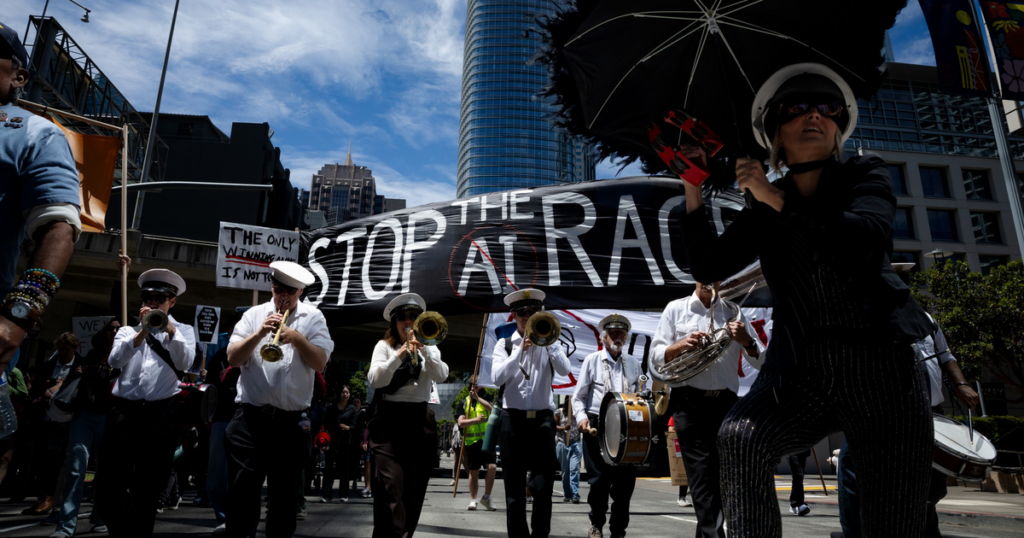
 Protesters gather outside OpenAI headquarters. | Source: Manuel Orbegozo for The Standard
“I don’t think that data centers will be stopped,” said Moretti, adding that for the AI companies, “it might be an inconvenience, but I don’t think it’s a matter of survival.”
Collectively, hyperscaler companies — Amazon, Google, Meta, and Microsoft — are on track to spend more than $720 billion (opens in new tab) on AI infrastructure this year.
Microsoft and OpenAI declined to comment on how the election results will affect its AI ambitions. Anthropic, Meta, and Google did not respond to requests for comment.
While the companies show no signs of slowing their spending on data centers, the backlash in the run-up to the election set a shift in messaging. Anthropic promised to cover electricity price increases (opens in new tab) for neighbors — a major concern for communities with data centers. Meta said (opens in new tab) it foots the bill for energy and water used by its data centers. OpenAI recently tried to rebrand data centers as “AI compute campuses.”
On Thursday, OpenAI released (opens in new tab) documents that attempt to make data centers more palatable to consumers. The company outlines commitments to pay for its energy and water use and promises to no longer “use non-disclosure agreements with public officials” regarding development plans for its data centers.
It also published an essay (opens in new tab) by its chief global affairs officer Chris Lehane Thursday addressing the blowback.
“The data center ‘debate’ of 2026 could take on a different meaning. Voters may look back at decisions to build, delay, or block infrastructure and ask whether elected officials helped America compete or held it back,” Lehane wrote.
The cost of building data centers is a pressing issue, with some lawmakers promising to roll back tax incentives for developers, according to analysts at investment banking firm Jefferies.
Changes to the law won’t hit tech companies right away. Many have contracts in place that will cover the next few years.
“Financially, I don’t think it’s going to have a major impact,” said Jeff Thramann, CEO of LT350, a Colorado-based startup developing small-scale data centers that can fit in a parking lot. “If the demand is there and people need to use these models … [companies are] going to find a place where they’re going to get the revenue to ultimately get the returns that they need.”
The large-scale data centers that are the size of hundreds of football fields are typically used for training AI models. Those could be located anywhere, he said, including outside the U.S. or in space. And given the growing backlash against data centers over the past year, AI companies have been looking at alternatives, Thramann said.
In its S-1, Anthropic said it is expanding its data center presence overseas to avoid concentrating too much in the U.S. Meta is also looking internationally. The company’s platforms president, Dina Powell McCormick, said Wednesday (opens in new tab) at the WSJ Tech conference in Napa that “to start new data center build-outs today in the United States will be very challenging.”
“I can also tell you that every hyperscaler is now thinking about, do we need to build outside the United States? Because they’re enormous investments, hedging those investments is a wise thing to do,” she said, according to The Wall Street Journal.
 Source: Courtesy Camille Cohen for The Inside View, Inc.