
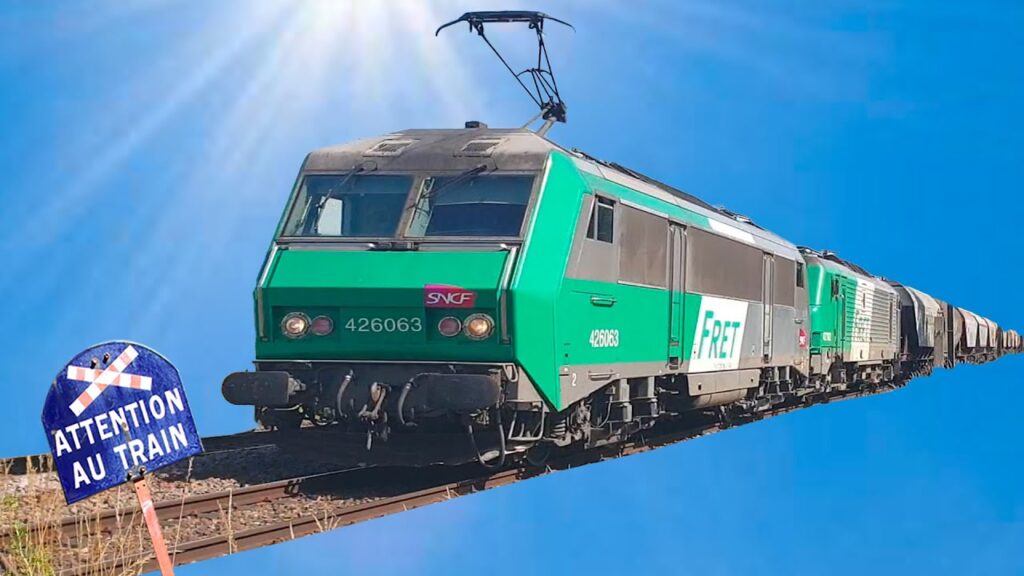
La numérotation des locomotives de la SNCF
Numbers and letters! Like road vehicles, railway vehicles, whether cars, wagons or motor vehicles, are subject to registration. Quite empirical at the birth of the railway companies where we were often content to use the name of the company which built it or that of the one which put it into circulation, followed by a
Fairly short number, this identification gradually became more complex, organized and extended. This video constitutes the 2nd and final part of the one offered last week on this channel. This time we will talk about modern times, from electric or diesel machines to
TGVs and other self-propelled vehicles and take a look at what the future has in store for us. What do the letters in the registration of steam locomotives correspond to? This is one of the questions you asked me and which I answer in this new issue. Hello and welcome to Aiguillages !
Following the publication of last week’s topic devoted to the numbering of steam locomotives you sent me some questions in particular about the meaning of the letters following the first series of numbers. For example, you wanted to know
What the C means in 141 C 100. So in fact these letters do not have any particular meaning, they are only there to distinguish between machines sharing the same axle arrangement while not not belonging to the same family. A 141 C is technically,
And even visually different from a 141 P or a 141 R. These letters were assigned to them by the SNCF in chronological order, from A to N for the machines it inherited from the companies and from P to U for those ordered by it after its creation in 1938. The letter
U was first reserved for a series of Type 140 locomotives which were brought by the Americans to Europe during the Second World War. Some were made available to the SNCF at the end of the conflict while awaiting the arrival of the 141 R, but
They were never officially allocated to it, which freed up the letter U for a machine with a singular destiny, the 232 U 1. Initially ordered for the Northern Company, it should have been part of a small series of machines whose delivery was
Interrupted by the war. It was ultimately the SNCF which took possession of it in 1949, but it remained the one and only of its series. The letter W was reserved for locomotives brought by the English army also during the Second World War, finally the letters X,
Y and Z were assigned to machines ceded by Germany to France for war damages . As a reminder, the T which sometimes precedes these letters indicates a tender type machine, that is to say on which water boxes are placed on each side of the boiler, while
The coal is stored in a hold located on the more often at the rear of the cabin otherwise, near the water box on the driver’s side. These arrangements made it possible to do without a tender attached to the machine, which facilitated maneuvers, movements being able to be made
In either direction of travel, but considerably reduced the autonomy of the machines, which limited its use for maneuvering purposes or on short journeys such as those made by commuter trains. For this purpose, type 141 TC machines were equipped with reversibility from 1930 and were assigned to pulling and pushing Talbot trains on the
Lines of the Paris suburbs departing from Saint-Lazare station by the Railway Administration iron of the State. These locomotives pulled the trains in one direction, pushed them in the other, a driving cabin being fitted in the car located at the other end of the convoy.
Let us now come to the numbering of locomotives other than steam locomotives. In this area, things have evolved quite a bit over time. A first method was applied from the creation of the SNCF in 1938 to 1962. It was largely inherited from that in
Force in the companies. As there was a non-negligible risk of producing duplicates, the company has added a number as a prefix to each registration. It indicated the region from which the machines came. 1 for the East, i.e. the former companies of the East and
Alsace-Lorraine, 2 for the North and the company of the same name, 3 for the West region using the machines of the railway administration of the the State which had itself recovered those of the Paris-Orléans, 4 designating the South-West where another series of locomotives had been recovered
From the Paris-Orléans and the Compagnie du Midi, 5 to represent the South-East coinciding for the main part with the domain of the ex PLM and 6 covering the southern part of French territory, or other machines of the PLM and the Compagnie du Midi in the Mediterranean region. In this
System the electric locomotives operating at 750 or 1500 volts direct current arrive first. Their numbering goes from 1 to 9,999. There is an exception for the machines on the Perpignan-Villefranche-de-Conflent line powered by 15,000 volts 16 Hz 2/3, ex BB Midi
Registered in the 4900 series. A new type supply arriving in France, 25,000 volts 50 Hz, in 1954 an additional numbering period was opened to register the new machines under numbers between 10,000 and 19,999 for locomotives operating only at 25,000 volts, 20,000 and 49,999 for poly-tension machines.
At that time, steam and electric locomotives constituted the majority of the engine fleet, but the numbering in force already established principles which would be applied to other types of machines which would multiply in the future. For diesel machines, the numbering system is taken from that which the
PLM had developed in the 1930s. It was itself inspired by that of steam locomotives and is based on the counting of the driving axles. Railcars are numbered between Z 1 and Z 9999, shunters between Y 1 and Y 9999 and railcars are prefixed I’m going to talk to you directly about this one.
The numbers from 1 to 1,999 are in principle reserved for direct current electric vehicles, with a small exception, they are also used for shunters whose registration begins with a Y to distinguish them. From 10,001 to 19,999 are classified machines
Powered only by 25,000 volts, from 20,001 to 29,999, those capable of operating under two systems, whether dual-voltage or dual-frequency, from 30,001 to 39,999 locomotives able to circulate under three electrical systems, from 40,000 to 40,999, under 4 systems. From 50,000 to 59,999, dual-current electric multiple units. Then come the thermal vehicles classified between 60,001
And 79,999 and the dual-mode vehicles from 80,001 to 80,999. Note a few small coquetry such as the fact that the authors of this classification have managed to ensure that the sum of some serial numbers give a new digit falling in the correct interval. This is
The case of 7,200 + 15,000 which gives 22,200 or 8,500 + 17,000 whose result is 25,500, in other words the combination of the technical characteristics of a series of machines classified in the category of current locomotives. continuous with those of another, placed in that
Of single-phase machines, gives rise to a dual-voltage machine placed in the series of dual-voltage machines. To avoid assigning the same number to a locomotive, a railcar or a railcar, the former are classified in series always ending with three 0s, for example BB 26,000, or that of CC 72,000, and railcars by 500,
For example the Z 20 500 or They have in common with a series of BB the numbering 25,500, but were assigned the letter U to distinguish them. These letters, which were originally there to recall the arrangement of the axles, are gradually losing their importance. ,
To the point that they could simply disappear quite soon. For the record, still present on a good number of machines in the form of a set of a maximum of 6 alphanumeric characters, they make it possible to distinguish the type of machine. The
Letter A being used to designate a single driving axle, B, distinguish 2, C: 3, D: 4, and the numbers the number of carrier axles which are inserted if necessary. This will be the case for the A1A A1A 68000 which has two bogies made up of 3 axles each, including two motors
At each end and 1 carrier in the middle. We can push the detail to the point of specifying whether a single motor drives the axles, in which case we will speak of type BB or CC for example, or if each axle has its own motor, which will be noted B0B0 for example
For locomotives. of the 36,000 series. As for them, the TGVs are numbered in the machine series since their locomotives can be assimilated to this category. The Paris-Sud-Est TGVs appear in the Z 23 000 and Z 33000 series, those of the TGV Atlantique: Z 24 000,
Those of the TGV Réseaux Z 28 000 and Z 38 000 and the TGV 2N Z 29 000. More recently, the The first TGV M engines received by the SNCF were recorded in the Z 21000 and 22,000 series. Due to the fact that they circulate widely outside French borders,
The “Eurostar” and “Thalys” TGVs are subject to a special numbering. On January 1, 1999, a new reform of the numbering system took place. A European Union directive imposing an organization by activity on railway companies, the SNCF had to distribute its rolling stock among different structures each
Specializing in a type of traffic. To integrate this new feature without completely disrupting the existing numbering, these new entities are identified by a prefix consisting of a number between 0 and 9 placed at the top of the pre-existing numbering. 1 indicates belonging to the France-Europe Travel activity which includes TGV,
2 to the Intercity activity, 4 to freight, 5 to Regional Express Transport, 6 to infrastructure and 8 to Transilien. The other figures are reserved to allow the definition of new activities, particularly in the context of opening up to competition. I hope you like the numbers because
The European Vehicle Number will gradually add quite a few. It was designed to promote interoperability between networks, in other words, the idea is to allow more and more trains to be able to cross borders more and more easily. But on this occasion, no less than 12 new digits
Will make it possible to identify the rolling stock. For the first one, it’s easy, it will always be a 9. The next one indicates the type of machine. 1 for an electric locomotive, 2 for a diesel, 3 for a high-speed train, 4 for an electric multiple unit, 5
For a diesel multiple unit, 6 for a railcar trailer, 7 and 9 not being allocated, but 8 assigned to shunters. The next two numbers indicate the country of origin. For France, 87. The 5th is a zero, the next 6 are the number of the machine,
Preceded by a 0 or several 0s if the first group of numbers is less than 100,000 or 10,000. Follow a hyphen and a self-check number which verifies that the full digit is valid. I will spare you the UIC number which also exists, which is also made up of 12 characters
, but which has only been applied to cars and wagons and not to motor vehicles, but which will very probably be replaced in the long term by the number European Vehicles. Did you suspect that so many engine numbering systems could have
Existed in France? Tell me in the comments. I remind you that you can find all the reports broadcast on this channel, on its website www.aiguillages.eu and that to be sure not to miss any, you can subscribe to the newsletter which
Will allow you every week to be notified when a new video is posted online, on the Aiguillolettre page. And if you haven’t watched yet the first part of it which was devoted to the identification of steam locomotives, it is not too late, you can find it by clicking on this thumbnail.
➡ Mon livre aux éditions La Vie du Rail (édition 2023 !) : https://www.aiguillages.eu/pages/boutique.php#
🔻🔻🔻 Cliquez sur Plus pour accéder aux liens !
➡ Soutenir Aiguillages :
▶︎ Passer en première classe : https://www.aiguillages.eu/pages/passerEn1ereClasse.php
▶︎ Tipee : https://fr.tipeee.com/aiguillages
▶︎ Patreon : https://www.patreon.com/aiguillages
➡ Mes réseaux Sociaux :
▶︎ Site web : http://www.aiguillages.eu
▶︎ Facebook : https://www.facebook.com/thierry.pupier.3
▶︎ Instagram : https://www.instagram.com/aiguillages/
▶︎ Twitter : https://twitter.com/aiguillages
▶︎ Linkedin : https://www.linkedin.com/in/tppvoixoff/
▶︎ Abonnement sur Youtube : https://www.youtube.com/channel/UCZ3xXAuhGLfZchx7IlV_LqA?sub_confirmation=1
#Aiguillages
47 Comments
Super video comme d'habitude
Ses avec plaisir qu'on les regarde😊
Un video sur le train le cévenol serait top🎉
Merci
Par contre j'suis déçu de la numérotation des locs à vapeur, j'pensais que la lettre avait un sens mais non 😅
Je ne suis pas du tout fan de ferroviaire mais depuis que je regarde des vidéos sur le sujet, je suis surpris, je ne pensais pas que le milieu ferroviaire est aussi compliqué et je n'imaginais pas que le réseau passe par tant de beaux paysages.
Je pensais par exemple que les voies ferrées passant par des forêts sont très rares, je voyais tout ce qui a trait à la SNCF de manière très "ambiance grise, bétonnée" comme dans les usines.
Du coup, je commence à comprendre pourquoi les employés de la SNCF tiennent tant à leurs avantages. 😅
Ça doit être sacrément différent que les jobs de merde dans l'industrie, postés, 6 jours sur 7, pour 1180 euros nets mensuels, dans des conditions et une atmosphère pousant à la déprime puis au suicide.
Mais comme dit, pour intégrer la SNCF (ou un truc du genre car il semblerait que la SNCF ne soit plus seule en France) il faut être passionné et pour accéder à certains postes, il faut être pistonné.
La 12069 😓. Que cette loc peut me faire mal au cœur à chaque fois que j’assure un arrêt au Creusot en sens pair 😢
Vos vidéos sont toujours très intéressante….. mais là vous m'avez perdu avec tous ces numéros
je vais devoir la revoir une seconde fois 😅😂
Très bien merci, juste dommage de mettre une 241 P à l'image en parlant des 141 P.
Bonsoir Thierry, comme toujours, bravo et merci. Comment s’effectuait le pilotage d’une vapeur en pousse ? Merci d'avance, prends soin de toi !
Que de chiffres !!!!!!!!!!!!!!! Merci pour cette vidéo qui récapitule bien les différentes séries. Une photo aurait été bienvenue pour les 2D2 pour les générations qui ne les ont pas connues. Il y a la 2D2 5516 à la Cité du train et seules ont été préservées les 2D2 5525 et 9135, qui ne circule plus depuis 1987, date de sa réforme à la SNCF'.
Bonsoir! merci pour tes précisons sur le dernier reportage et pour la qualité de celui de ce soir!
Super vidéo comme d'habitude !
Avec l’Europe la numérotation, déjà compliquée à la base, devient totalement incompréhensible. Pourquoi faire simple quand on peut faire compliqué … merci les technocrates.
Houla……. Faut suivre!!! Il me faudrait plusieurs visionnages , pour commencer à comprendre….
Reste plus que le bordel incompréhensible qu'est la numérotation des rames de tgv et surtout de leurs motrices et le compte sera bon 😂
👍
Merci pour les explications ! Je connaissais tout sur le matériel moderne, pas sur l'ancien. Par contre, un détail m'échappe, pas développé ici à priori : pourquoi passer à Z5XXXX pour les automotrices bicourants alors qu'il y avait la série Z2XXXX (Z20500, 225, 235, 24,, etc…) Pourquoi ce changement de logique ? A cause de la place dans la numérotation ?
très bon choix de sujet. La numerotation du materiel roulant c est toujours la premiere chose que je regarde. Petite precision, le chiffrage ou lettrage par essieu moteur on le retrouve dans tous les pays, ce n etait pas une specificité française.
Bonjour Thierry,
Superbe reportage 👍🏻👍🏻👍🏻👍🏻
Pour ce qui est de la nouvelle numérotation imposée par l'Europe avec les préfixes 1, 2, 4, 5, 6, 8 est quelque peu bousculée dans la réalité. En effet j'ai vu des machines INFRA (préfixe 6) faire du dépannage de trains voyageurs en panne, des machines FRET (préfixe 4) tracter des trains TER et des ex machines transilien (préfixe 8) vendues à du privé tirer des trains de marchandises. J'ai l'impression que cette numérotation si bien définie au départ devient un sacré bazar et que son application devient très aléatoire. On a un peu de mal à comprendre l'efficacité de cette règlementation.
Très bonbe chaîne YT
Merci pour cette vidéo, tu peux mettre un peu plus d'intonation sur tes prochaine vidéos Thierry ?? Tu sais pourquoi il y a le nombre 50 qui est présent sur certaines nez-cassés ?
Salut Thierry.
À quand le retour des reportages de modélisme ?
Cela nous manque terriblement.
Bonne jurnée et à bientôt.
Jacques.
Merci Thierry pour toutes ces explications de chiffres…👍
Superbe vidéo, j'ai appris encore des choses alors que je pensais en savoir deja pas mal , par contre les nouvelles numérotation ca va être un enfer on va continuer à dire bb26000 c'est mieux 😅
Bonjour l'ami Thierry qui nous nous guide sur les bons AIGUILLAGES ❤
Très intéressant! Je trouve cependant que ça manque d’infographies pour synthétiser et résumer toutes ces infos. On s’y perd dans tout ces chiffres.
Eh bien, alors là, j'en ai appris encore plus que d'habitude ! je ne m'imaginais pas que cela pouvait être aussi complexe, surtout à la fin ! je vais devoir me faire un tableau Excel pour me souvenir de tout cela !! Beau travail et merci Thierry !
Pas facile d'y retrouver ces œufs dans cette omelette, 😂😂; après c'est avec l'habitude qu'on s'y retrouve, merci Thierry !!!
Très intéressant mais très pointu…😉
Merci pour le travail.
J'avoue que je suis intrigué par l'existence des rames reversibles à l'époque de la vapeur, et je me demande si un épisode dédié serait envisageable. J'avoue ne pas arriver à concevoir comment on oeut piloter à distance une machine à vapeur à une époque où l'électronique n'existe pas ou peu
Pour finir avec cette série sur l'identification, tu pourrais faire un épisode sur l'identification des wagons marchandises? Je me suis souvent demandé a quoi ça correspondait (Fals, Shimms etc)
Bonsoir MON THIERRY j avoue connaitre un peut les numeros des machines diesels , electriques et tgv , maiis pas de la facon dont tu nous explique ca , moi je m y retrouve , mais de ta maniere cela me parait plus complexe , et en plus si rajoute des numeros rien pour moi vas s arranger , heureusement quil y a des gens comme toi pour nous expliquer , sinon bonne video vraimet merci beaucoup MON POTE JE VALIDE 🥰🥰👋👋👋👍👍👍👌👌👌👌👌DIT MOI DONC QUAND SE TROUVE LE PROCHAIN SALON SI TU SAIS BIEN SUR ! BIENVENUE SUR MES LIGNES SNCF A BIENTOT CHEF ! THIERRY
Bonjour Thierry.
Merci pour ces détails, et j'ai appris quelque chose avec les nouvelles numérotations (électriques, diesel…)
Je voudrais revenir sur la précision de loco à vapeur 141. Il me semble que les 141TC étaient sur la banlieue Nord (tirant très rarement des rames Talbot, plutôt des voitures de banlieue type Nord) et que c'était des 141TD sur St Lazare, avec effectivement des rames Talbot
Une question (hors sujet) qui est toujours restée sans réponse pour moi, c'est pourquoi, les postes de conduites des CC 40100 ont étés modifiés. Les custodes vitrées ont été obturées par des plaques d'acier, ce qui d'une part a réduit la visibilité mais aussi ont défiguré ce chef-d'œuvre (pour moi)… Quelle en était la raison ??
Un grand merci à celui, ou ceux qui pourront me répondre avec précision …
Beatiuful video, greetings from Asturias to France 🚂👍🔝
Top les détail. Moi je bosse à eurotunnel on a aussi des numero qui disent beaucoup mais plus cour lol 4 chiffres 9820 = loco qui va sur des trains pax de série 7mw. 9705 loco fret qui va que sur du fret mais 7mw aussi . 9015 loco pax fret mais de 5 mw. Les véhicules encore autres chose lol
Pour aller au bout de l'exercice, autant mettre un code barre à la place de cette nouvelle numérotation…
Wow, geniale video, Thierry mais quelles complications a la SNCF. Je me suis toujours demander pourquoi ne pas appeler mono-tension, MT, bi-tension, BT, etc. J;ai arrette a comprendre dans les annees 90 avec la nouvelle numerotation. Bonne recapitulation!
Pourquoi faire simple quand on peut faire compliqué ?
2D2. CC, BB, on n'a pas encore utilisé :' R2D2 et 6PO. Cela viendra un jour peut-être 😄
Bonjour, est-il possible d'avoir un episode ou une partie d'episode sur les voitures de type cabine 8 que j'utilisais sur la ligne st brieuc – Montparnasse dans les annes 90. Des cabines mi siege mi-transat 😊 . Merci pour ces videos !
En tant que cheminot en retraite je connais par cœur les numéros de tout le matériel sncf et antérieur ! Merci pour votre reportage ! 👍
Bonjour Thierry,
Merci pour ce nouveau reportage.
Plus compliqué tu meurs.
Mais grace à cette vidéo, c'est devenu un peu plus clair.
Merci.
Bonne fin de journée et bonne soirée.
Merci Thierry la sciences du chemin de fer français.
Bonjour Thierry, je viens de regarder la vidéo, félicitation pour ton travail, je ne pensais que c c'était si compliqué et je préfère les machines vapeur c est plus simple. Cordialement. Ollivier
Magnifique modèle
Merci pour ces informations très complètes, y compris les lettres des locos vapeur.
;-)))))
Le marquage des engins moteurs de la SNCF devient aléatoire, entre effacement, couche de crasse, tags…
On dirait que la SNCF a honte de ses engins, de son logo, qui n' apparait plus sur certaines machines.
Que dire de ces ridicules numéros remplaçant BB.
Je ne parle même pas des blasons des villes, des baptêmes, tradition qui est tombée aux oubliettes depuis des lustres.
Et des livrées multiples et bariolées, indignes d' une grande administration ferroviaire.
Ouigogo rose crasseux, jaune infra en tête de rames Corail (ce qu' il en reste), de Frêt en tête de ouigogo…
Voire d' une pauvre 22200 livrée d' origine avec un capot infra ou gris béton, telle une vieille 205 toute pourrite…
J' en parle dans mon site : lien dans le compte.