
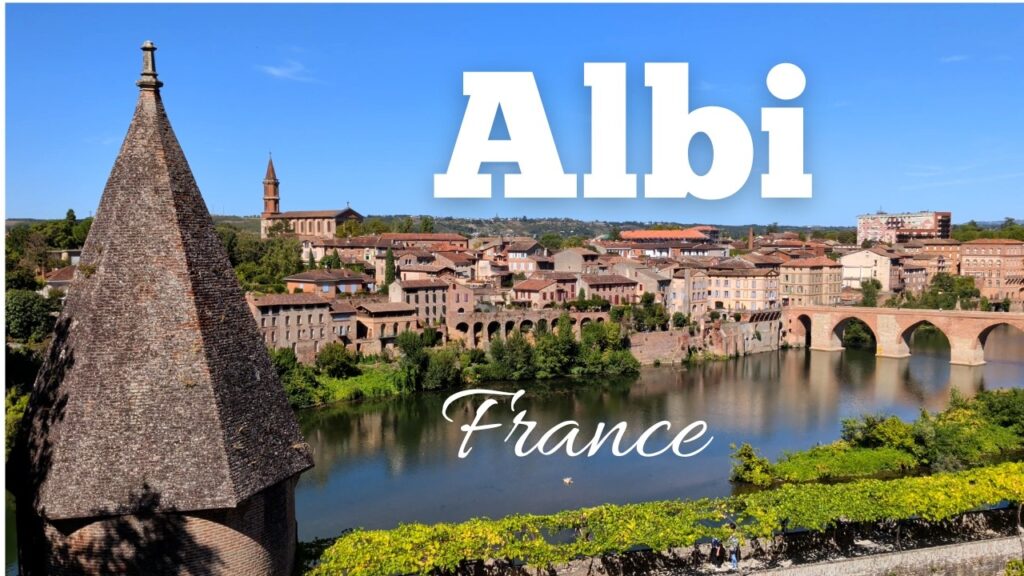
Albi – one of Europe’s finest medieval gem.
Albi is the main city of the Tarn department in the Occitanie region of southern France (historically part of the Languedoc region). The Tarn River flows at the foot of its fortress walls, and on its left bank lies the city’s historic center, a designated UNESCO World Heritage Site.
As of 2020, the city has a population of 49,230 residents. Albi is considered the third most populous municipality in the area after Montauban and Toulouse.
The historic part of the city is a World Heritage Site. Notable buildings include:
The Gothic Cathedral dedicated to Saint Cecilia, built between 1282 and 1512, adorned with ancient frescoes, and featuring a grand pipe organ choir;
The Church of Saint-Salvi;
The Prefecture building—a former palace of the Counts of Albi (the Palais de la Berbie), which served as the residence for archbishops for a long period;
A hospital and a theater.
Crossing the Tarn are an old bridge with 6 arches and a new one with 5, spanning a total length of 160 meters.
Modern Albi is a railway hub and the seat of the Archbishop of Albi (one of the 23 archbishops of the Catholic Church in France, with the episcopal see located at Saint Cecilia Cathedral). The city is home to a lyceum, a library, and the Toulouse-Lautrec Museum, which houses the world’s largest collection of the artist’s works.
Additionally, the city features a bronze statue erected in 1843 honoring the famous navigator Lapérouse, who was born nearby in Guyot.
1 Comment
Albi is incredibly beautiful town! 🥰